As I approach my upcoming retirement from Positive Feedback, I’m revisiting my very first submission for the magazine. I’d previously authored music reviews that appeared here as part of a content-sharing arrangement between PF and Audiophile Audition, but this was the first piece published under my own byline. It’s a chronicle of a journey of discovery that’s been ongoing for decades, updated with a surprising recent twist!
'Tis better to have loved and lost than never to have loved at all. Thus quothe Alfred Lord Tennyson in 1850, and how true those words ring in the modern world. To at least have had something you truly cherished is indeed better than to have never known the joy of experiencing it, right? Or is it? Are you one of those people who only concentrate on the future before you, or do you look back with regret, bemoaning the loss of that which once was a source of such joy? I think most of us occupy the ground somewhere in between, taking comfort in the present, while only occasionally lamenting the once precious things that slipped from our grasp.
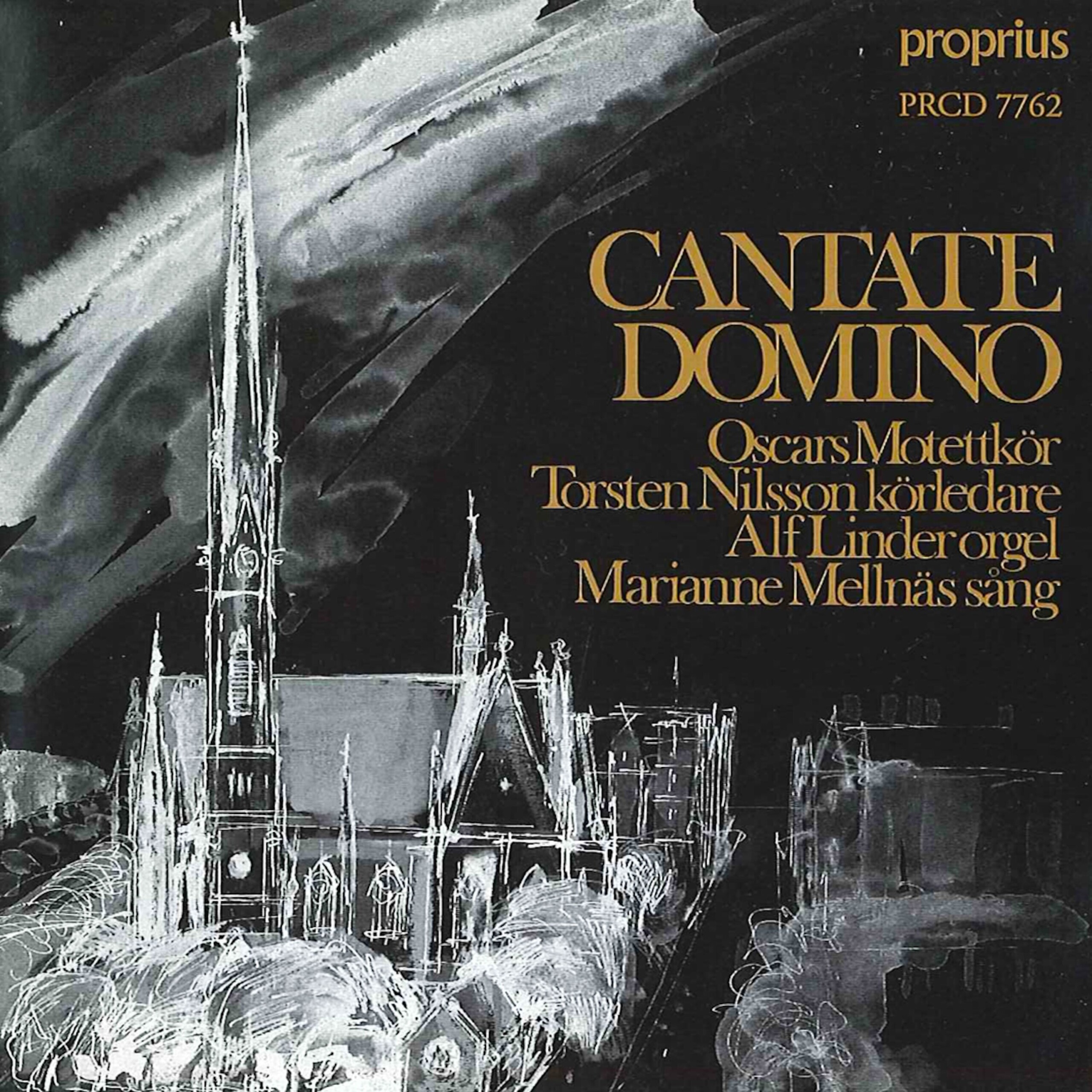
Cantate Domino, Proprius Records (PROP 7762)
In 2003, I received Proprius Records' first foray into the still nascent SACD format, the evergreen seasonal choral classic Cantate Domino. My review was an all-out rave that extolled the disc’s many virtues, and I hailed the SACD¹ as a benchmark for choral and vocal reproduction. I still stand firmly by my evaluation; the SACD was and is glorious, capable of providing a truly rewarding listening experience on exceptionally resolving audio systems. Cantate Domino is a remarkable achievement and one of Proprius Records’ finest recordings.
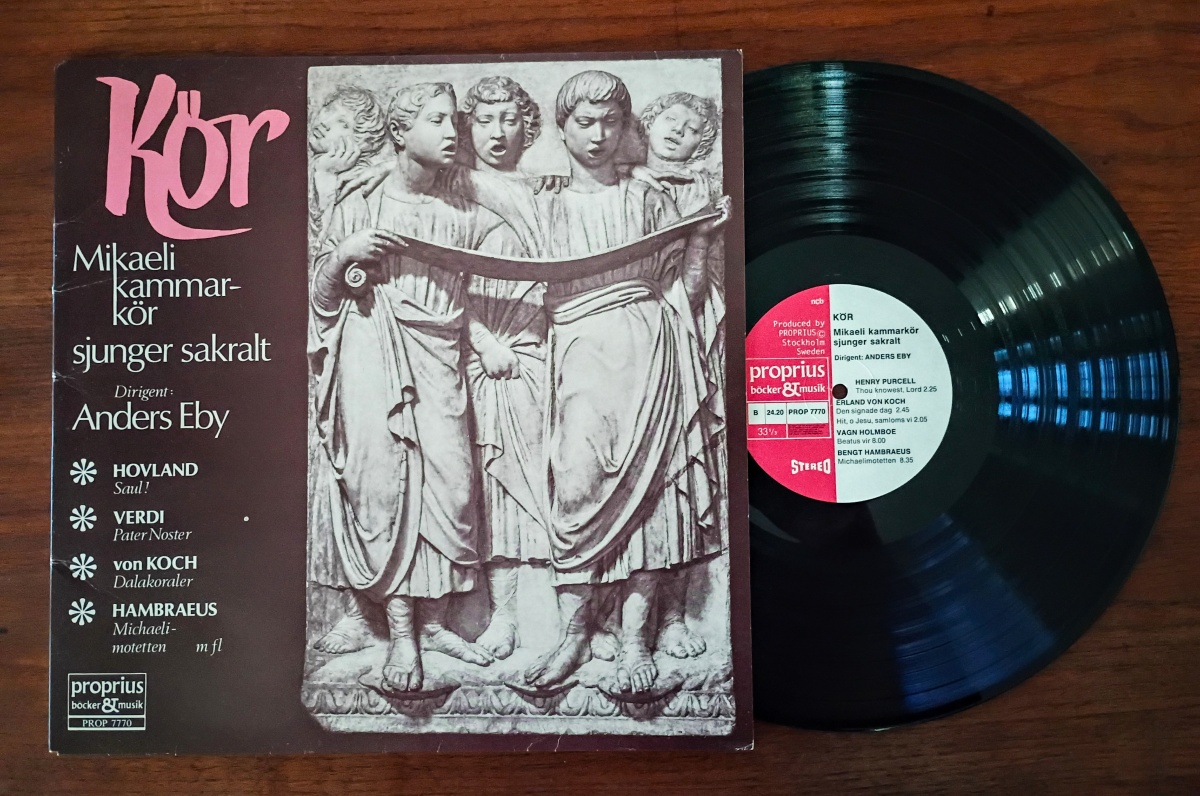
I’d been a fan of Cantate Domino for years; it was among the first CDs I bought at the dawn of the compact disc. And I obsessed over the new SACD, which was in constant rotation in my system for months on end. It served as a glorious reminder of my astonishing experiences with Proprius LPs early on in my audiophile experience; they often displayed a level of realism that few competing LPs could match back in the day. But despite all the SACD’s goodness, my mind couldn't help but return to another Proprius choral recording – one that had been virtually shoved behind a locked door somewhere in the recesses of my mind. That disc was Kor by the Mikaeli Kammarkor (Michael’s Chamber Choir) led by conductor Anders Eby – my first-ever Proprius LP, and the one that early on awakened in me a previously unknown love for choral singing of all types.
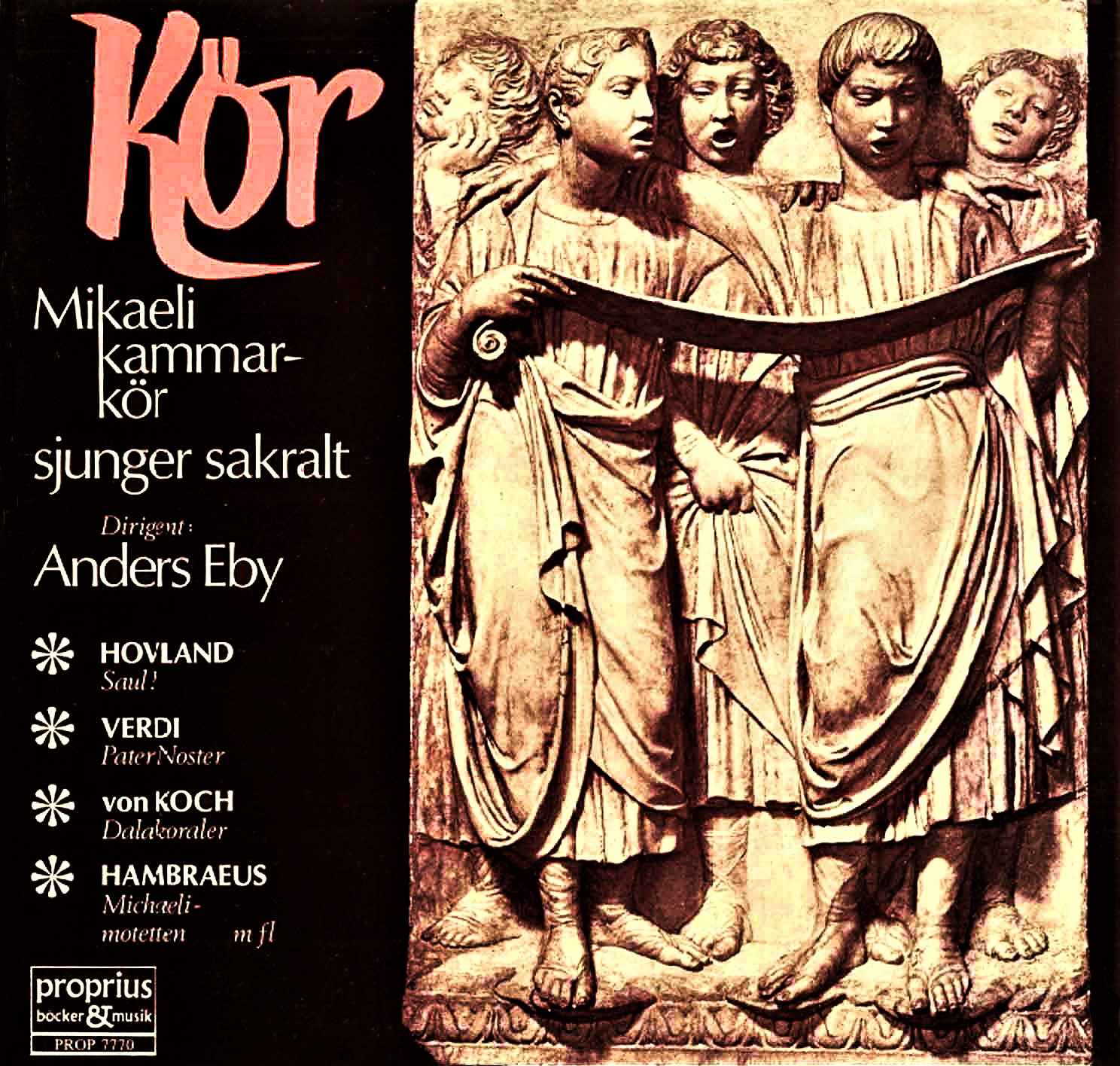
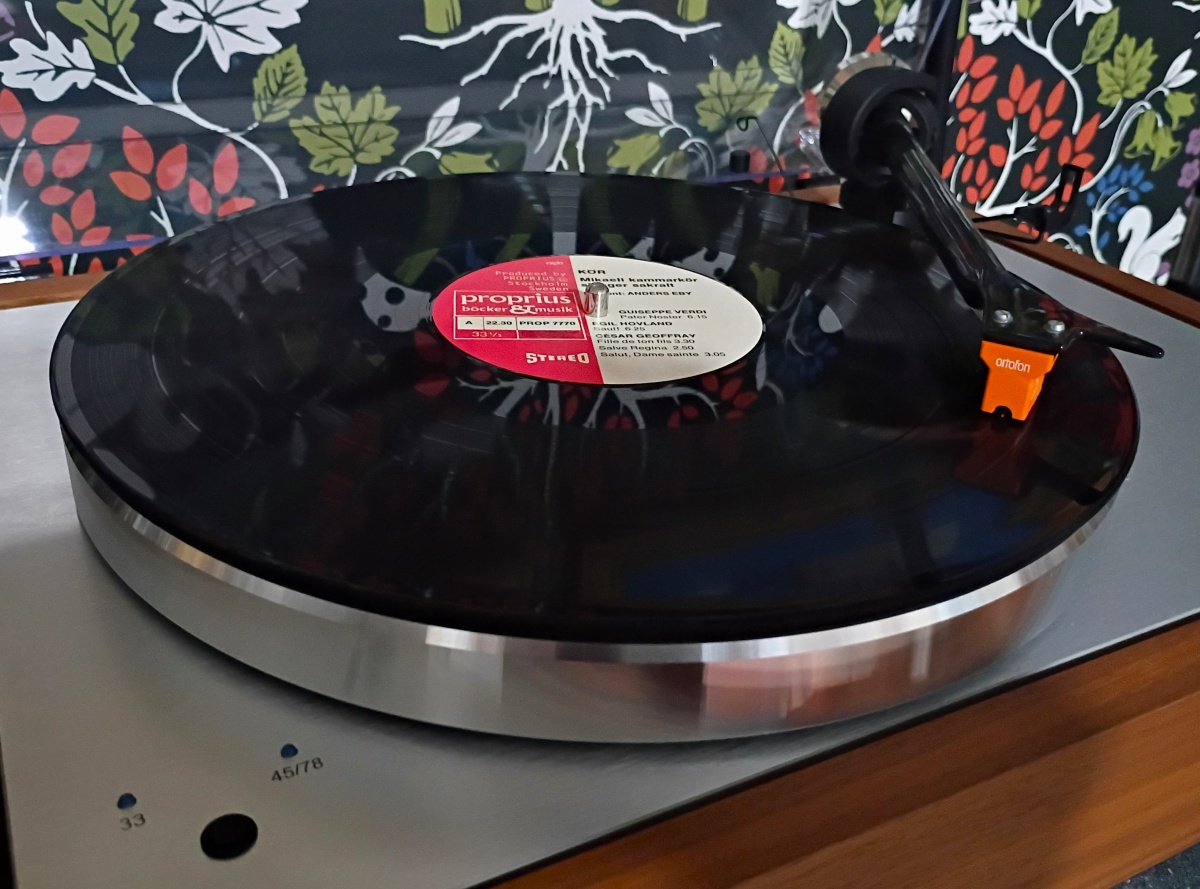
Kor, Proprius Records (PROP 7770)
My lifelong obsession with Kor (Swedish for "choir") was rooted in an instance of purest happenstance. Around 1979, a small audio shop opened in my hometown of Gainesville, Georgia; alongside an intriguing selection of well-priced stereo gear with high-end aspirations, they also stocked a modest collection of LPs, many of them from Mobile Fidelity Sound Lab. This was indeed a blessing, considering that the nearest alternative to procure high end LPs was in Atlanta, nearly a hundred miles to the south. I'd become something of a regular fixture at the shop; business early on was relatively slow, and the congenial owners were always eager to shoot the breeze and indulge me with lengthy listening sessions to show off their equipment. They were at the time pushing a top-of-the-line cassette recorder from Sony; it had a cool, multicolor fluorescent display, and one of the owners had cobbled together a cassette tape for demo purposes with tracks culled from various MoFi LPs with some "other stuff" thrown in for good measure. I was intrigued by the MSFL content on the cassette (which was all that I’d heard up to that point), and they kindly offered to lend me the tape for a weekend to delve a little more deeply into the music.
The MoFi content included jazz selections by Joe Sample, John Klemmer and Earl Klugh, as well as more mainstream rock fare from Pink Floyd and Supertramp. But it was when I finally made it to the "other stuff" on the cassette that my interest was truly piqued. Out of a prolonged silence came a deeply mysterious male voice speaking a language I couldn’t identify. The spoken narrative was soon joined by frenetically paced chanting and singing, which built into a chaotic climax punctuated by potent bursts from a large pipe organ. The impact of the performance was tremendous, with a level of dynamic range my system was barely capable of reproducing. As the cacophony reached a staggering crescendo, it instantly fell to complete silence, from which the narrator was again joined by the voices and organ – my senses were definitely overloaded! It was beyond anything I’d ever experienced; I had to find out more about this music, and the weekend dragged by as I counted the hours until the shop opened on Monday morning. I was desperate to find out exactly who and what this music was!
The mysterious music on the tape was from the Proprius LP Kor, and as luck would have it, the shop had just sold their last copy. It would take a couple of weeks to get another, and again, I counted the days until the LP finally arrived. I can say without hesitation that Kor completely changed my frame of reference in terms of how I listened to music from that point on, and for the rest of my life! It was hard for me to quantify and process the mass of information that flowed into and out of my brain as I became more familiar with the LP's selections. Having been raised in the rural foothills of the north Georgia mountains as a backwoods Protestant, I had no experience whatsoever with formalized choral singing, especially in a religious context. But what stymied me the most was the bizarre mix of the sacred and the profane that populated this LP from both classic and contemporary composers. And the multitude of languages it was communicated in, including Swedish, French, English, and Latin.
Explaining my newfound guilty pleasure to my friends was challenging. The music that most frequently occupied my turntable was often some form of progressive rock, including (but not limited to) Yes, King Crimson, Genesis, ELP, and the Strawbs. As my closest contemporaries got wind of my newest obsession, they clearly thought I’d lost my mind! At that point, I saw Kor as totally disparate compared to my typical proggish source material, but I now can see a more firm connection (Rick Wakeman would definitely see it!).
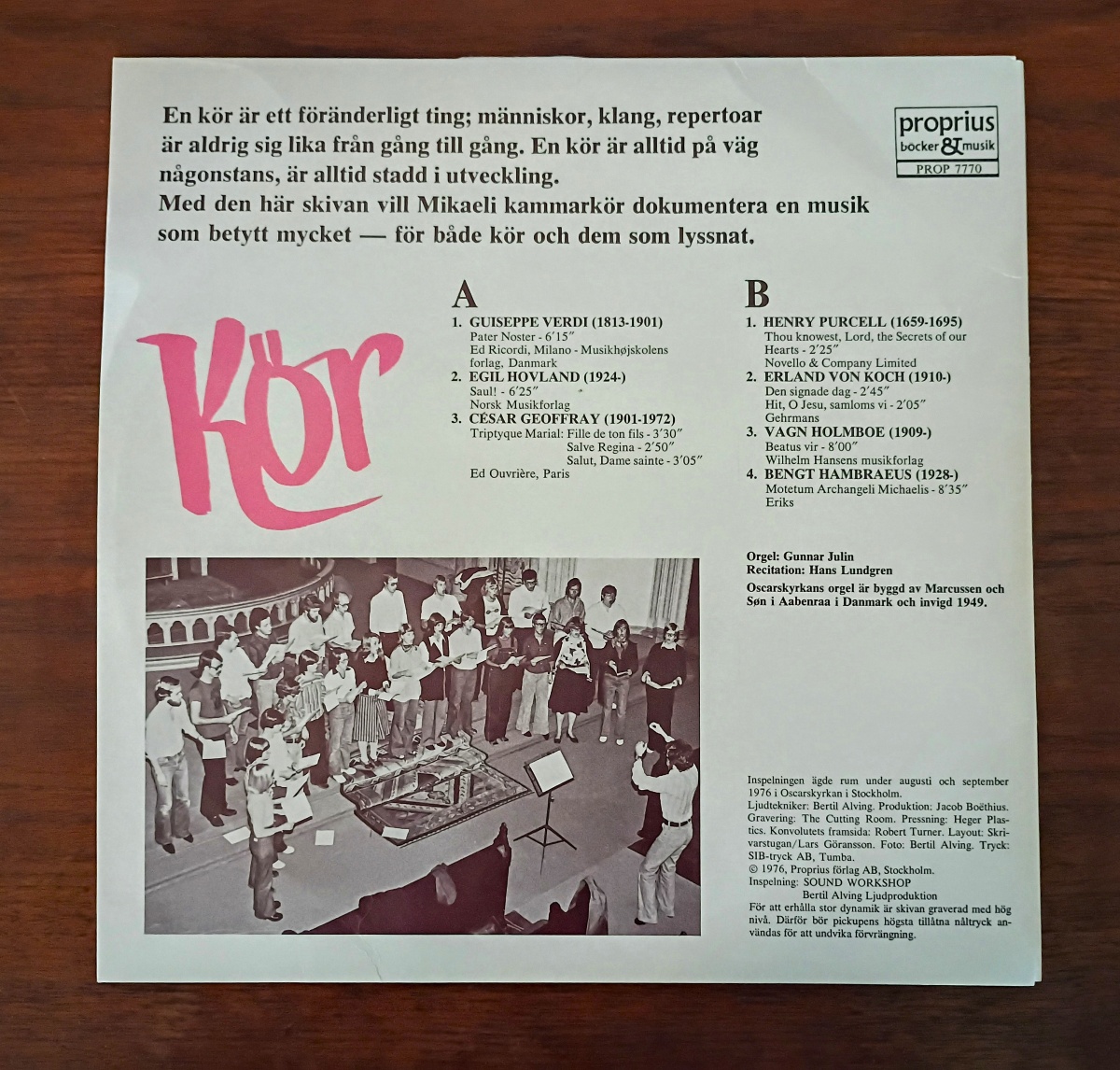
Side one of Kor represents – for me, at least – the absolute pinnacle of recorded choral singing. The LP's opening track, “Pater Noster,” is essentially the "Our Father" taken from the formalized Latin mass in an arrangement by Guiseppi Verdi, and sung acappella. It’s the stylistic antithesis of the side’s second track, Norwegian composer Egil Hovland's “Saul,” which was the mysterious narrative with chorus and organ track that I found so addictive upon first hearing. This mind-blowingly haunting performance has moments that are also very calming and soothing, and listeners will be drawn to its brazen power. The side ends with what is for me the most sublime nine minutes in recorded choral singing that exists, Cesar Geoffray's “Triptych Marial,” another acappella rendering. This three-part offering to the Virgin Mary combines French and Latin texts, is both deeply beautiful and intensely powerful, and don’t let anyone ever tell you that the unaccompanied human voice won’t send your amplifiers into clipping!
Side two is equally compelling and wildly eclectic, opening with the classic “Thou Knowest, Lord, the Secrets of our Hearts” by English Baroque composer Henry Purcell. It’s followed by a diverse selection of offerings from additional Baltic composers like Erland von Koch (the peaceful and serene “Den Signade Dag” and “Hit, O Jesu, Samloms Vi”), Vagn Holmboe (a 20th century inspired take on the Latin chant “Beatus Vir”), and Bengt Hambraeus (“Motetum Archangeli Michaelis” – which is undeniably the wildest organ and choral recitation I’ve ever heard!). An ongoing internal debate rages constantly inside my brain as to which of the sides provides the most satisfying listen; while I generally waver between the two, side one invariably wins, with its unmatched combination of beauty, majesty and sheer dynamic power.
Waxing poetically about love and loss
After years of reveling in the joys of this vinyl beauty, I married and moved to Atlanta. During that ordeal, my beloved Kor LP was lost, stolen along with many other valuable LPs from the open pickup truck enlisted for the move. The world was entering the compact disc era at that point, and most specialty shops had just about totally ditched the poor LP in favor of its newly crowned successor. LPs were disappearing in droves from the shelves of retailers, and outlets that had been previously eager to special order obscure LPs were suddenly much less enthusiastic. Over a period of several years, I searched in vain, to no avail – it seemed quite hopeless. As the memories of my favorite LP grew fainter, I pushed it more deeply into the recesses of my mind, taking comfort in my recently acquired Red Book CD of Cantate Domino. While musically satisfying, I believed the CD to be somewhat technically deficient³. And despite being an enjoyable listen on its own merits, it was incapable of replicating the nearly religious experience that listening to Kor had always provided.
The eclectic collection of compositions on Kor has never been duplicated, and only on a very rare occasion have any of the album’s tracks appeared individually on any CD from any record label. The most frequently offered title is “Pater Noster,” which was programmed on several CDs in the 1990s, most notably on a release from Chesky Records. Unfortunately, the overriding tendency on those recordings was to employ a bloated, much too operatic soprano soloist, which destroyed the delicate character of the piece. A near-hit was a long out-of-print issue on the Koch label, but it employed an all-male choir, and lacked the requisite femininity that made the performance on Kor so very distinctive. All said, each of the four or so versions I came across were seriously lacking and left me cold. The track “Saul” turned up on a CD from the Christophorus label, but an all-boy choir and an English language reading effectively eliminated the mystique of the original.
Searching for Kor – now with the help of the Internet
Fast forward to around 2001, where my day job forced me to become more computer and internet savvy, and where I unexpectedly discovered the wealth of information and resources available on the World Wide Web. Still, a Google search for Kor or PROP 7770 turned up exactly four hits, and two of them were ABC radio program listings for long-since passed airings of the late Karl Haas' Adventures In Good Music program. The other two were in Japanese! A stroke of luck led me to the Proprius Music web site, but it was barely functional and had limited information, especially concerning availability – of anything. There was, however, an email address! A concerted effort on my part finally got a response from someone at classical music powerhouse Naxos, who apparently had just acquired distribution for Proprius. His response was less than enthusiastic, and not helpful in any way, other than to direct me to Proprius' American distributor, May Audio, who promptly informed me that nothing I was looking for was or is available.
After two years as a mostly classical music reviewer for Audiophile Audition, I decided what the Hell and attempted to contact Proprius again via email. This time, I got a prompt response from an actual Proprius employee, Tryggve Palmquist². Who unfortunately had no cheerful news regarding Kor, but did offer to send the just released SACD of Cantate Domino, along with a steady stream of additional Proprius CDs and SACDs. Another Google search for Kor yielded numerous hits, unfortunately all dead ends. Even a search of the massive GEMM database came up empty.
Time marched on; I’d do an occasional Google search, with typically less-than-satisfying results. Suddenly, the novel idea of doing a web search for the Mikaeli Kammarkor occurred to me, and not only did they have a website, but there was also a discography page with available titles. Of course Kor was never issued on CD, but a footnote read: The choir has a few LP copies left. I fired off an urgent email, and got a prompt response from Lars Cronsioe, who not only sang in the choir, but also administered their website. For $30, he’d send a sealed copy – that’s $15 for the LP, and $15 for shipping and handling. I sent the money by Global Priority mail to Stockholm, Sweden; he received it in two days, and shipped the LP the same day he received the cash.
For weeks I waited in anticipation, when suddenly, my work phone rang and my wife announced, "Were you expecting a package from Lars somebody-or-other? From Sweden?" and my heart leapt! It was finally here! She then followed with "What is it?" I told her it was the LP that I had been searching for, and it finally had arrived! "Oh," she said, "Well, there might be a problem. It's been sitting in the mailbox for a while today, and, well, the mailman kind of shoved it into the mailbox – it took every ounce of strength I could muster to get it out, and it's not exactly very flat now." A twelve-inch LP, packed in flimsy cardboard, shoved into a ten-inch mailbox, in the sun for hours. It was my worst nightmare come true, and the thirty-minute drive home was excruciating.
Upon arrival and inspection of my treasure, I found the LP jacket was bent badly and cracked at the spine, but amazingly, the LP itself was only very slightly warped. However, playback revealed that it probably suffered more damage than was immediately obvious, and had it come through the ordeal in slightly more pristine condition, would probably have yielded much better results. The surface noise on the LP is about the worst of any I’ve ever owned. Cleaning hasn’t helped much – I can’t help but believe that the hours contorted in a warm mailbox stressed the vinyl and contributed to its excessive noisiness. Despite that, the music on this album is so enjoyable and essential, I had no problem getting beyond the noise and into the music. Kor is still, in my humble opinion, the finest recorded example of choral singing ever produced, and would have been a perfect choice for Proprius and Naxos to reissue on CD or SACD, as they were doing with other titles in Proprius' back catalogue at the time. When I’d close my eyes and listen to the LP – warts and all – it still took me back thirty years to the time I first heard this music, and never ceased to thrill me infinitely!
I eventually acquired another LP copy – I provided Lars Cronsioe with one of the LP mailers I've gotten from either Acoustic Sounds or Elusive Disc, with protective material like bubble wrap within. The repackaged and replacement arrived in better condition than the first time, and you wouldn’t believe the earful I gave the U.S. Postal Service regarding the first delivery attempt! My postman was walking on eggshells for months!
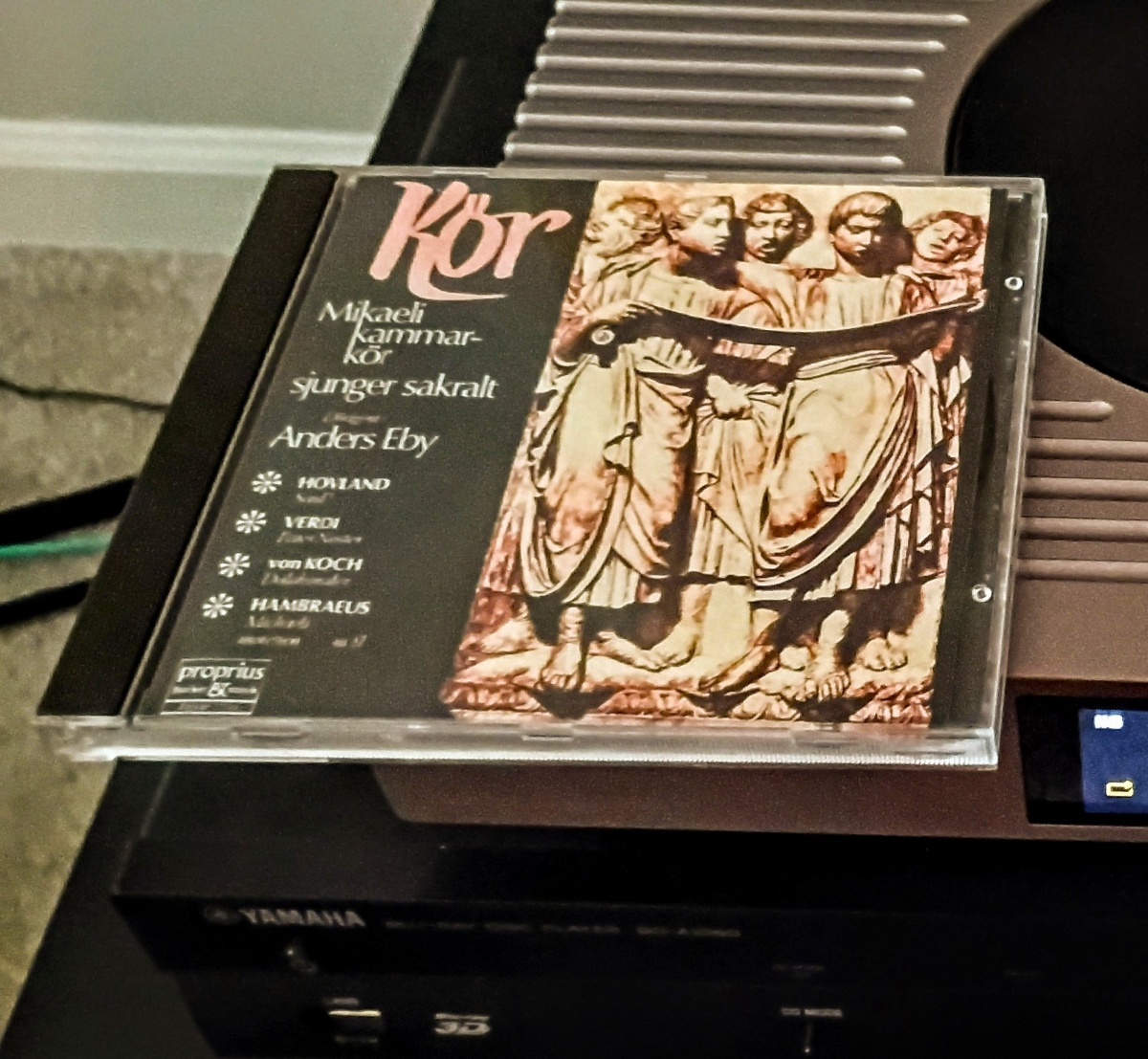
August 2026 update, now with CD playback of Kor in my system!
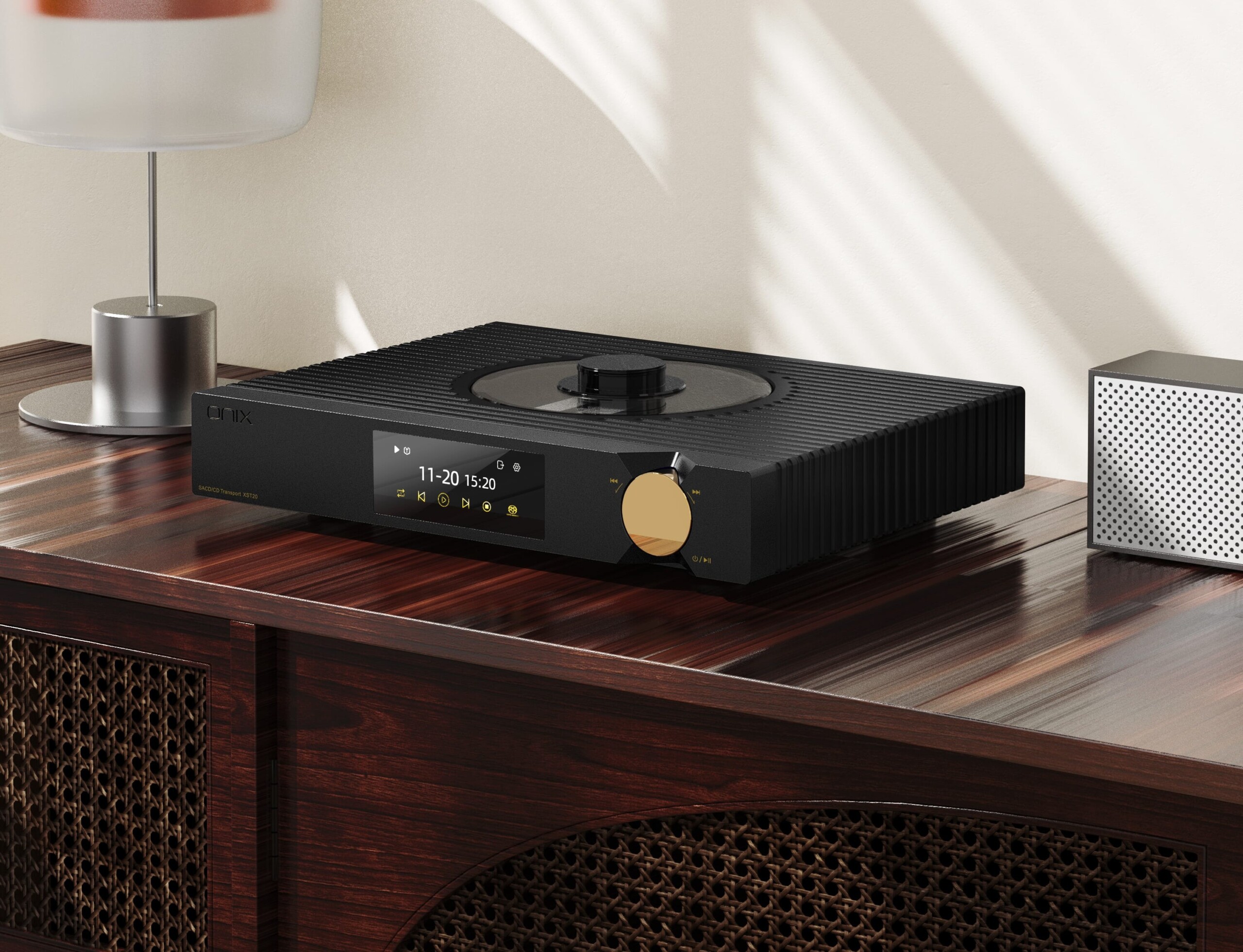
The arrival of the Onix Zenith XST20 disc transport has totally transformed my approach to Red Book CD playback in my system, and almost singlehandedly pushed my LP and digital server systems into the background. With the XST20 sending its signal via an i2s connection to my Topping D90III Discrete 1-bit DAC, the sound from my CD library is now beyond compelling, and shockingly so! Such that CDs now sound as I imagined they might at the dawn of the compact disc revolution in the early 1980’s. I’m finding that almost without exception, I prefer CD playback to all other formats; the sound quality is intensely vibrant, and offers a level of engaging realism that everything else – especially the digital server files – can’t seem to match. YMMV, but it’s definitely my current reality!
I did a little experiment recently, and I've been fairly chuffed by the results! Where I burned a CDR for Kor from the original WAV files that were sent to me directly from Proprius’ distributor Naxos, who at the time were in the process of creating an online streaming service. The WAV files for Kor are the only digital version this particular title has ever existed in. I’d been working on cozying up to the principals at both Proprius and Naxos, and after sending them a link to my article (this one!) about the Kor LP debacle, Naxos’ marketing director saw fit to provide me with their WAV files. They’ve been on my server now for about a decade, and while I always found the sound quality of the server fairly glorious compared to the more pedestrian CD playback in my system, it wasn’t always musically perfect. I mostly found playback of Kor to be less than compelling played across whichever music server happened to be currently in use. Buoyed by my ongoing positive experiences with the Onix Zenith XST20/Topping D90III Discrete system, I started contemplating creating my own music CD for Kor. It sounded insane, but it just might be worth the effort – and actually work!
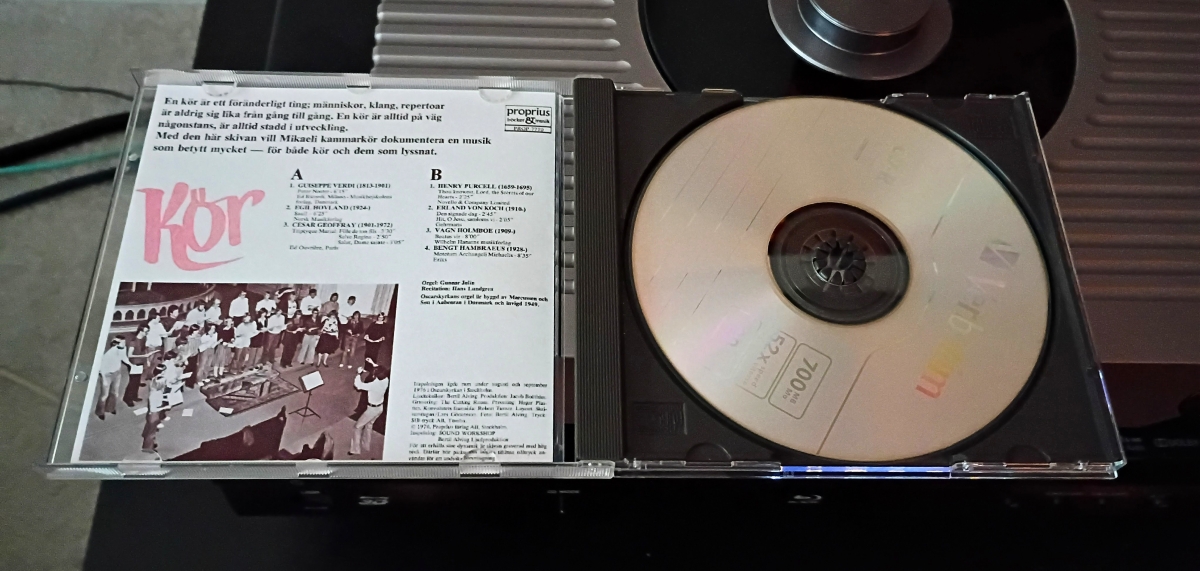
I hadn't burned a CD in over a decade, so I tracked down a pack of CDRs and started burning test discs; it took multiple tries to get a perfect result. I no longer had dedicated CD burning software, and a couple of stabs with Windows Media Player weren’t up to my expectations. I eventually downloaded the burning program Nero, which I used a lot back in the day – it has plenty of optimizations for burning CD Audio discs. The biggest obstacle was getting beyond the manner in which the WAV files had been created from the original tapes by Naxos, which were broken apart as individual tracks with extended analog silence followed by a steep digital fade-to-black. I found it particularly troublesome on Cesar Geoffray’s “Triptique Marial,” which is essentially one song, and is delivered on the LP gaplessly – the glaring digital gaps on my burned CD were horrifying! I eventually had an epiphany; Nero offered an option to burn the disc with no silence between tracks, and that magically reassembled the final version of the CDR to present playback that matched my LP. The finished disc has blown me away with its goodness; it preserves all the spatial cues and astonishing audio qualities of the LP in spades, and delivers the performances across the XST20/D90III Discrete combo with musical perfection! I even created artwork and printed it for the CD inserts. It turned out soooo much better than I even imagined possible!
I pulled out the Magneplanar LRS loudspeakers from the storage closet again, setting them up in an extreme in-room positioning. I set them facing forward and 2/3 of the way into the room, with virtually no toe-in, and spaced about 16 feet apart, such that the loudspeaker panels aligned in the vertical plane are only two feet or so from my ears at the listening position. The finishing touch was placing a pair of GIK Acoustics absorption panels on the walls directly facing the loudspeaker panels, with another pair of GIK Abfusors centered on the wall behind my head at the listening position. The realism of the stereo image in this setup isn’t exaggerated or bloated at all, and the performances on my new CDR of Kor jumped out of the speakers like never before – it’s really as though I’m actually in the church where the recordings were made in the mid-1970’s. And totally minus any of the LP’s tics, pops, crackles, or the music server digital fade-to-blacks; I couldn't be happier with how this seemingly hairbrained experiment turned out!
Tom
All photos by the author.
¹ I was exceptionally proud of the fact that a pull quote for my Audiophile Audition review of the Cantate Domino SACD was used by Proprius Records in their SACD period advertisements in Gramophone magazine. When I walked into the local Tower Records not long after the review was published and picked up a copy of the recent issue of Gramophone, I just about fell out when I saw the pull quote highlighted in Proprius’ full-page ad on the inside front cover! I really felt like I was no longer a complete hack!
² Throughout my dealings with Tryggve Palmquist of Proprius over the years, I was under the impression that he was probably just a low-level functionary – until I received my very last email from him, announcing his retirement...from his longtime job as president of Proprius Records!
³ My impressions of the technical inadequacy of the original Cantate Domino CD were mostly due to the limitations inherent in consumer level compact disc players at that point in the 1980’s. I’ve revisited a number of older CDs recently with considerably more positive impressions over my Onix Zenith/Topping combo!