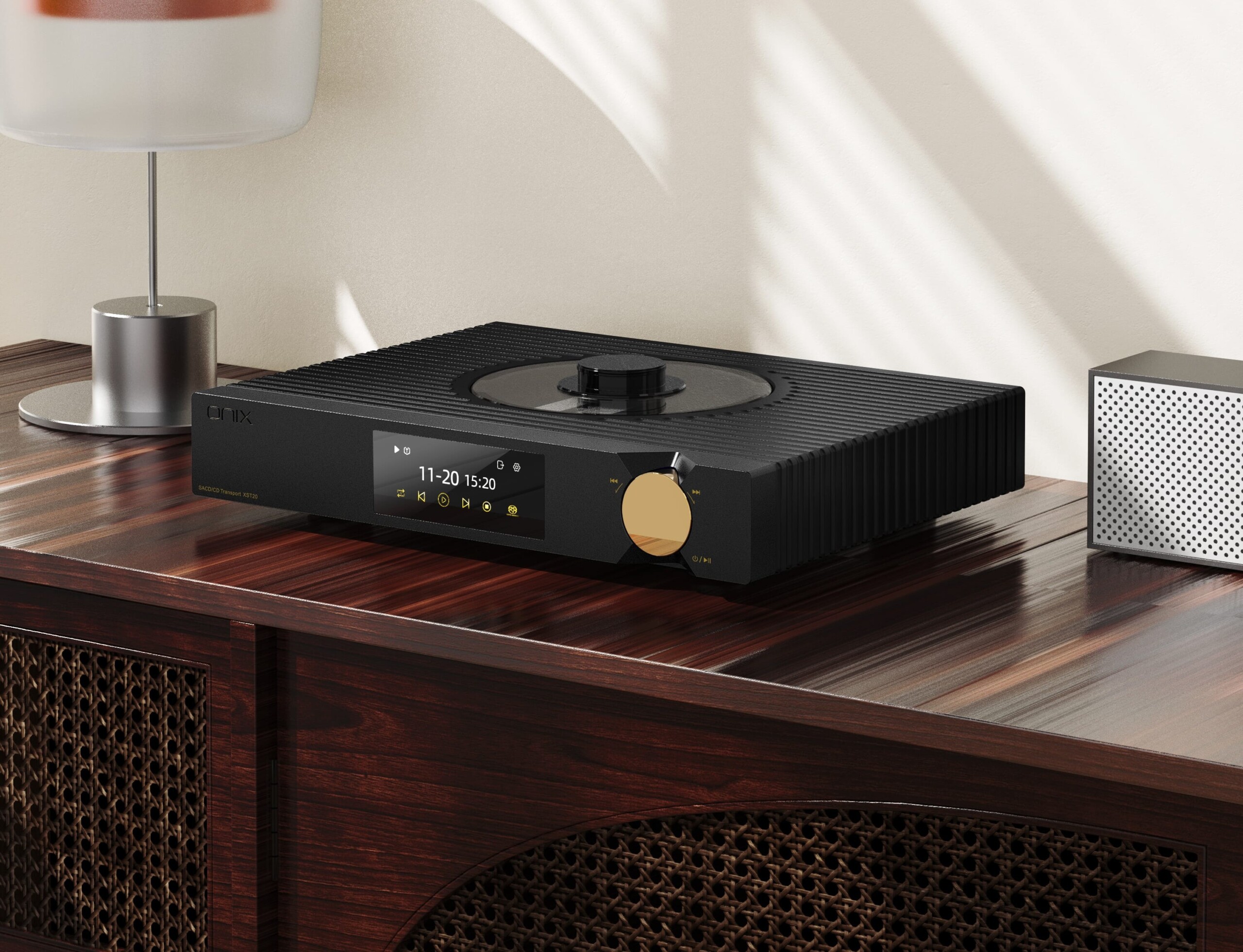


I recently awoke to a WhatsApp message from Dalibor Kasac of Euphony Audio, asking me to please call him as soon as possible. He had exciting news regarding upgrades to their Stylus operating system, and was certain I’d share his enthusiasm for the new features. Our conversations over the last year or so have led me to expect major changes to Euphony’s business model, and when we talked this time, the information was stunning: the newest iteration of Stylus now offers full support for Roon, which far-and-away has been the industry’s gold standard for digital music server and library organization for about a decade. Euphony's new Roon interface, Stylus Connect, is on the verge of being launched, and Dalibor wanted me to reach out to his compatriot Robert Devcic to arrange to have the new software remotely installed on my system. After hanging up from Dalibor’s call, I quickly messaged Robert to make him aware of my current system situation: recent listening room reconfigurations and my fascination with physical disc playback via the Onix Zenith XST 20 transport found me with neither my Euphony or Aurender servers up and running. And above everything else, I hadn't had an active Roon account in five years!
Robert informed me that the new Stylus Connect configuration didn’t require the dual computer setup of my current Euphony system, and I needed to remove the Endpoint device from the playback chain. Once again, it appeared Euphony was headed towards a “less is more” raison d'être by employing a simplified system that would utilize only the higher-powered Summus device (1TB Intel Core i7, 8th Generation, 16GB RAM, Linux OS). After reconfiguring the system and getting it online, I set it to “Remote Control,” which would facilitate Robert's remote installation. I’d then only need my Roon credentials to log on – which of course, I didn’t have, so I assured him that I’d give him a call once that information was in hand.
I immediately got the ball rolling in hopes of getting a professional courtesy license from Roon for evaluation with Stylus Connect, which I'd been assured would integrate effortlessly with Roon. That proved to be a bit trickier than expected, and required me to reach out to David Robinson at Positive Feedback to confirm publication-specific credentials that Roon required to issue the license. Surprisingly, it took over a full week of jumping through hoops to gain access to the temporary press account. Upon its activation, I immediately messaged Robert; he’d already remotely updated my unit, so selecting Stylus Connect as Euphony's audio system and logging in to Roon was all that remained. It was up and running in mere moments, and the wow factor of Roon was undeniable; needless to say, I’d definitely forgotten how much I used to dig its beautiful GUI and feature set!

First, a little background about my prior Roon experiences
My earliest streaming audio experiences began in mid-2016, propelled by equipment from Sonore, including their micro, ultra, and opticalRendu models. Sonore maufactured superb streamers, but they all required an outboard music server and audio player; I initially experimented with extremely complex (but free!) open source software applications like MinimServer and various UPnP music players. Open Source software programs often have really steep learning curves that required hours of experimentation to get them even close to working properly; that was further compounded when I attempted to get MinimServer to run my music library from a NAS. At the point when I thought I might jump off a bridge, I was approached by upstart Roon Labs with the offer of a courtesy account to evaluate their new media server/audio player software. I’d been hearing nothing but good things about Roon from sources throughout the audiophile world, so I jumped at the opportunity!
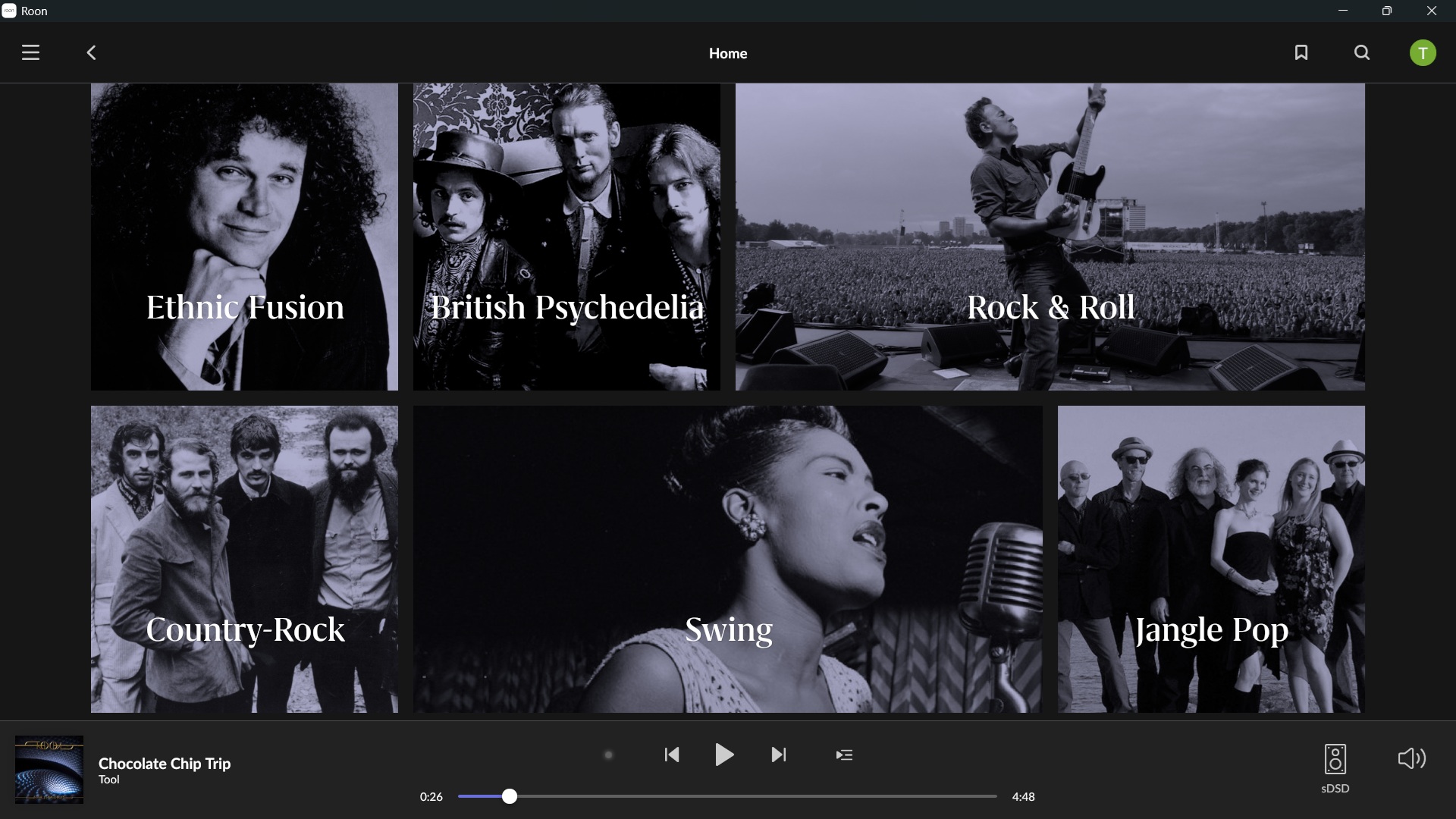
Roon's GUI offers a stunning array of artist and genre visuals.
Roon actually worked – plain and simple – first time, every time, and obviated the need for increasingly wonky open source solutions. Organization of my music library had never been easier, their feature-laden GUI was off-the-charts great, and I thought the sound quality was pretty decent as well – I was fairly smitten with Roon’s nearly perfect functionality. I wasn’t too jazzed about the looming Roon subscription cost, which was then $10/month (or $400 lifetime) – but for the time being, it worked, and I’d deal with having to pay for Roon when it became a actual issue.
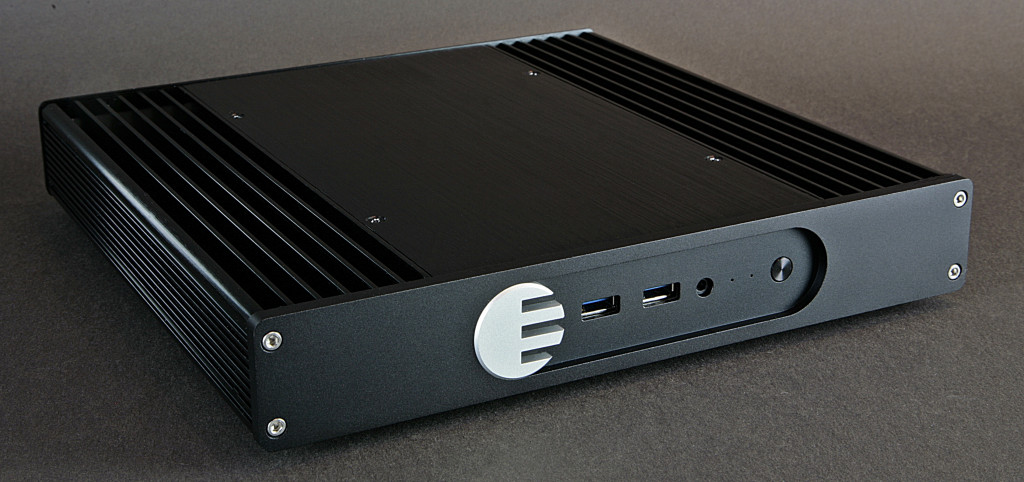
Euphony's Summus was a turnkey, single-box solution that proved to be a game-changer!
In 2019, the Euphony Audio experience began for me when their Summus arrived; it was, as Dalibor Kasac promised, a turnkey solution with integrated server, audio player, and streamer functions. Dalibor insisted Stylus' sound quality would definitely exceed that of Roon, and his assessment was spot on, but the server’s GUI was fairly pedestrian looking, and its functionality was a bit lacking, especially compared to Roon. That said, a workaround with HQ Player allowed the end-user to incorporate Roon as their server while maintaining access to Stylus as the music player. Euphony wasn’t Roon certified, but the workaround gave you the best of all worlds in terms of superb digital streaming and excellent sound quality, with Roon’s exceptionally beautiful GUI serving (quite literally!) as the icing. By this point, I’d long since caved and was paying for a subscription to Roon.
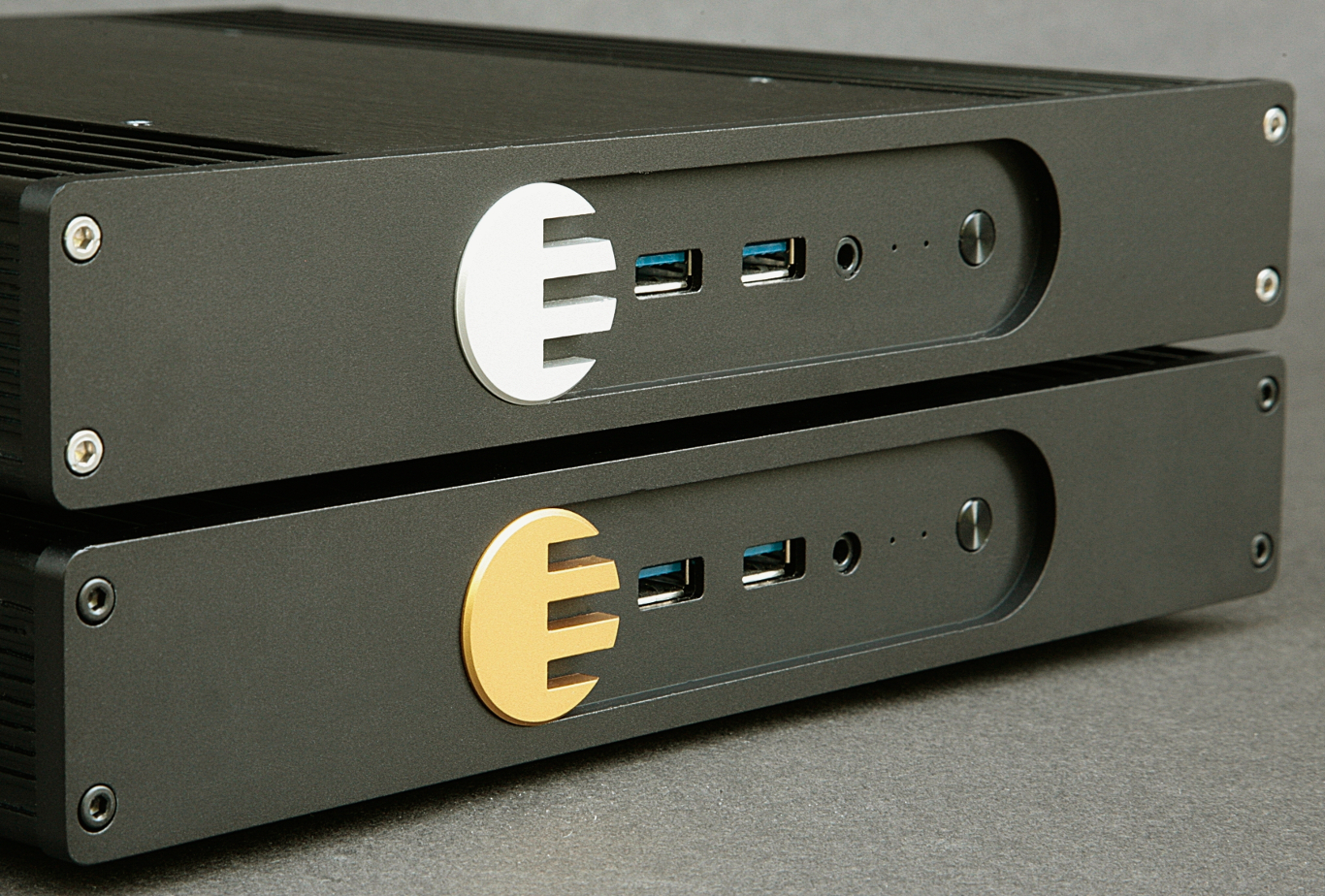
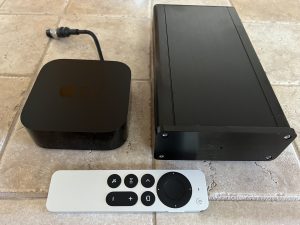
Summus (above) and Endpoint (below) together provided breathtaking digital playback!
Over the next couple of years, upgrades to Euphony’s Stylus OS made improvements in every performance metric, with greatly enhanced operational stability and a much improved GUI appearance. And the 2021 arrival of the Euphony Endpoint upgraded my streaming setup to a dual-computer configuration, with streamer, server, and player functions now separated between modules. The resulting improvements in sound quality were beyond belief – but they came with a slight caveat, as the HQ Player workaround that allowed Roon access was suddenly no longer available. There was no possible way to incorporate Roon into my digital music system, and I decided that my infatuation with Roon’s GUI was more superficial than anything, so I canceled my paid subscription. And up until a couple of weeks ago, I never looked back.
Back to the future…where almost every streaming app has a “Connect” option
Euphony Audio is a small, forward-thinking company that’s not only highly focused on technical excellence, but above all on hardware/software options that deliver superb sound quality. Their recent announcement wasn’t the first time they’d made changes to their company’s direction mid-stream. Which is entirely understandable with principals like Dalibor Kasac and Robert Devcic, who respectively function at creative and technical levels far beyond that of the typical audiophile. Through their partnership, they’re constantly searching for the most cost-effective method to deliver statement digital audio playback in a package that not only delivers superb sound, but also ticks many of the boxes high-end audiophiles require – including a world-class GUI like the one offered by Roon. Their recent, stunning shift in direction has been evolving over the last couple of years, and their embrace of the “Connect” trend is totally unsurprising.
In late 2024, another call came from Dalibor that laid the groundwork for Euphony’s future direction: they were abandoning their server-based business model, which had recently been transitioned to a subscription base. Their research & development focus was being shifted onto a single-box hardware solution that might possibly include a DAC of their own design, enhanced streaming capabilities, and would also convert all files to a higher rate of DSD for playback. Euphony's status quo with Stylus would continue for the near term, but I'd eventually need to get an outboard music server to work in combination with their new hardware.
That information fairly alarmed me, and I researched the situation nearly non-stop over a period of several months, eventually acquiring an Aurender A1000 network player. Its functionality was a little over the top, with a built-in AKM-based DAC that was configurable to DSD direct. But its pricing was similar to models in their line that offered only music server capabilities, so the A1000's excess of riches was a welcome distraction! Mid-2025, I basically mothballed the Euphony system in advance of the arrival of their new hardware, and spent several months fully exploring the scintillating functionality of the Aurender system. That is, until the Onix Zenith XST20 SACD/CD disc transport arrived this past March!
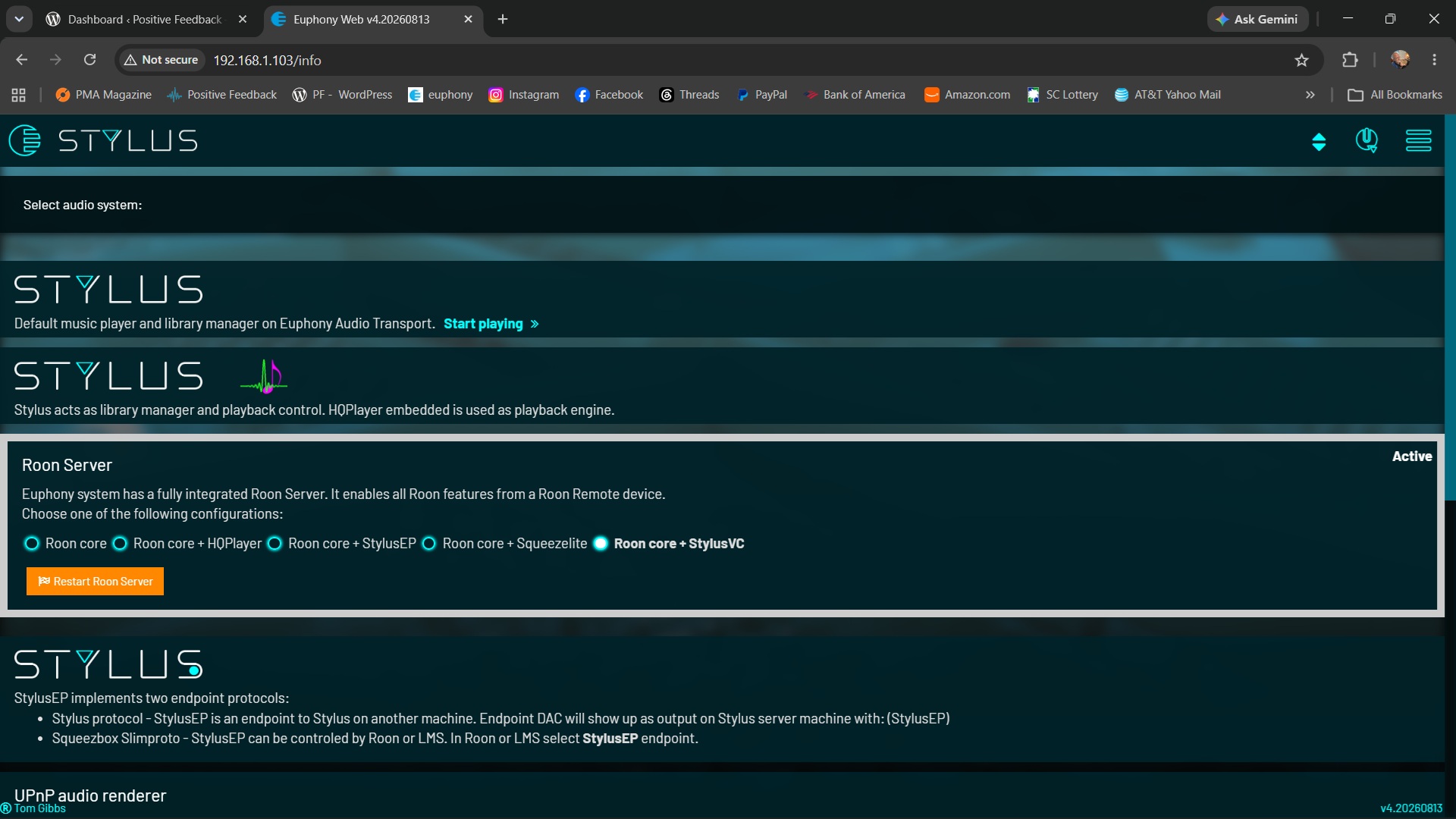
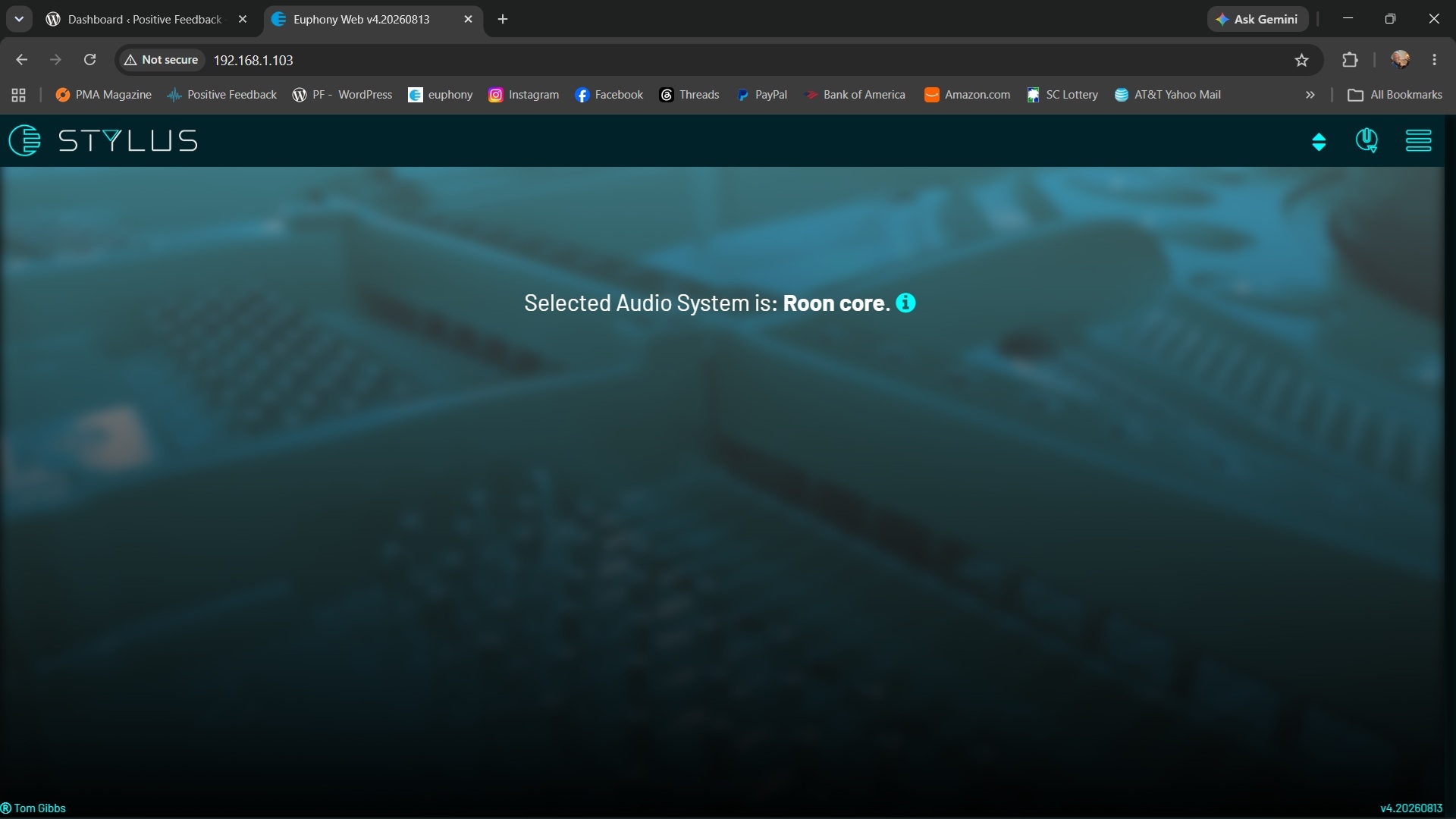
Stylus Connect
I've always been amazed by how quickly the wheels turn at Euphony Audio, and in the directions they've taken their pursuit of digital audio excellence over the years. So it really came as no surprise that in my recent conversations with both Dalibor and Robert, I definitely got the impression that there was now no timeline for the arrival of their proposed new hardware – if it was even still on the table. Stylus Connect’s Roon functionality would free them from the need to offer continued support of their own music server option, and besides, most audiophiles obviously preferred Roon in their high-end streaming systems anyway. The arrival of Stylus Connect will help ensure Euphony Audio’s continued viability in the high end marketplace.
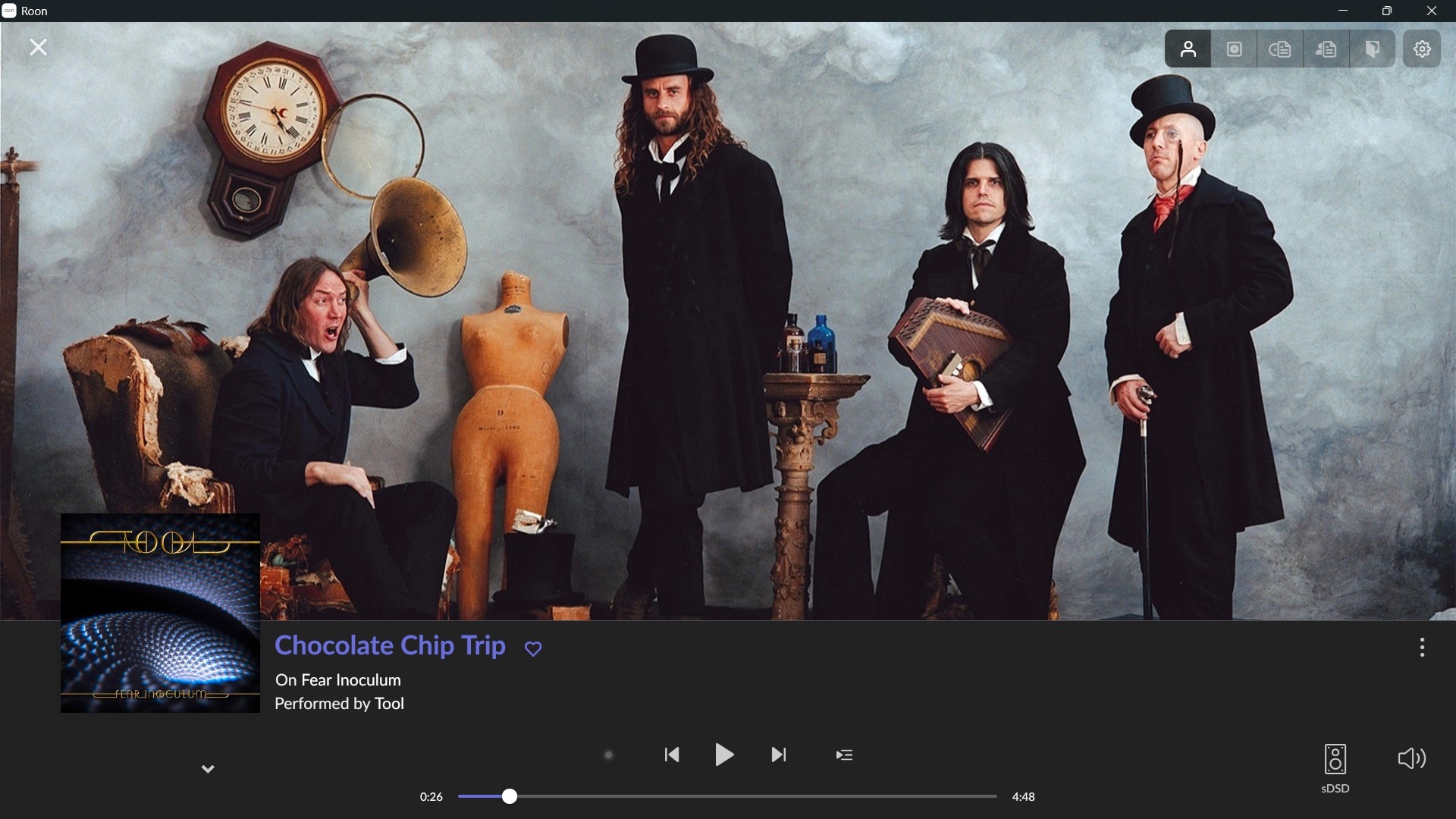
Individual track playback on Roon is always accompanied by really cool artwork!
What did surprise me is how seamless my transition to Stylus Connect has been, and how greatly improved its functionality and sound quality are compared to the very recent past. During Euphony’s dual-computer phase, there were occasional digital handshake hiccups that occurred between the units; with Stylus Connect, once the system is booted, it runs effortlessly in the background, requiring scant attention from the end-user. The need will rarely arise to even open the Euphony app on your desktop, Android tablet, or iDevices.
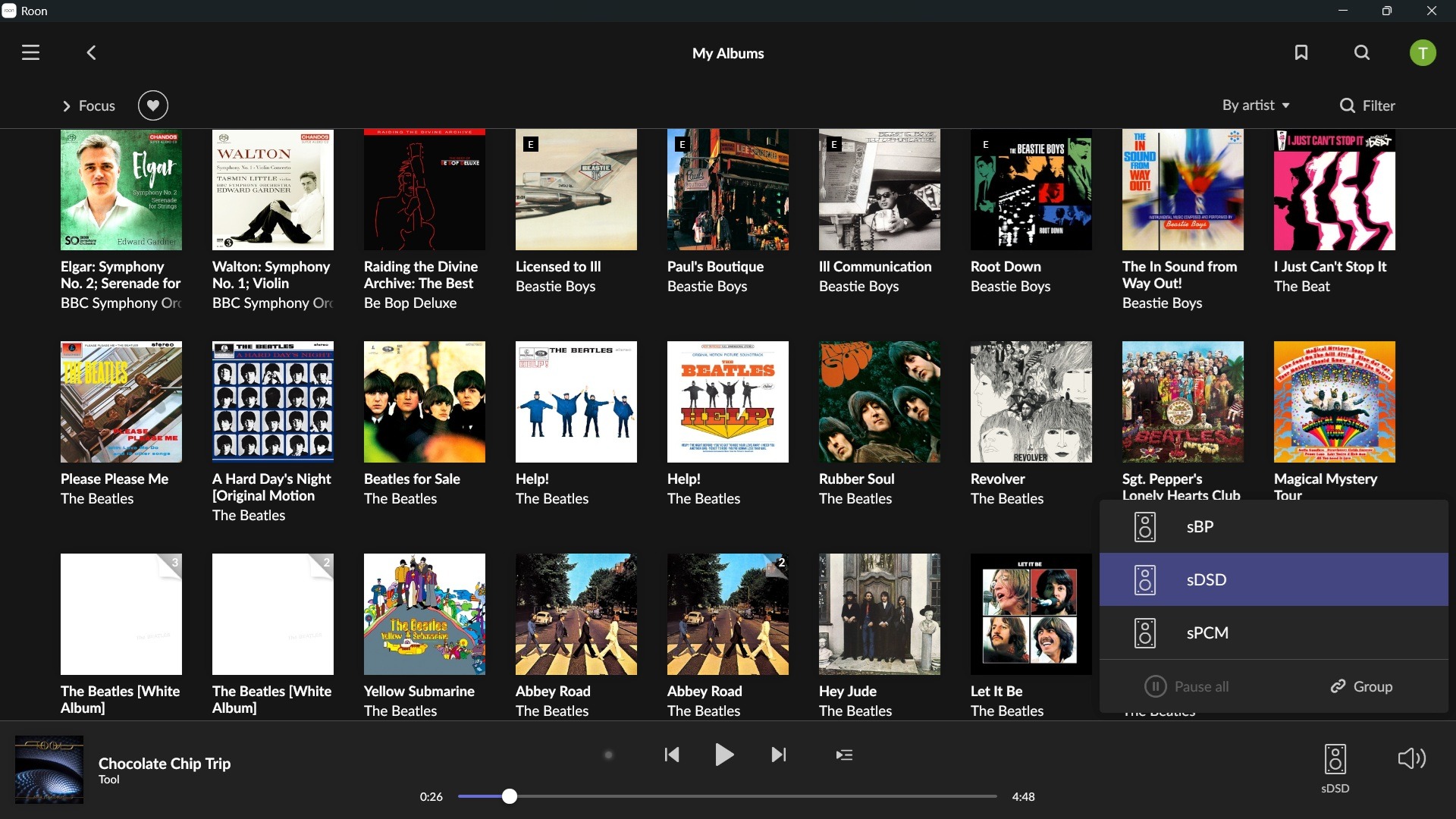
Roon's audio player selection dropdown offers all three flavors of Stylus Connect.
After launching Roon for the first time in five years, then getting the system settings to my liking, the only remaining task was to choose an audio source, which was Stylus Connect. It's actually identified in Roon by three different playback choices, "sBP," "sDSD," and "sPCM." sBP translates to Stylus Bit Perfect, which plays all files in their native bit-and-sample rates; the other two choices are fairly self explanatory – sDSD converts everything you play to DSD 256(!), while sPCM converts everything to PCM 384. However, the end-user should notice fairly quickly that the complex upsampling algorithms don’t allow for higher bit-rates of DSD or PCM to be played back natively.
Translation: if you want to listen to a DSD 512 file, you’ll need to select sBP from the audio system pulldown, to guarantee the file is played bit-perfectly. The same goes with higher bit-rates of PCM, although I’m fairly certain that PCM upconversions go more smoothly than DSD-to-DSD up-or-down conversions. For example, the DSD upconversions from all my SACD rips (DSD 64) unsurprisingly sounded slightly imperfect through sDSD playback, while upconverted PCM of any bit and sample sounded superb. That’s basically it; there are no further settings or tweaks available on the Euphony app. And because Roon is acting only as the music server, there are no audio settings to negatively impact Stylus' superb sound quality during playback.
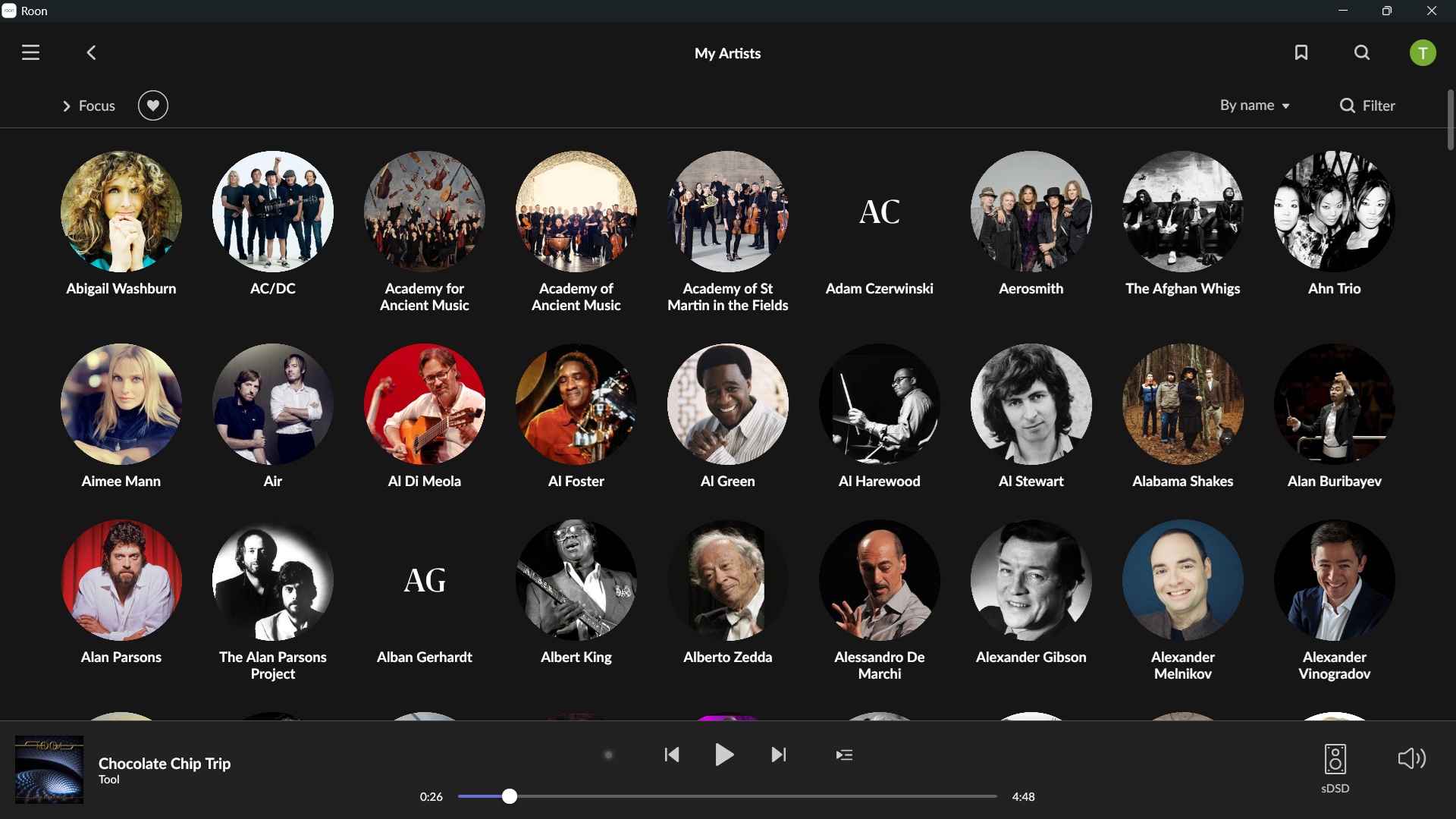
Roon offers multiple screens from which to choose your music, including albums, genres, or even artists.
As an early adopter of SACD from its inception, I've ravished in the sound quality of native DSD recordings, in addition to that of many superb analog recordings that have been remastered to DSD. Euphony has enlightened me to the joys of PCM to DSD conversion, and in Euphony's previous iteration, a licensing agreement with Mozzaik Audio allowed upsampling of any bit-rate of PCM to DSD 64 for playback. I thought the sound quality of all the CD rips on my server were off the chain as DSD 64, but with Stylus Connect's upsample to DSD 256, that sound quality is exponentially better! Euphony's own Robert Devcic took part in Mozzaik's research and development of their DSD upsampler, and I have no doubt he was instrumental in bringing the new upsample algorithms to Stylus Connect. I'm definitely a fan!
Euphony’s future is now
When Dalibor reached out to me this past February it was to update me on their ongoing affordable DAC testing, and to advise me that two Topping Models, the compact D90III Discrete and full-sized D900 were among the very best DACs they’d heard over the last couple of years. Both are true 1-bit designs, with the main difference being that the less expensive D90III Discrete employs only 16 PSRM switching modules per channel, compared to 32 PSRM modules per channel in the D900. However, the D900 has only balanced outputs, and my continued explorations into SET tube amplification required a DAC that also offered single-ended outputs; that eliminated the D900 from consideration in my situation.
Euphony Audio still employs the insanely expensive Master Fidelity NADAC (MSRP $27,500) in their reference system, but they spend almost as much time listening to the more modestly priced Topping D900 DAC (MSRP $1800). That DAC choice is probably more in line with what most budget-conscious audiophiles would be listening to in less than cost-no-object systems, anyway. And while I’m confident their DAC experimentations will continue, I’m also pretty certain that the status quo that will be established by the implementation of Stylus Connect will remain their modus operandi for the foreseeable future. In any case, it's a nice upgrade for existing users, especially those in love with Roon, and will definitely offer an excellent option for audiophiles currently shopping for a well-priced, high-end streaming system.
Logos courtesy of Euphony Audio and Roon; all images courtesy of the author.