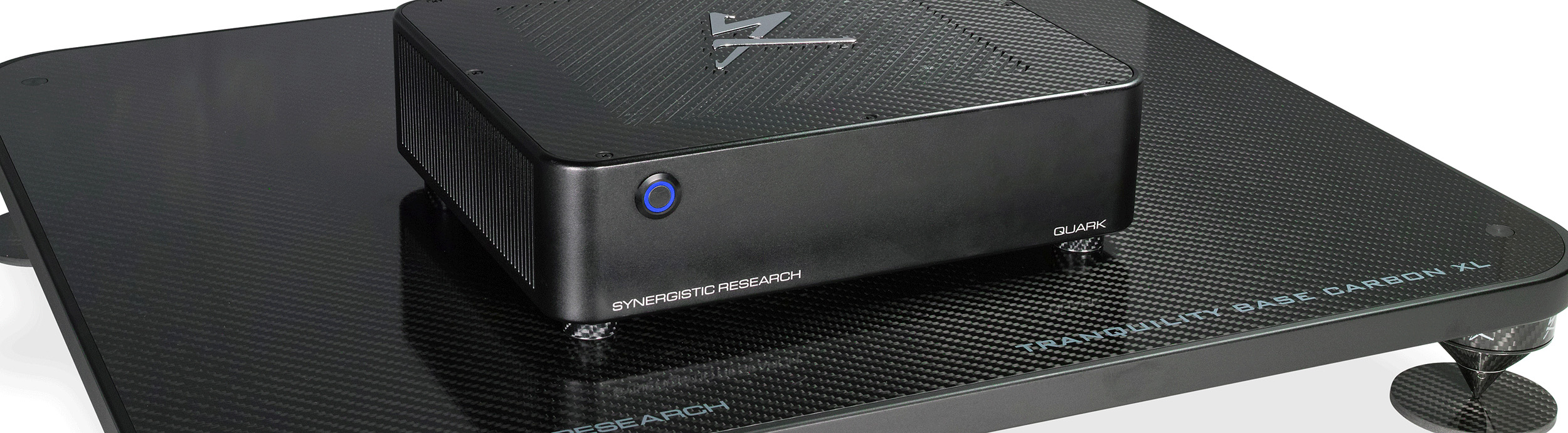
During my visit to Axpona 2026, there were several outstanding new products that made my show highlight list. One of the most impressive was the new Synergistic Research Quark streaming server. Ted Denny’s demonstration at the show was quite intriguing and highly entertaining as always. Ted is Founder, Proprietor and Chief Designer at Synergistic Research. If you ever make it to a future Axpona, you should definitely stop by the Synergistic Research room. I always learn something new to consider and appreciate when it comes to high end audio.
I guess that it is somewhat known in the industry, that I am more of a dedicated vinyl guy, though I do greatly enjoy the digital format too. With this reputation in mind, Andy Wiederspahn (President, Synergistic Research), reached out to me at the show and asked me if I might be interested in reviewing the Quark. If yes, he asked that I approach the review within any format and process that would satisfy my needs and analysis, but to also include a thoughtful and fair comparison to analog. I agreed, and I was very excited by the opportunity! Thank you Andy!
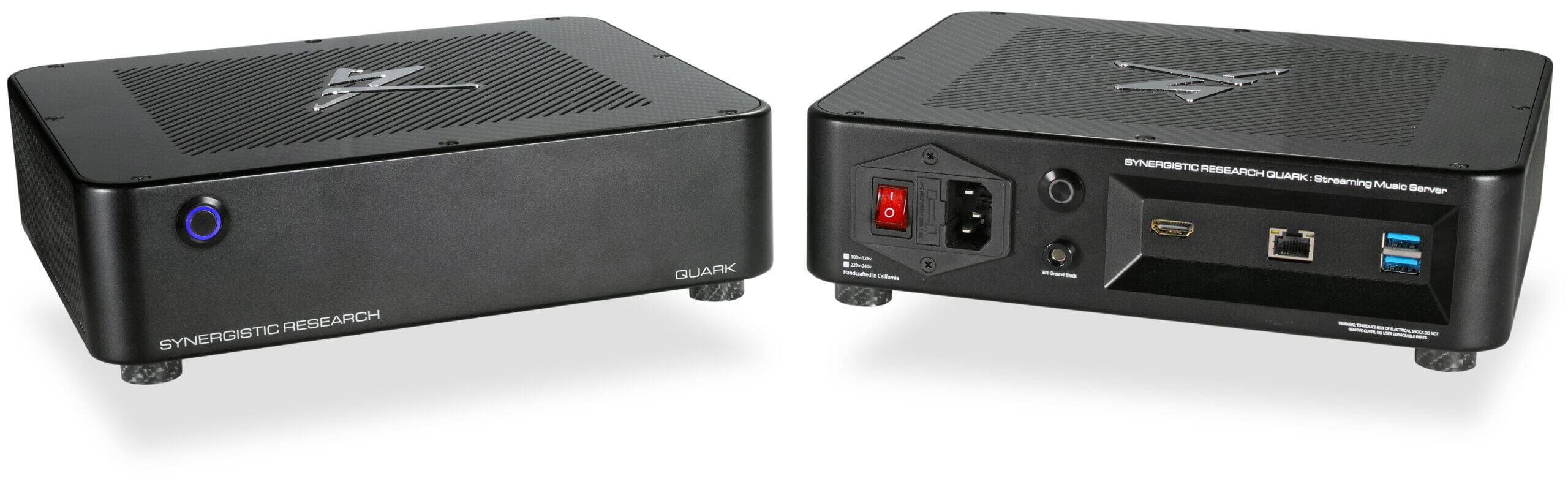
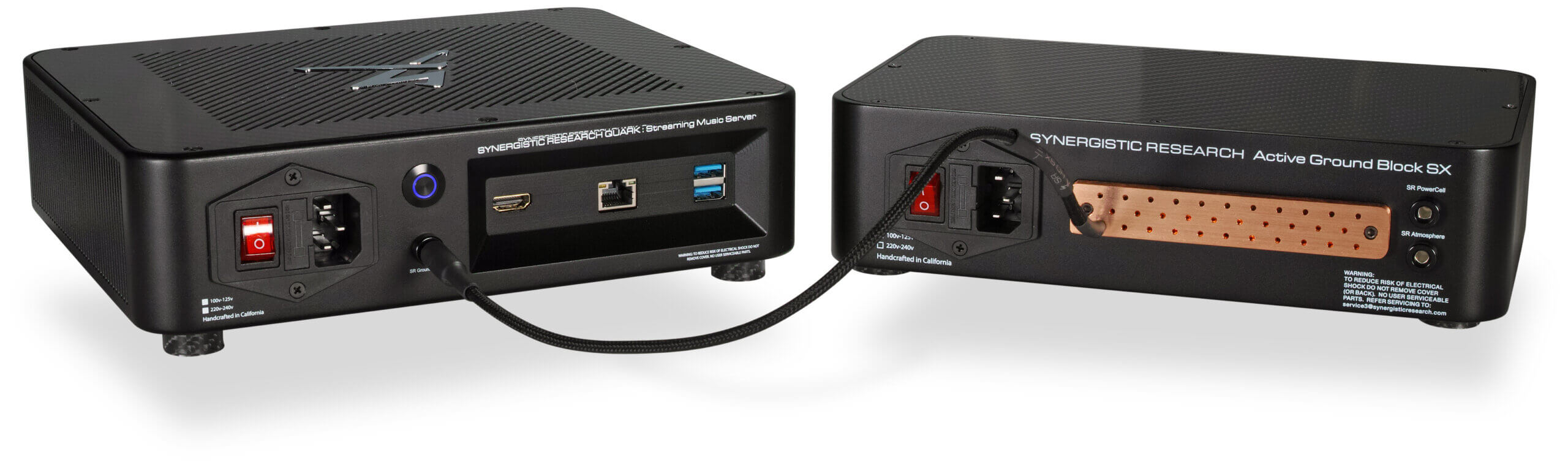
With a performance that is said to be very close to their highly rated flagship Voodo streamer server with a MSRP of $14,995, the Quark is a Roon-dedicated streamer server with an MSRP of $8995. Ted Denney has taken most everything that he has learned along the way about digital, and utilized it in the new Quark. Like most Synergistic Research products, one of the key design principles of the Quark is to employ several unique ways to manage and control the noise floor. This list can be extensive, but this includes electromagnetic (EMI), radio frequency (RF), and various structural and resonance issues. Please see a list of the innovative technologies that were utilized in the Quark design below.
Roon of course, is also an interesting element of the offering, as it provides several wonderful features on its own. This includes a management and playback platform that unifies both local music files and streaming services like Tidal and Qobuz. It also provides an amazingly rich amount of meta-data for both artist and recording information. Amongst many more attributes, it even includes several very powerful tools for room correction, parametric EQ and up sampling.
You have be totally fascinated by all the potential of this exciting package of hardware and software design. As always though, the proof is in the pudding. For me, only the bench marks that have all-ready been established in my own listening room will answer all my many questions about sound quality and ergonomics, and I do have questions. I imagine that this is also true of my readers!
Digital - The Problem Redefined
At a high level, the Quark operates on a principle that a computer's power supply and processing platform inherently generates high-frequency noise and contamination. If not addressed properly, this will greatly impact the sound quality and the ability to emotionally connect to the music. The following highlighted narrative, which was taken directly from the Synergistic Research website, explains it better than I could ever paraphrase.
Cable in Your System.
Every streaming server is a computer. Every computer operates on chips — CPUs, RAM, voltage regulators, integrated circuits — that switch at MHz-GHz frequencies. That switching generates broadband electromagnetic noise as a direct, unavoidable byproduct of computation.
The digital data isn’t the problem. The ones and zeros arrive intact. The noise doesn’t corrupt the file. It does something worse. It leaves the streamer.
It exits through the digital cable connecting the streamer to your DAC. It exits through the power cord connecting the streamer to your power conditioner or wall outlet. And once it’s on those cables, it doesn’t stay on those cables.
It radiates into the electromagnetic field surrounding every conductor in proximity — your analog interconnects, your speaker cables, your power cords, every cable in the loom. One cable to the next. The noise migrates through electromagnetic coupling from the digital source into the analog signal chain — without any galvanic connection between them.
This is where the damage happens. When MHz-GHz noise rides on a cable carrying your analog audio signal, it reshapes the propagation pattern of that signal. The audio waveform and the contaminating noise share the same conductor. They share the same electromagnetic field.
The noise doesn’t sit alongside the music as a separate artifact you can filter out downstream. It superimposes itself on the field the music propagates through — compressing the phase relationships that encode soundstage depth, altering the harmonic structure that encodes timbral accuracy, collapsing the spatial information that tells your brain where every instrument sits in three-dimensional space.
This is what the world has been calling “digital sound” for over forty years.
The compressed presentation. The flattened soundstage. The hardness in the upper frequencies. The sense that digital is accurate but not alive — technically correct but missing the ease, the depth, the three-dimensionality that analog listeners have always claimed as vinyl’s advantage.
It was never the format. It was never the ones and zeros. It was never sampling versus continuous waveform. It was never the DAC chip or the reconstruction filter or the bit depth. It was the frequencies that digital chips operate at — MHz-GHz switching noise generated inside the streamer, migrating outward through every connected cable, jumping to every adjacent conductor through electromagnetic coupling, and reshaping the analog waveform your speakers ultimately reproduce. The contamination doesn’t come from the recording. It comes from the machine playing the recording.
For forty years, the audio industry has treated this as an inherent limitation of the digital format. It isn’t. It’s a contamination problem with a specific mechanism and a specific origin point — and it has a specific solution. Eliminate the noise inside the streamer before it ever reaches the cables. Before it migrates to the analog chain. Before it reshapes the waveform your speakers reproduce. Solve it at the source - and digital doesn’t sound like better digital. It sounds like music. That's Quark.
Key Design Elements
The list below is an attempt to provide a short summary and description of the many technologies and design elements that were utilized in the Quark. I tried to keep it short and sweet, but there is even more detailed information to be found on the Synergistic Research website. Please see the link at the end of the review for additional detail and insight.
Low-Power Architecture: By using a highly simplified circuit and motherboard, low-power processing, and a refined linear power supply, the Quark generates significantly less electrical noise than traditional high-performance computers.
Compact Form Factor: This is a direct consequence of the low-power architecture. A processor that draws less power generates less heat. Less heat means a smaller chassis. The Quark maintains the same thermal headroom as the full-size Voodoo.
EM Cells & ULF Generators: The Quark incorporates SR’s proprietary Electromagnetic Cells and an ELF/ULF (Extremely Low Frequency/Ultra Low Frequency) field-biasing system that conditions the internal field that the audio signal propagates through.
Carbon Fiber & CNC Machined Aircraft Aluminum: The Quark chassis utilizes a semi-permeable carbon fiber architecture and CNC machine aircraft aluminum that traps noise while allowing resonance issues to pass through.
Multi-layer UEF Ground Plane Technology: Works in concert with the electromagnetic cells to establish a clean and stable ground reference point for the entire digital circuit.
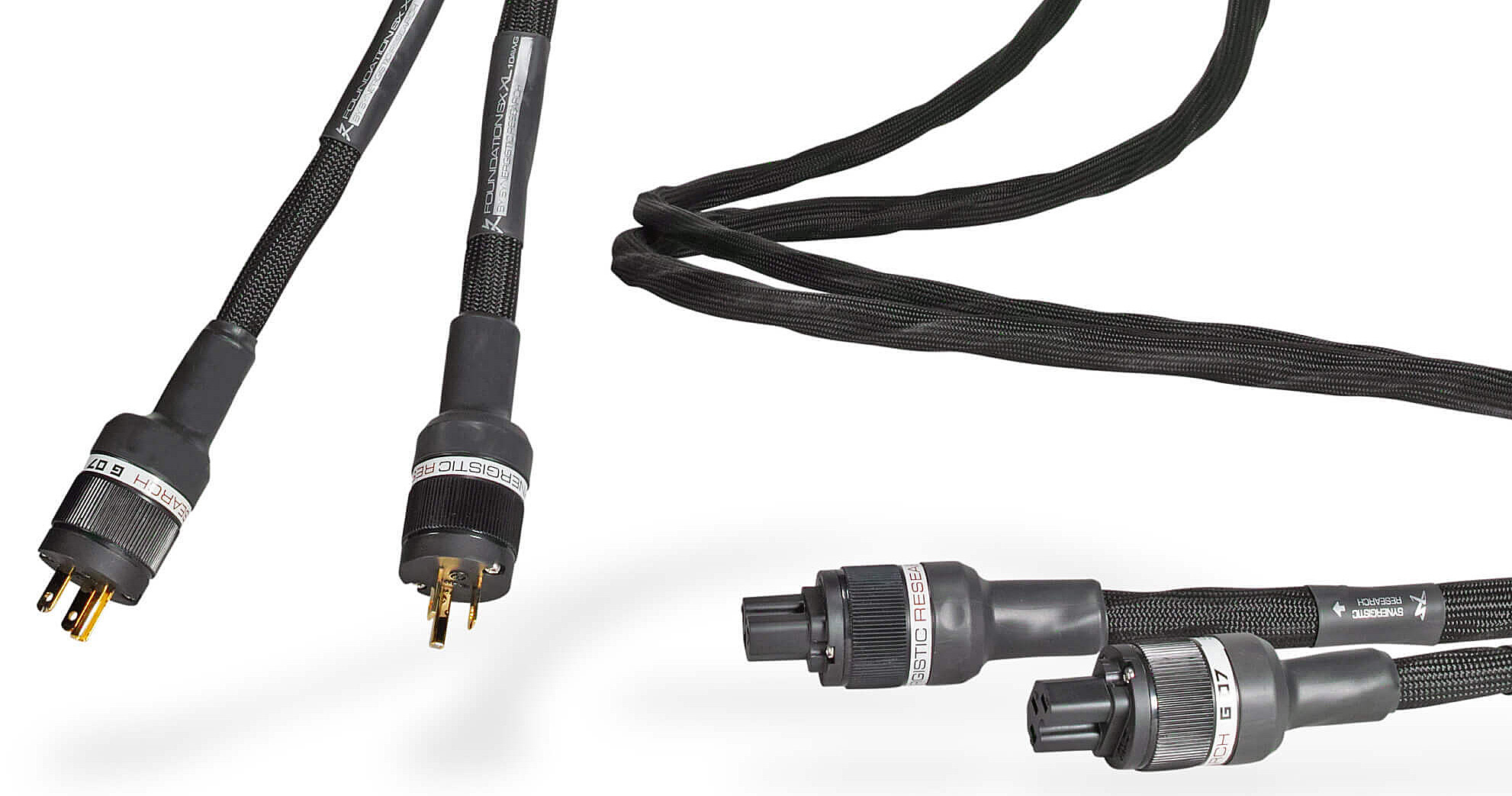
Upgraded Power Cable & Fuse: Quark ships with a Foundation XL 12 AWG power cable (normally a $999 MSRP) and a SR Master Fuse (normally a $297 MSRP) at no additional cost.
Active Ground Block Connectivity: Quark can connect to a Synergistic Research Active Ground Block through a dedicated ground connection - extending the ground architecture into your broader system topology and lowering the noise floor further.
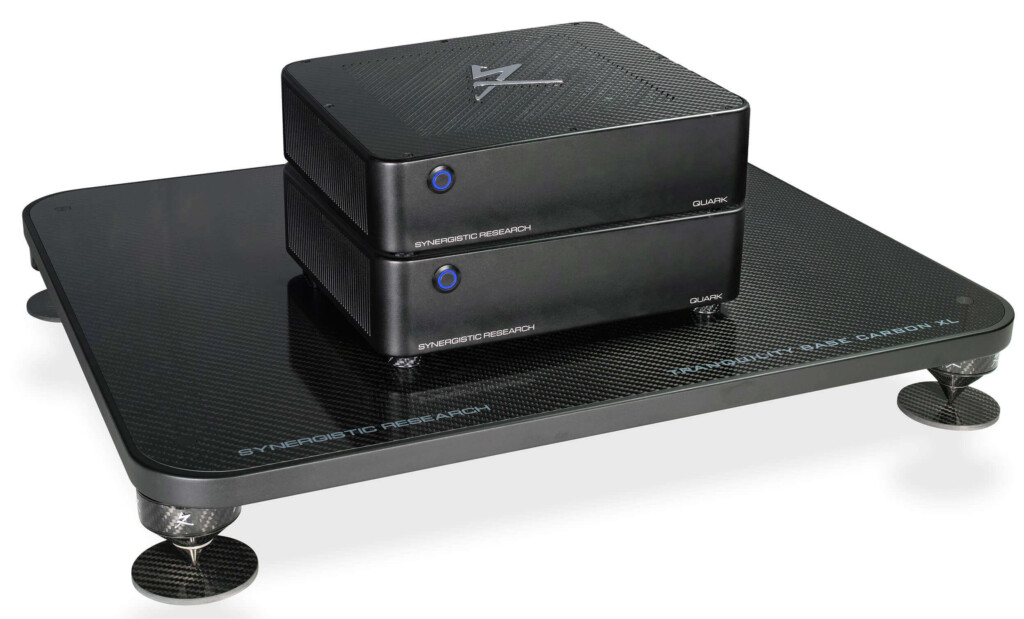
Maximizing Roon Architecture: One can pair a Quark with a Voodoo or a second Quark, dedicating one unit as the Roon Core Server and the other as the Roon Endpoint. Separating core processing from audio output eliminates the sonic penalties of running both functions on a single device.
ELF/ULF Biasing System
One particular and unique feature of interest for the Quark is the ELF/ULF Biasing System mentioned above. As stated by Synergistic Research, the ELF/ULF Biasing System generates a coherent low-frequency electromagnetic field inside the chassis. A typical home can be saturated with MHz-GHz noise from Wi-Fi routers, LED lighting, switch-mode power supplies, smartphones, and dozens of additional broadband emitters. This noise rides on every conductor in your system. The audio signal can arrive at your speakers with the spatial and timbral information compressed, smeared, and degraded.
Again, as defined by Synergistic Research, ELF/ULF biasing doesn’t remove the MHz-GHz contamination. It establishes a coherent field structure that the audio signal couples to preferentially. The contamination is still present. Only the signal’s relationship to its field environment changes.
There are three selectable ELF/ULF frequencies that allow you to voice the Quark to your system, your room, and the music you are listening to. These settings are said to not color the music or alter the data stream. They have been designed to reshape the ambient electromagnetic field environment surrounding the circuit.
Blue (Default): Linear note transitions from low to high frequencies with a relaxed midrange. Large, enveloping soundstage. The natural starting point for most systems and recordings.
Green: Slightly more forward midrange presence with added bass weight. Systems that benefit from additional warmth and density respond here.
Red: Optimized for recordings mastered with significant phase information and holographic sound staging.

Set Up & Thoughts On Roon
I must state upfront that you have to be patient as you set up the Quark and experiment with all the various options. From a sound perspective, my first listening session right out of the box with a couple of my local Audiophile friends did not go well. It took over a week for the unit to finally burn in and it continues to make additional gains as time has moved forward. Be patient and you will be rewarded!
You also have to consider all the possible settings like the ELF/ULF Biasing System mentioned above and possibly even some of Roon tools for room correction, parametric EQ and up sampling. It was also important to make the proper cabling choices, though the included Synergistic Research XL power cable was an excellent match.
For my system, the final setup did not require a bunch of creativity as I basically stayed with the Foundation XL power cable and the standard Blue biasing option. I did not use any of the Roon tools. But again, each variable did make a difference and I did take the time to experiment. The amazing thing is that users will have many ways to really customize the sound and fine tune to your musical taste.
I was completely new to Roon, as I have been using an Aurender N10 music server for several years along with it’s excellent Conductor control app. For the Roon set up, I was fortunate to have those same Audiophile friends mentioned above on hand as they did have some Roon experience. In the end though, it only took a few minutes to get the Roon app up and running. After connecting cables for ethernet, USB and power, and then downloading the Roon app, I was quickly ready to rock. Please note that for Roon to engage properly, the Quark and had to be powered up and connected to the network and the DAC first.
It did not take me much time at all to understand the various Roon menus and to jump in on all the meta-data. It was very logical and well presented. I was totally swept away by all the information and pictures provided for specific albums and performers. The ability to link to other related performer discography, album credits and history was almost mind blowing. I have always been very satisfied by my Aurender N10 and what it and the Conductor app can provide from this perspective, but the Quark and Roon were a very powerful combination.
Sound
The Quark provided the finest digital sound quality that I have yet experienced in my listening room. With my Aurender N10 music server and the uniquely upgraded DAC (which is an amazing performer) in my D’Agostino Progression Integrated, the noise floor has never been an issue or even noticeable in the past. But now, there was a blackness and a clean slate like never before. Vocals and instruments just seemed to jump out of the soundstage. There was a newfound level of clarity and definition, but not with all the added edge and ringing that can sometimes come along for the ride with this much detail.
I am also kind of a bass freak. Bass performance is one of the first things that I evaluate in a new product review. With the Quark in the system, bass was consistently tight and with plenty of inner detail and slam. It depends on the recording of course, but rarely did I find any bloat or sloppy boom in the playback. In fact, the Quark tamed this issue on several of my most favorite music tracks that have consistently displayed this issue. Still fun and with amazing energy, but no boom. Bass performance from a digital front end has in general always been a big plus for my ears, and the Quark took it to a new level.
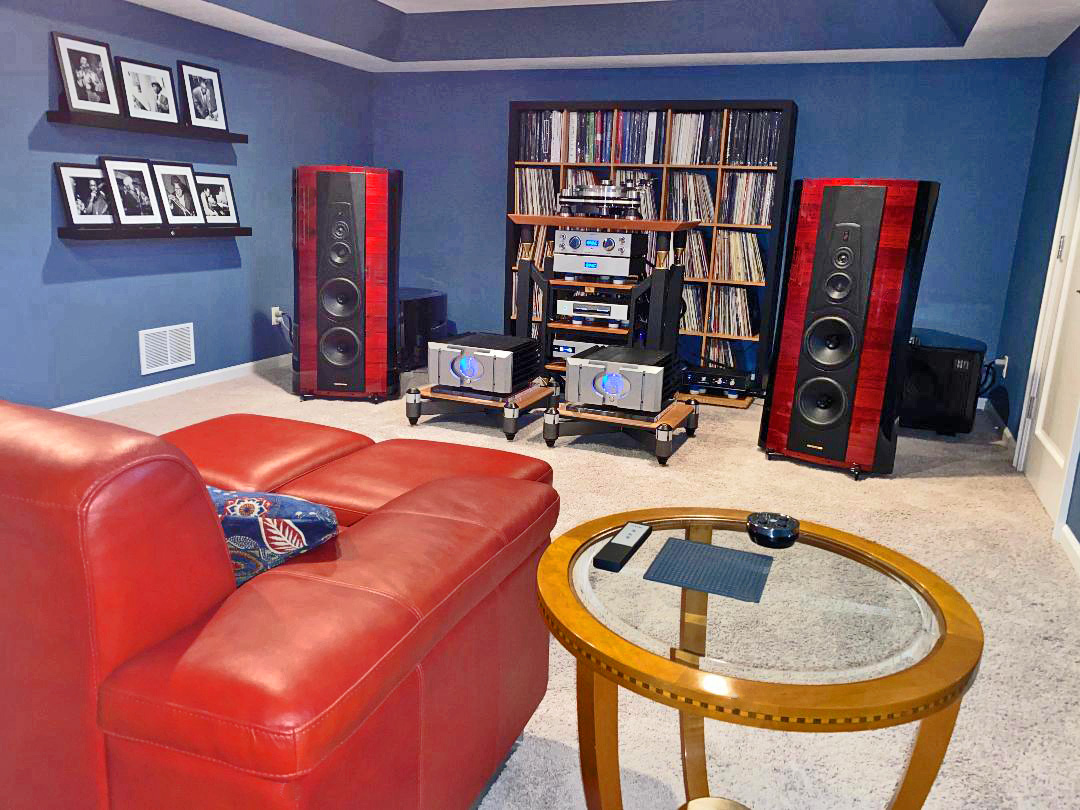
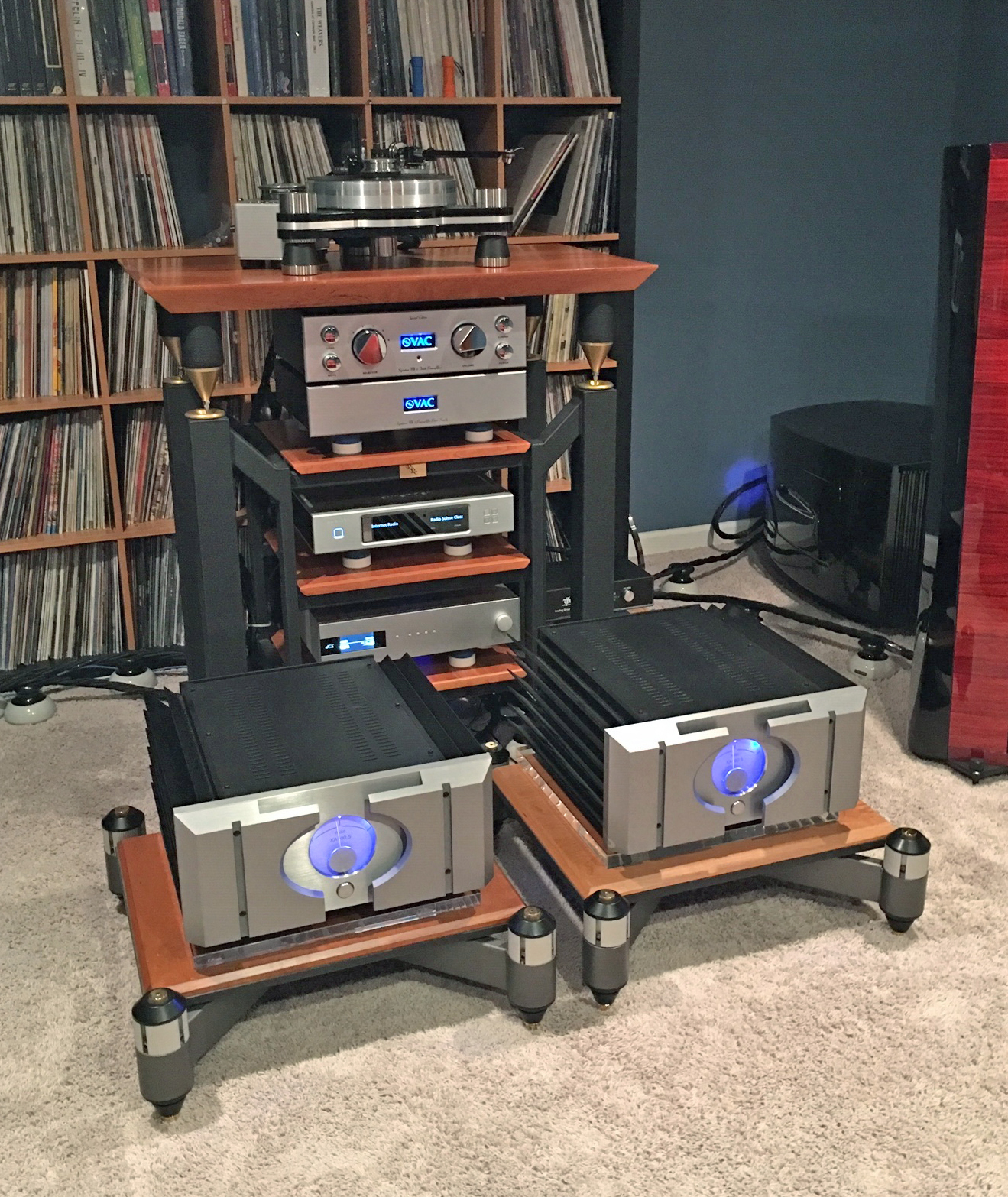
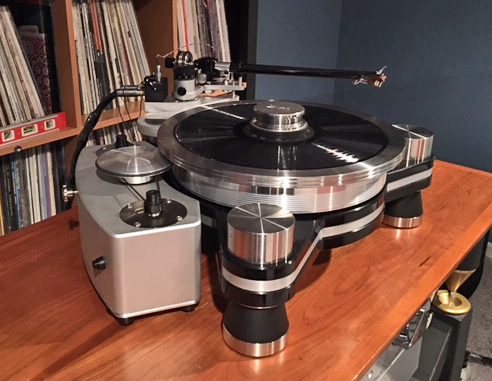
Highs and mids were exquisite. This is where I spent more time comparing the sound quality of the Quark to that of my analog front end, which includes a VAC Renaissance phono preamp (recently re-tubed), VPI Avenger Plus turntable, VPI Unipivot Fatboy tonenarm, and a van den Hul Crimson XGW Stradivarius moving coil cartridge. I could not equivocally state that the Quark was the equal or the better, but it was definitely different than what I have experienced in the past from many high end servers. Digital was clearly now a contender. In fact, this was a whole new ball game!
With the Quark in place, the sound quality of the highs and mids were wonderfully liquid and natural. You get the detail and the excitement, but now you also get the goose bumps and emotional connection that most analog simply delivers with ease. Hi-hats had a proper sustained shimmer and bark without the excessive and thin sounding sizzle that many digital sources can throw at you. There was a lushness and texture to strings and woodwind instruments that just had my heart aching. The clarity, tonality and space of most vocal recordings were so much more immediate and alluring. From top to bottom, the Quark delivered in spades!
Music

Art Blakey and the Jazz Messengers, Moanin’ (Qobuz 24 bit/192 kHz)
The album Moanin’ by Art Blakey and the Jazz Messengers, is one of my top ten jazz albums of all time and most consider it a quintessential example of the hard bop genre. Released in 1958 on the Blue Note label, group members include Art Blakey on drums, Lee Morgan on trumpet, Benny Golson on tenor saxophone, Bobby Timmons on piano, and Jymie Merritt on bass. You would be hard pressed to dream up a better all-star lineup from that time. The title track was inducted into the original Grammy Hall of Fame in 1998 and the entire album was inducted in 2001.
The title track Moanin’ is an absolute killer. With the Quark in place, and when Lee Morgan kicks in on his trumpet solo, you are almost startled by the golden glow and the fiery aggressive attack of his instrument. The same for Benny Golson and his solo. The raspy reedy nature of his tenor sax has never sounded better as it explodes out of the soundstage. Yes, Art Blakey is the foundation and driver on drums, but it’s almost more important to note what we hear from Tommy Timmons on piano and Jymie Meritt on bass. The Blue Note label and producer Rudy van Gelder are not exactly well known for superb piano reproduction. Here we have all the proper weight and timbre that you could ever ask for. Bass is deep, muscular, and well defined. Very impressive! Very satisfying and enjoyable!
Peter Gabriel, Live At Womad 1982 (Qobuz, 24 bit/96 kHz)
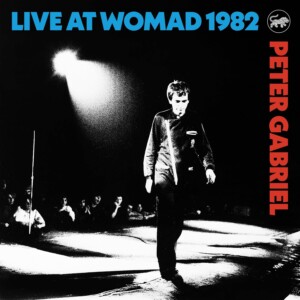
This live concert from 1982 was just recently released and is now available in 2026 on digital file, CD and vinyl. Peter Gabriel was in all of his glory at that time. This turned out to be an interesting adventure as I went through somewhat of a roller coaster ride between the digital and analog formats. I was quickly hooked on the performance while streaming on Qobuz, and while waiting for the vinyl to arrive. The album on Qobuz sounded fantastic! When I finally did catch up to the vinyl, I had to smile, as it had an additional jump factor and energy that could not be denied. Not the first time this has happened.
When the Quark arrived for this review, I discovered still another revelation as I returned to the Qobuz stream. The Qobuz stream was now equally stellar, as it duked it out with the LP head to head for sound quality. Not exactly an audiophile mastering for either format, as there was still some limited compression on both, but the track “Biko” on Qobuz was now so much more expansive and airy. Drums and synthesizers swirled around the listening room with a thunder and drama that will get you up and dancing. Gabriel never fails to astonish. This is an absolute must have for any serious Gabriel fan. Digital at its best!

Jennifer Warnes, Famous Blue Raincoat (Qobuz, 16 bit/44.1 kHz)
One could truly not evaluate the Quark without taking a deep dive into some female vocals. Jennifer Warnes fit the bill perfectly. As popular as Jennifer Warnes is, her skills as a vocalist are still very much unappreciated. Her timing and creativity are some of the best in the music industry. With this in mind, I reached out to her audiophile classic Famous Blue Raincoat, which was originally released on the Cypress Records label in 1986. As a tribute to Leonard Cohen and his very poetic and masterful writing skills, Jennifer Warnes has proven that she has no peer (IMHO). Sometimes Leonard can be a bit dark, but Jennifer has taken many of these songs to delightful new place in time.
This title has been reissued on almost every format multiple times, but I was surprised that it was only available on Qobuz at a CD quality sampling rate (16 bit/44.1 kHz). It did not matter. The Quark took the handoff and provided a highly immersive, three dimensional, full bodied listening experience. The track “Joan of Arc” is the highlight of the entire album for me. Leonard makes a guest appearance on this song, and their duet can be mesmerizing. Both have such distinctive and rich voices that come through here clear and strong. Again, with the Quark in place, there is a natural bloom and palpability to each, while a huge wall of individually layered instruments and background singers frames their efforts. It does not get better than this!
Final Thoughts
The Quark is not just another top notch product from Synergistic Research. Build quality, ergonomics, and sound performance have set new bench marks for my system and my digital front end. Roon and all its fabulous features makes it a very attractive package deal that will have you appreciate even more about your favorite music. The ability to customize the sound to your specific taste is a huge plus. Whether your preference is for digital or analog or both, the Quark must be a strong consideration as you seek out the very best in high end audio. Highly recommended!
Proper Perspective And Caveats
It cannot be overstated that system synergy and personal taste are critical when evaluating high-end audio components and music. These reviews are based on my subjective listening priorities, my specific system configuration, and my specific listening room. This combination is only one data point of many that exist out there for my components and the music that is played. Please consider my comments and analysis appropriately.
Review System
I have included a comprehensive list of all my components and a description of my listening room. Please click on my byline name in red above if this information is needed for reference and comparison.
Synergistic Research Quark - $8995 MSRP
Synergistic Research
11208 Young River Ave
Fountain Valley, CA 92708
949.476.0000