Greetings friends, I hope you are well!
Today’s feature article is about the incredible Audio Note (UK) Ongaku 211 single-ended-triode (SET) integrated amplifier.
Audio Note (UK) is Peter Qvortrup’s family-owned audio electronics business located near Brighton, England, that specializes in building hand-crafted high-fidelity fine audio systems for people who love listening to music, and of course, us audiophiles, like yours truly, who are passionate about music and this wonderful Hi-Fi hobby.
In case you are new to this article series, this is the fourth Audio Note (UK) integrated amplifier article - in ascending levels of performance - that I’ve written here at Positive Feedback: first the Oto Phono SE Signature (Level Two), then the Meishu Phono Silver Tonmeister (Level Three), the Tomei (Level Four), and now in this article, the top-of-the-line Ongaku (Level Five).
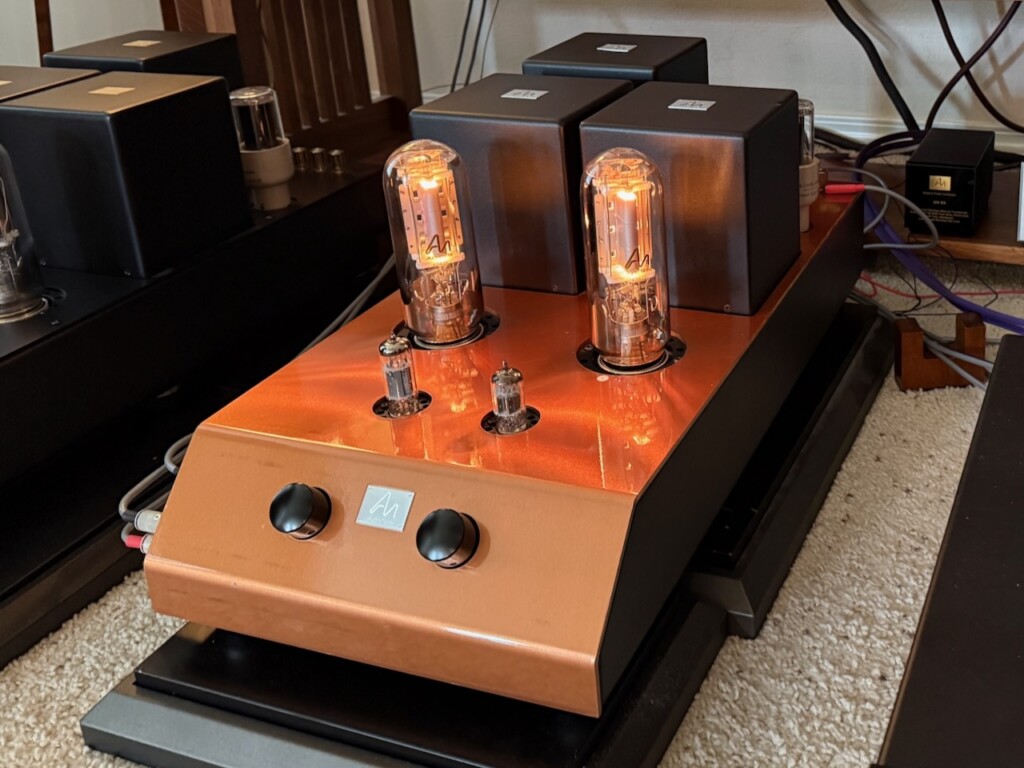
Above: Audio Note (UK) "Level Five" Ongaku 211 SET integrated amplifier.
Long-time readers know I have a special fondness for integrated amplifiers, as I believe they provide music and audio enthusiasts with the greatest performance bang for the buck, and particularly those integrated amplifiers that utilize single-ended vacuum tube circuits designed to complement contemporary and vintage high-sensitivity loudspeakers, of which I enjoy a modest collection: my Tannoy Westminster Royal SEs, and 3 pairs of vintage Altecs.
As you might imagine, this really has been a fascinating and enlightening journey listening to and writing about Peter’s integrated amplifiers product line that includes parallel single-ended-pentode (the Oto) and single-ended-triode designs (Meishu, Tomei, and Ongaku). They’re right up my alley, and I have learned a lot along the way!
As I have already alluded to, Peter’s integrated amplifiers are arranged in an ascending performance level system, and Peter considers the performance level of the integrated amplifier to be the anchor point to build your audio system around.
After selecting your desired integrated amplifier, as a rule of thumb, to complete your audio system, you would then select associated Audio Note (UK) components that are within the span of one performance level above and two performance levels below your choice of integrated amplifier, to give you the greatest components performance synergy for your money spent.
In this review series of Peter’s integrated amplifiers product line, Peter has demonstrated to me how his performance level system works, and we have “walked up” through the integrated amplifier performance levels Two through Five, while matching each ascending performance level of integrated amplifiers with synergistic matching levels of digital and analog source components.
This has been a very enlightening audio journey for me, and has very clearly demonstrated to me the power of Peter’s approach, going from the superb Level Two of performance with the Oto all the way up to the “Oh my god!” Level Five of performance with the Ongaku.
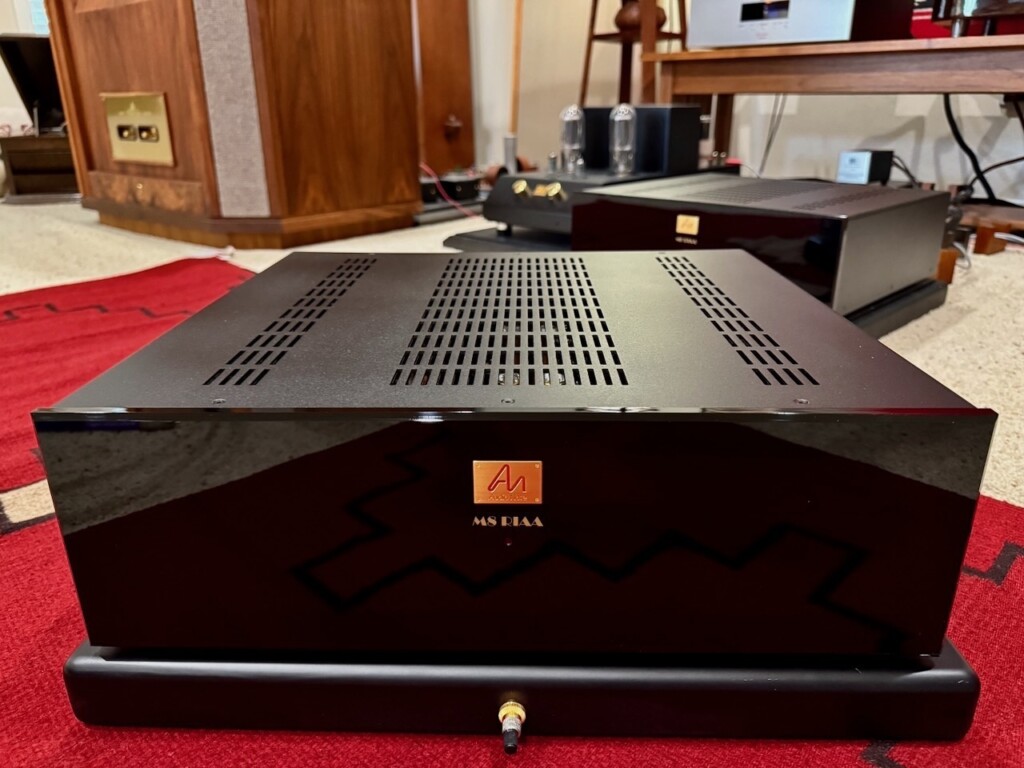
Above: Audio Note (UK) "Level Five" M8 RIAA phono preamplifier.
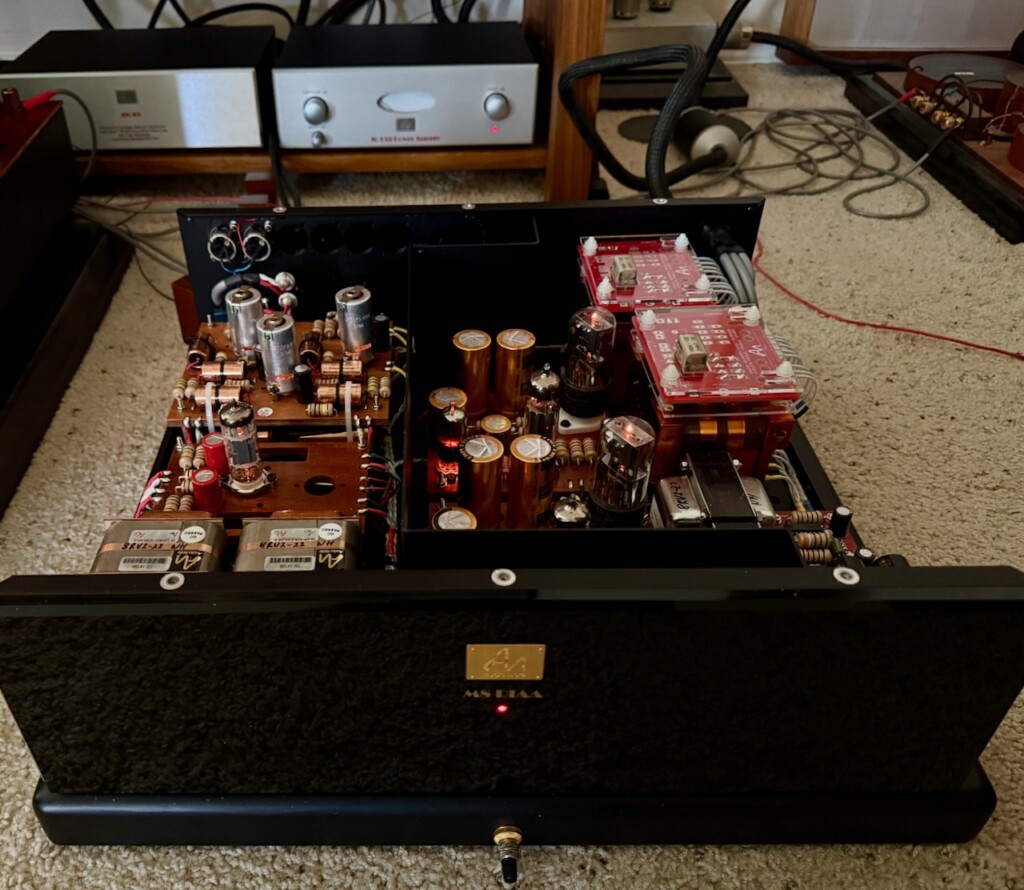
Above: Topless view the Audio Note (UK) M8 RIAA phono preamplifier.
To demonstrate the performance of the Level Five Ongaku, Peter has paired it with the Level Five M8 RIAA phono preamplifier (review HERE) in combination with the exotic top-of-the-line Io Ltd. field-coil moving-coil phonograph cartridge, and the equally exotic, top-of-the-line AN-S9 step-up transformer (reviews to come), as an analog source.
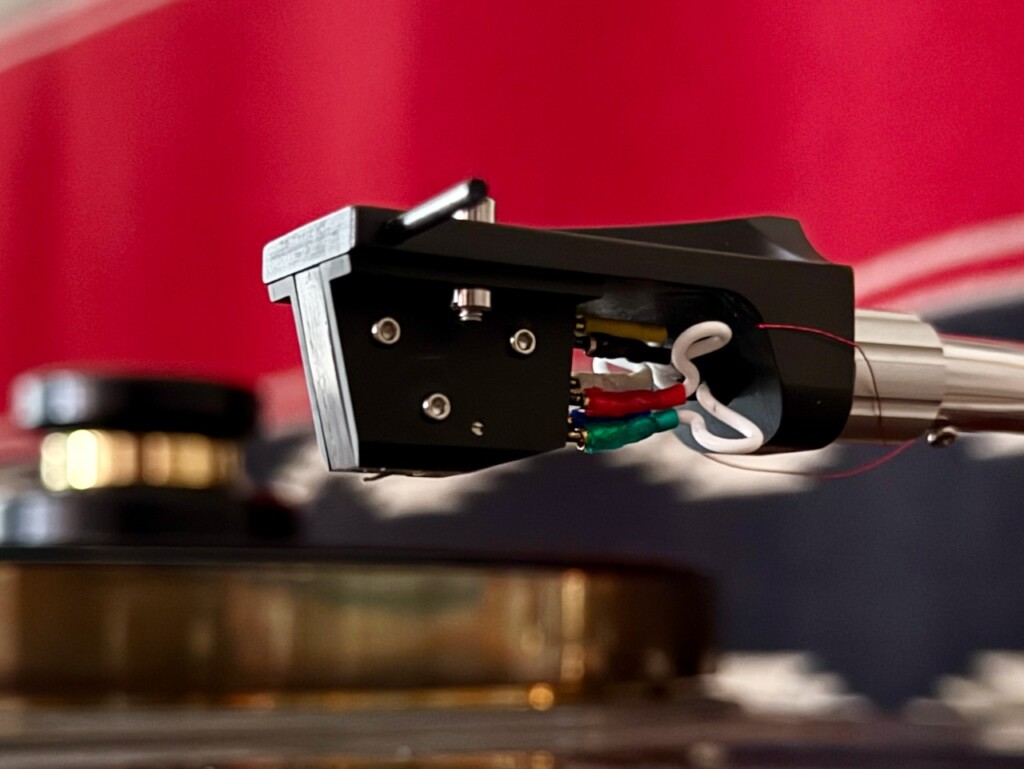
Above: The top-of-the-line Audio Note (UK) Io Ltd. field-coil moving-coil phonograph cartridge. Note the fine red field-coil leads exiting towards the rear of the cartridge.
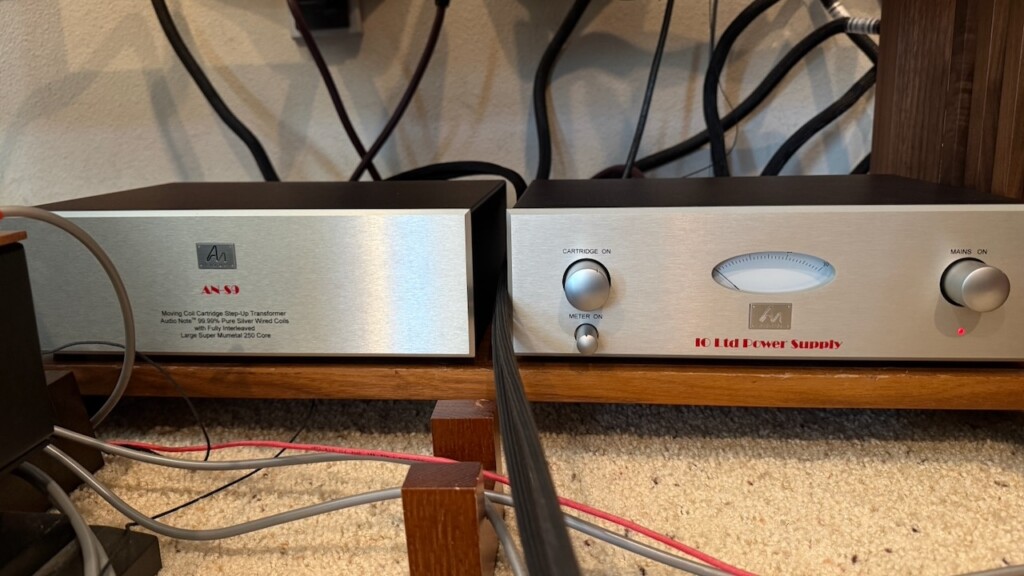
Above: The top-of-the-line Audio Note (UK) AN-S9 step-up transformer (left) and power supply for the Audio Note (UK) Io Ltd. field-coil moving-coil phonograph cartridge (right).
For an integrated digital source, Peter paired the Ongaku with the Level Three CD 5.1x Red Book CD player (review HERE).
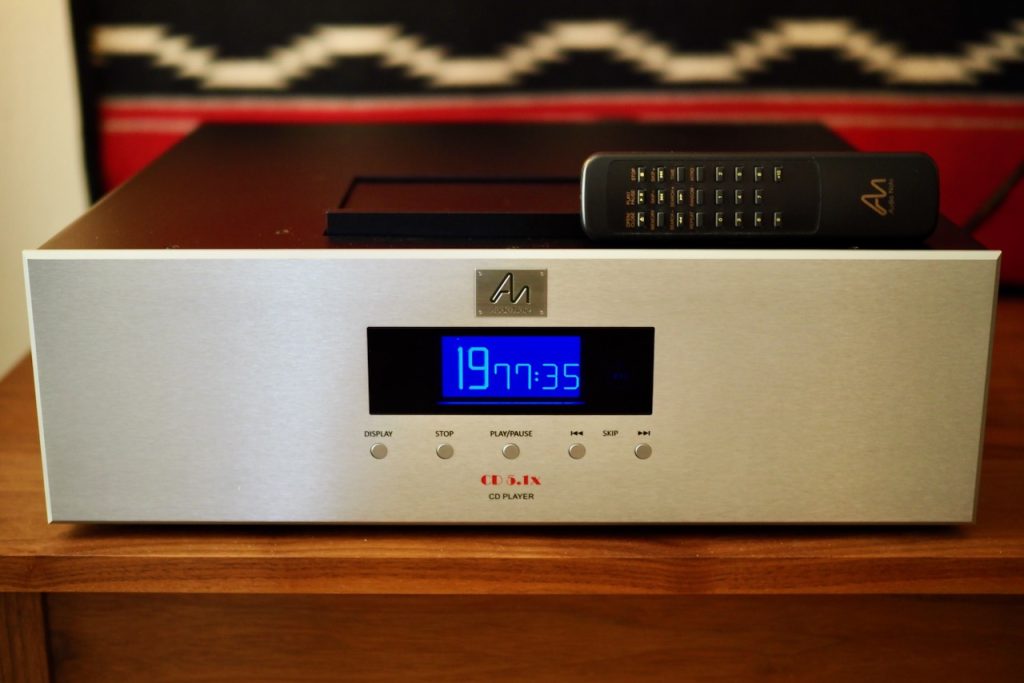
Above: Audio Note (UK) "Level Three" CD 5.1x Red Book CD player.
All the components were connected together with AN-V silver interconnects and AN-SPe silver loudspeaker cables.
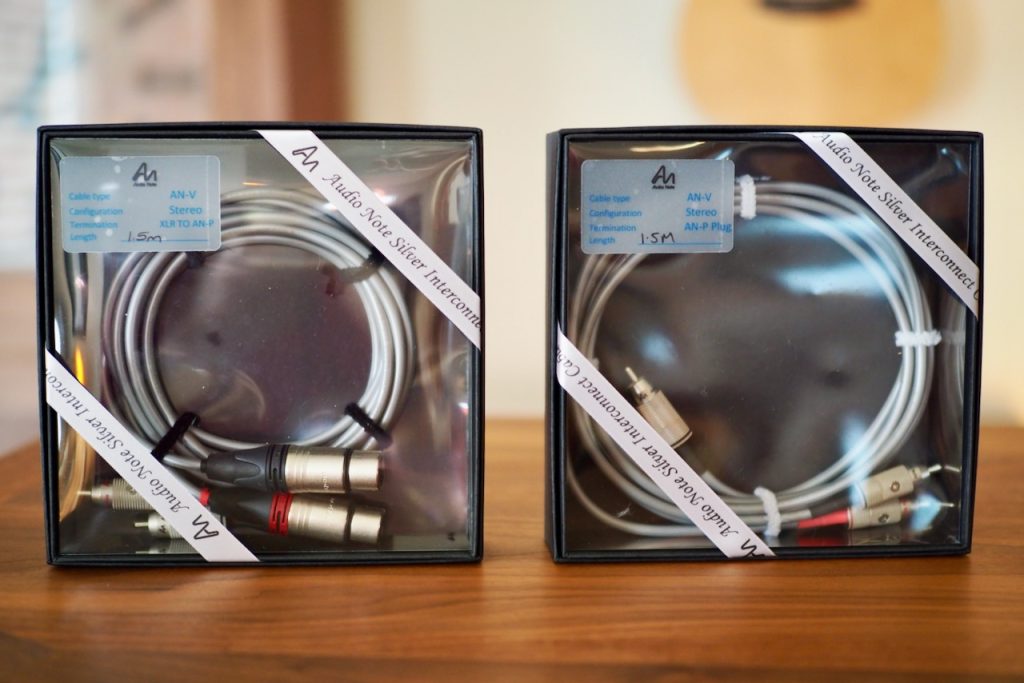
Above: Audio Note (UK) AN-V silver interconnects.
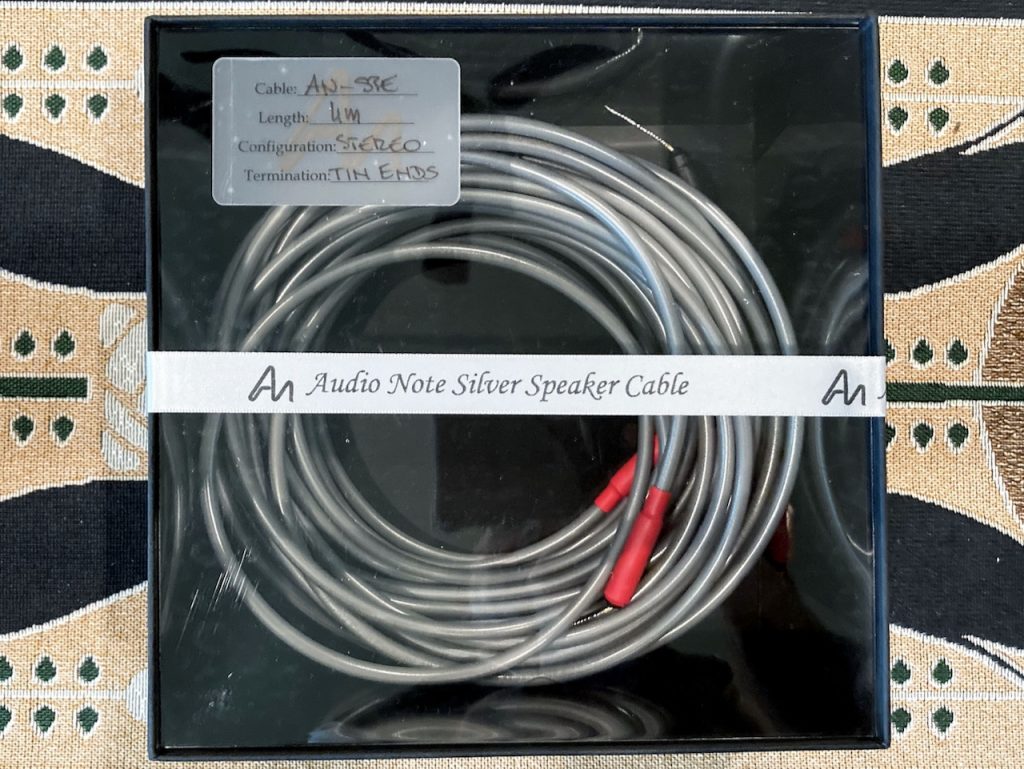
Above: Audio Note (UK) AN-SPe silver speaker cables.
For loudspeakers I used my usual Tannoy Westminster Royal SE loudspeakers, which are hot-rodded with Duelund CAST crossovers, with silver components in the high-frequency circuits, and copper components in the low-frequency circuits.
The positioning of my Westminster loudspeakers is in a typical audiophile arrangement, with a modified rule of thirds/fifths sort of positioning.
The front of my West's are 77 inches out from the front wall, sides are 48 inches from the side walls, and the loudspeakers are 112 inches apart, center-to-center.
My listening position is about 12 feet from the Westminsters, and the rear wall is about 12 feet behind my listening 'couch'.
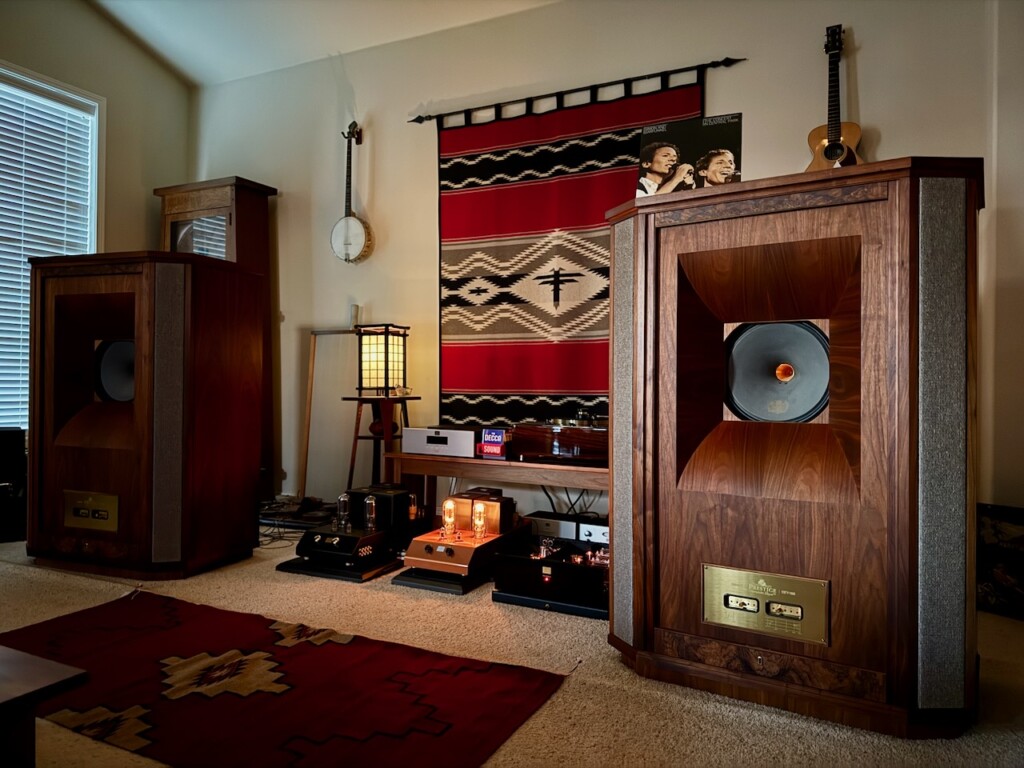
Above: System photo with Tannoy Westminster Royal SE loudspeakers.
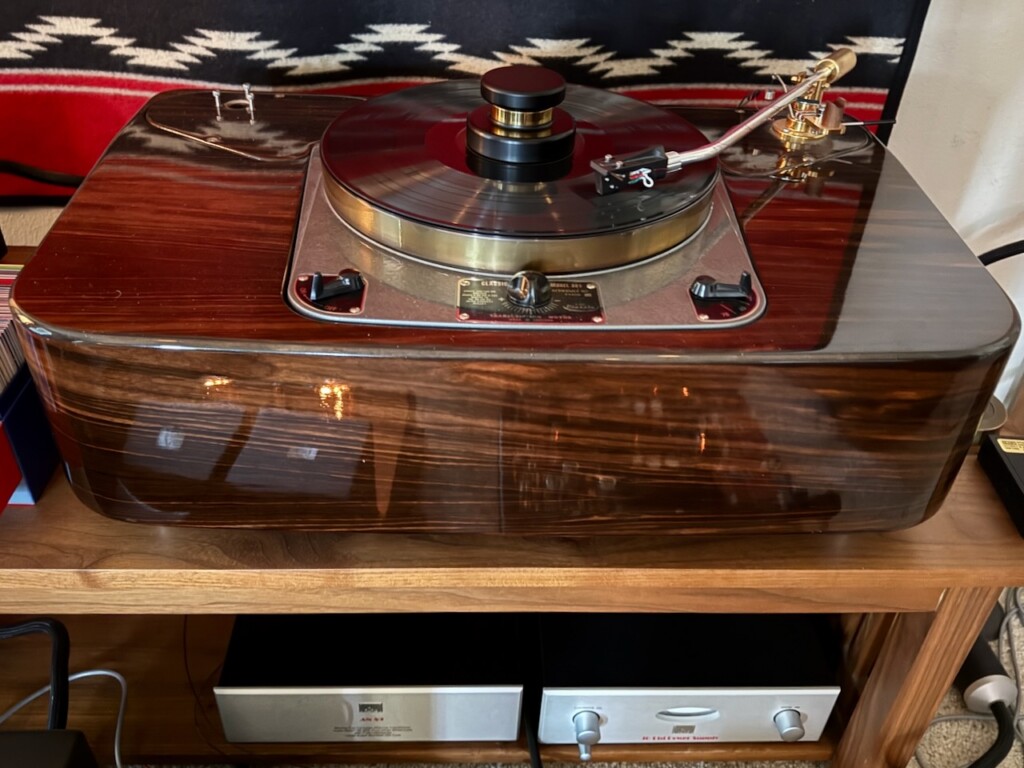
My Classic Turntable Company hot-rodded Garrard 301 turntable in an Artisan Fidelity plinth equipped with a Schick tonearm served as the foundation for the analog front end.
All components were connected by Acoustic Revive Absolute power cables to an Acoustic Revive RPT-6 Absolute NCFpower distributor, which in turn was connected to wall AC via an Absolute power cord, into an outlet composed of an Acoustic Revive CB-1DB receptacle base plate, CFRP-1F carbon fiber outlet plate, and Oyaide R-0 AC outlet.
The Ongaku 211 SET Integrated Amplifier
Now let’s take a closer look at the Ongaku 211 SET integrated amplifier.
So what is the Ongaku’s Level Five performance level all about?
To quote Audio Note (UK):
“Class A single-ended directly heated no feedback triode amplifiers, with only the very best parts and materials available, fully silver wired high content nickel iron C-core output transformers, Black Gate capacitors throughout where available, silver foil signal capacitors, and both circuit and power supply hard wired with silver wire.”
So, the Ongaku’s Level Five design criteria includes a circuit that is pure Class A operation, with zero negative feedback, a single-ended output stage utilizing 211 valves for 20 watts of output power, rectification via robust 5R4WGB valves, directly heated triode operation, Audio Note (UK) silver wire for all internal wiring, Audio Note (UK) two-watt non-magnetic tantalum resistors, either Black Gate electrolytic or Audio Note (UK) silver foil capacitors, and Audio Note (UK) in-house custom-designed and manufactured driver and output transformers that have fully silver-wired AN-Perma 50 nickel C-cores, and the mains transformer has a copper-wired HiB double C core.
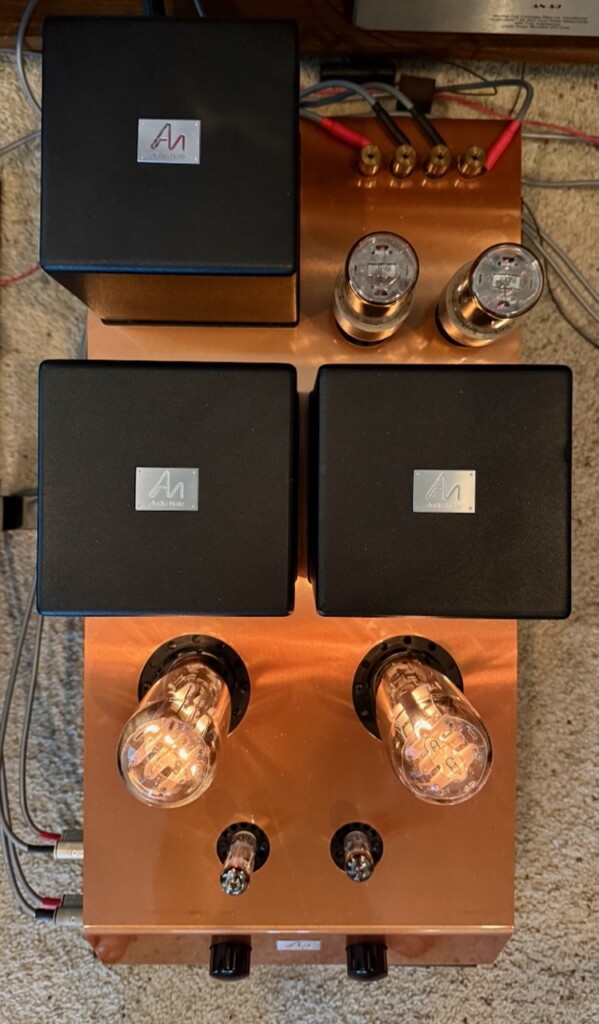
Above: Ongaku top view.
If you look at the top of the Ongaku, starting at the back of the chassis, you can see two new old stock (NOS) Chatham Electronics JAN CAHG 5R4WGA rectifiers to the right of the copper-wired HiB double C core mains transformer. Just in back of the 5R4WGA rectifiers are four Audio Note (UK) silver-plated binding posts.
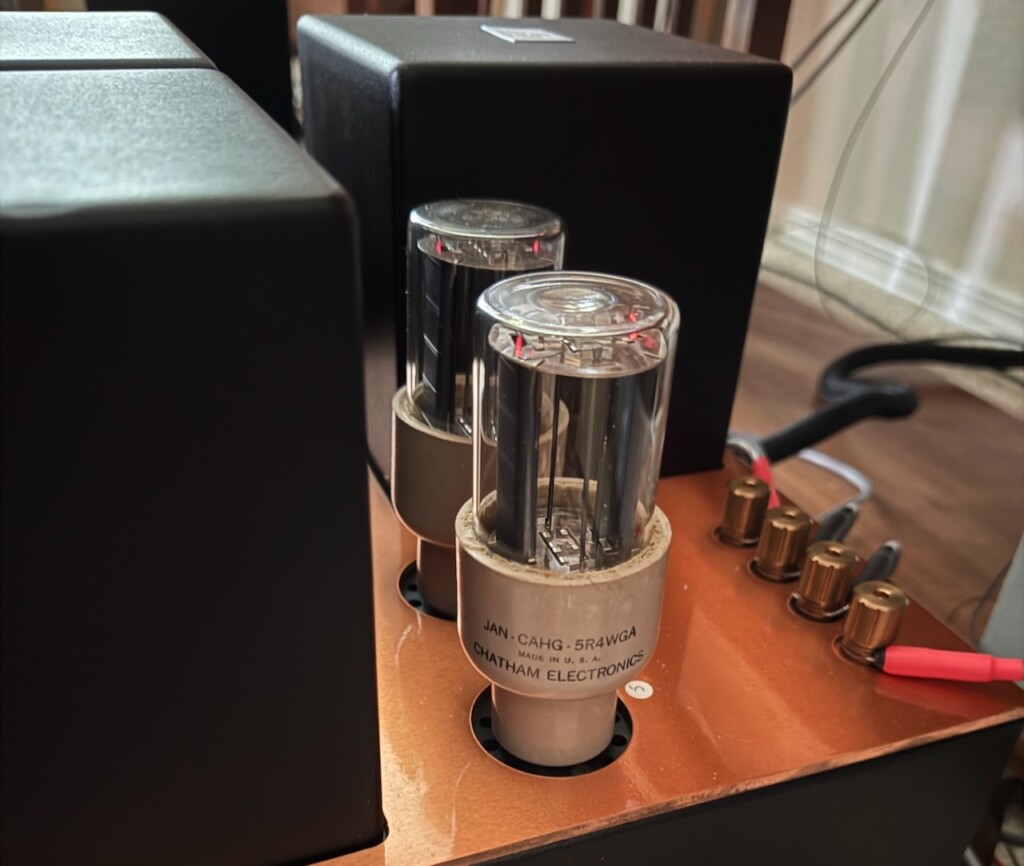
Above: Chatham Electronics JAN CAHG 5R4WGA rectifiers
In the middle of the chassis, you see two Audio Note (UK) 4242E output valves - 211 valves that are custom-made by Psvane for Audio Note (UK) - that are just in front of the fully silver-wired AN-Perma 50 nickel C-core output transformers.
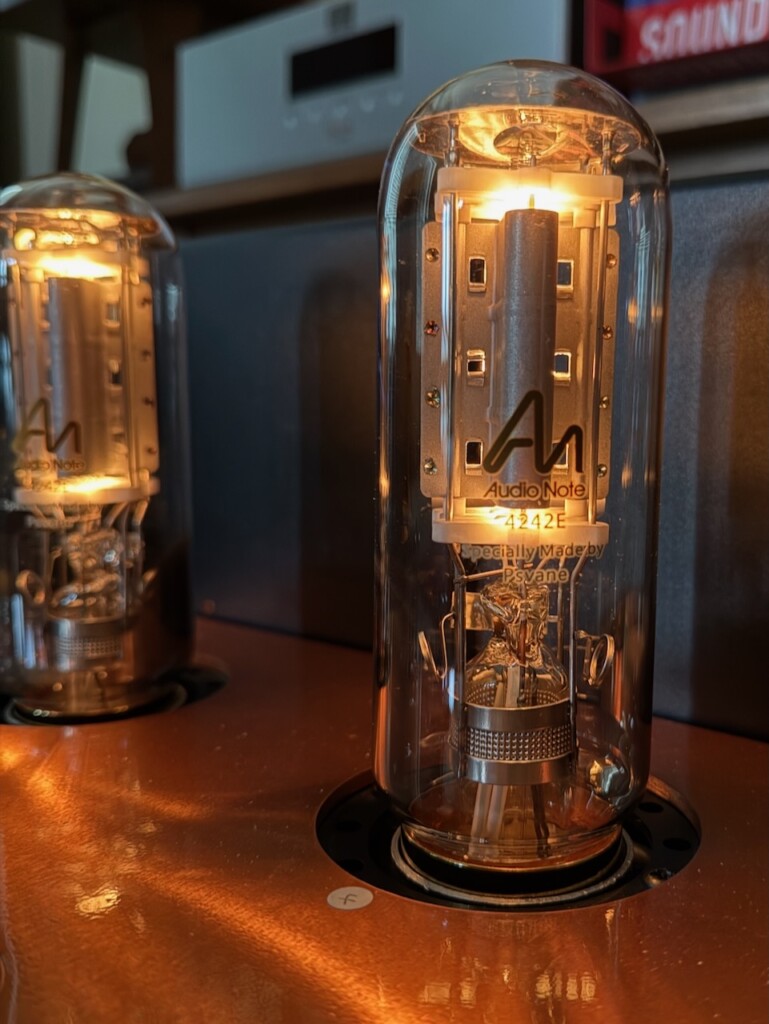
Above: Audio Note (UK) 4242E output valves - 211 valves custom-made by Psvane for Audio Note (UK).
At the front left of the chassis is a NOS 6463 Telefunken driver valve, and on the front right is a NOS 12AU7 Amperex input valve.
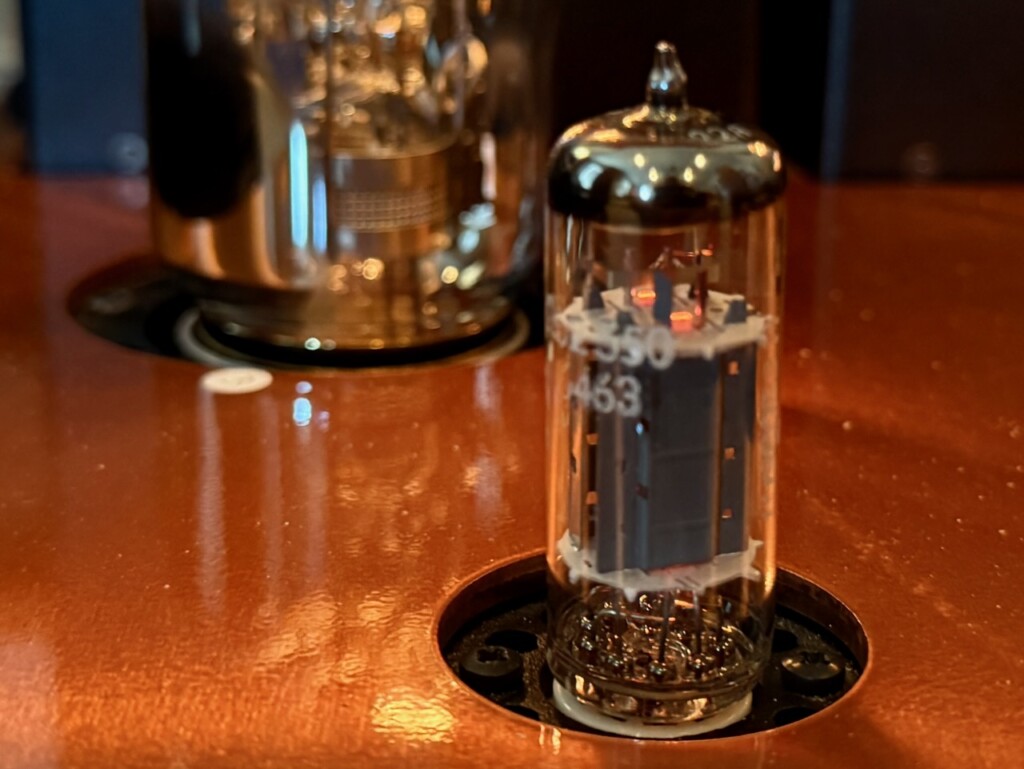
Above: NOS 6463 Telefunken driver valve
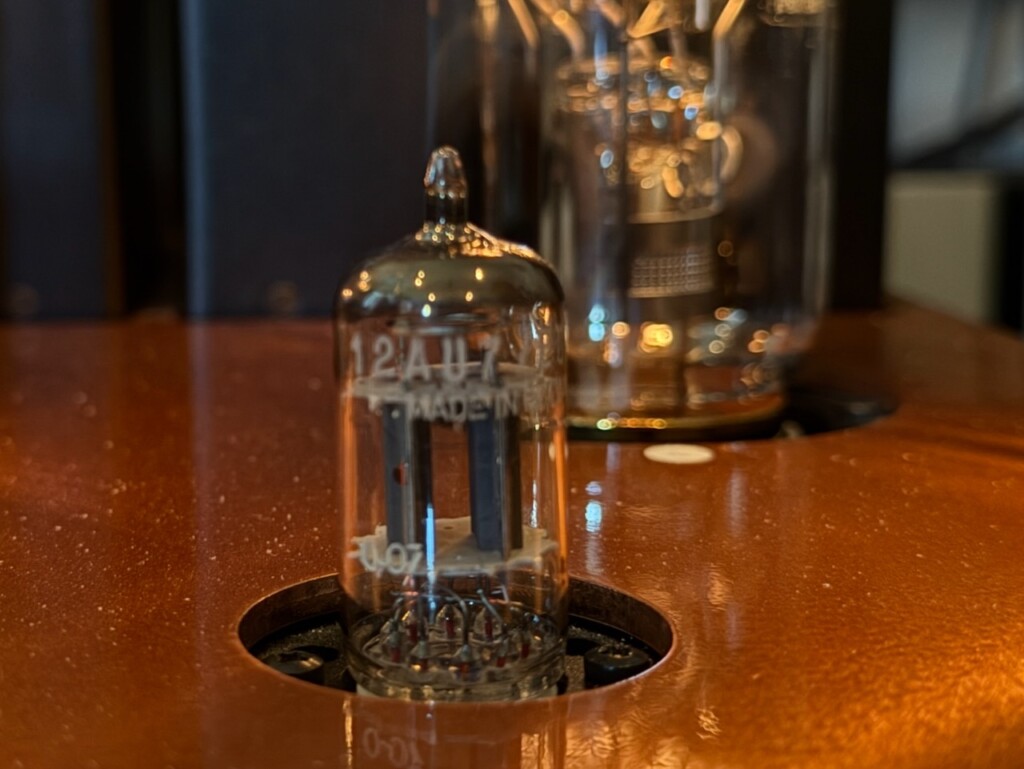
Above: NOS 12AU7 Amperex input valve.
On the front panel, you see the control knob for the TKD source selector switch on the left, and on the right is the control knob for an Elma stepped attenuator volume control that is populated with Audio Note (UK) tantalum resistors.
Now let’s flip the Ongaku over and take a look inside at the components that populate its circuits.
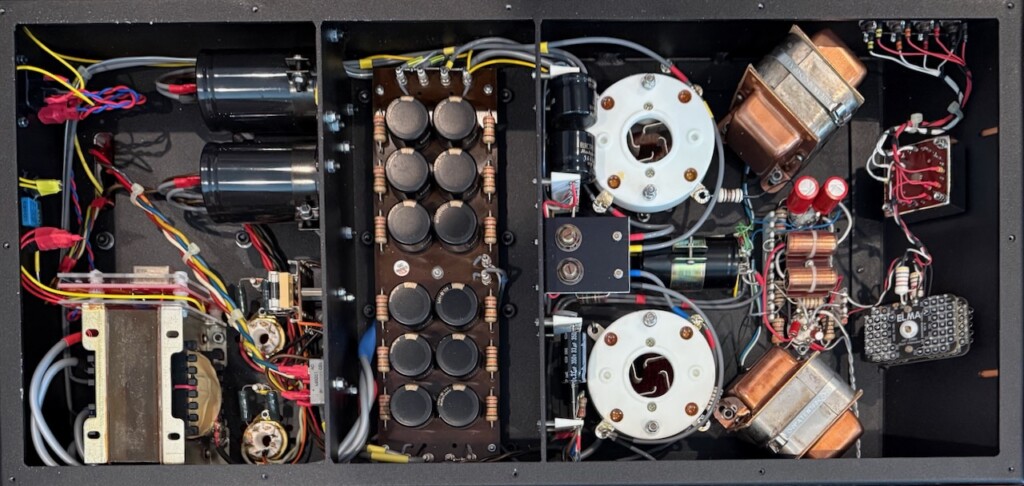
Above: Inside the Ongaku (bottom view).
The Ongaku utilizes Audio Note (UK)’s best-of-the-best custom circuit components, all chosen by ear for high contrast, high level of emotional engagement and sound quality, and the highest level of refinement.
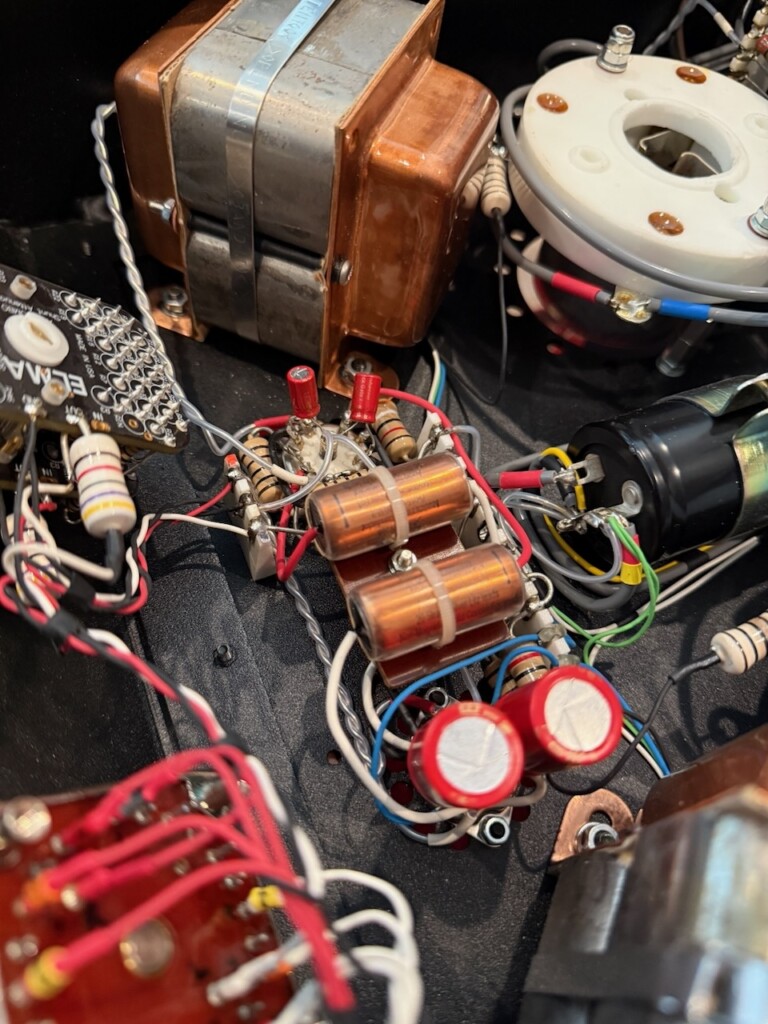
In the photo above notice the Audio Note (UK) silver wire used for internal wiring, the custom Audio Note (UK) in-house manufactured silver-wired AN-Perma 50 nickel C-core driver transformers, the Audio Note (UK) silver foil capacitors, the Audio Note (UK) 2 watt non-magnetic tantalum resistors (used throughout the Ongaku), and the Black Gate electrolytic capacitors.
Hint: Note that Peter’s Audio Note (UK) non-magnetic silver tantalum resistors are referred to as “tone kings,” and deliver improved tone, increased texture, a darker background, and a greater sense of immediacy compared to other fine resistors.
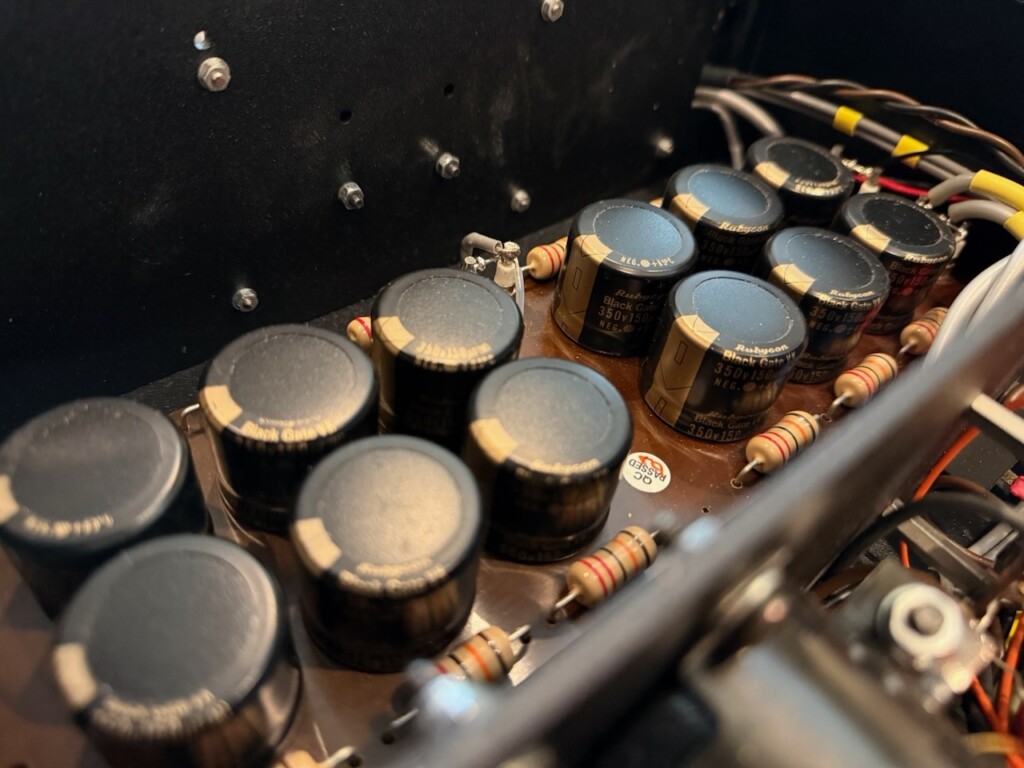
In the photo above, look at all those beautiful Black Gate capacitors in the power supply!
Now sadly out of production, Black Gate electrolytic capacitors were renowned for their performance in audio circles and were based on a theory called 'Transcendent Electron Transfer' and utilized fine graphite particles in their construction.
Black Gate capacitors were highly regarded for their ability to enhance the dynamic range, and to deliver a more authoritative, lively, and emotionally engaging portrayal of the music. Black Gate capacitors also provided a significant increase in overall clarity and detail across the audio spectrum that provided more insight into musical nuance, the timbre of instruments, which made it easier to accurately discern the contributions from individual instruments in more complex orchestral recordings. They were particularly notable for improving definition in the bass range, which gave more clarity and impact to the music throughout the low frequencies. The cherry on top was that Black Gate capacitors provided a smooth, liquid, natural quality to playback to give a more authentic live-like musical realism.
The revered Black Gate improvements to dynamic range, bass definition, clarity and detail, and sonic smoothness were their standout traits, so it should not be a surprise that the Ongaku also shares these traits. More about this in a moment.
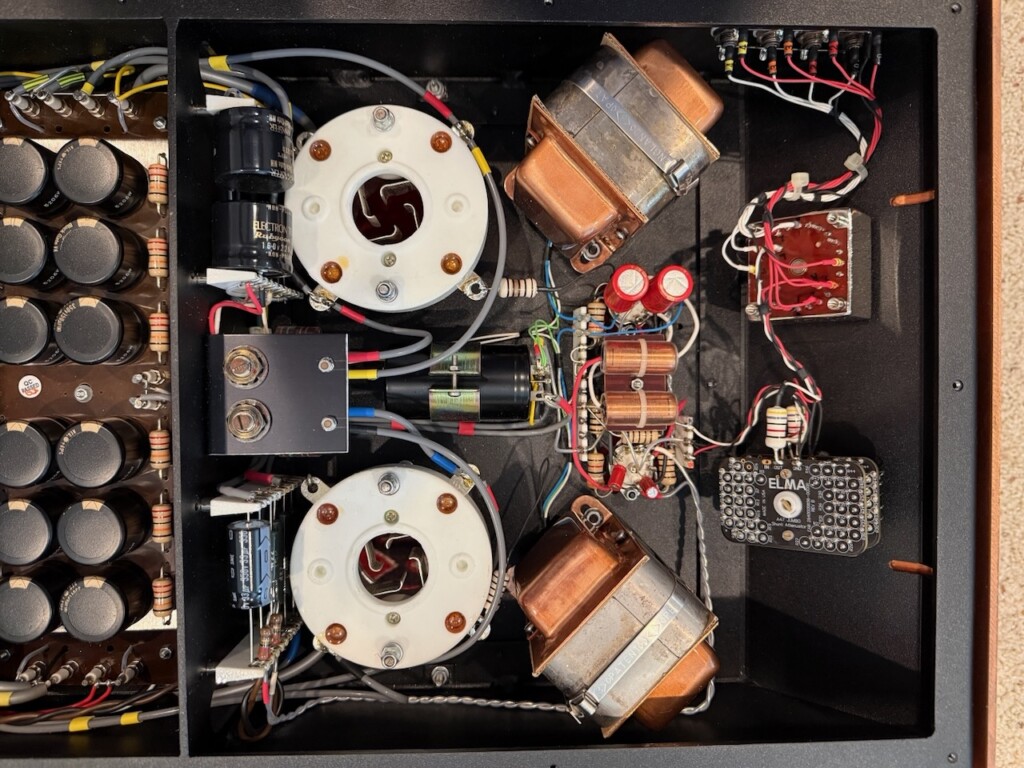
In the photo above, notice that all of the Ongaku’s capacitors are either Black Gate electrolytic capacitors (as in the power supply on the left), or Audio Note (UK) silver foil capacitors (as in the gold-colored capacitors between the driver transformers), depending on what’s best for a particular circuit location. Note the Audio Note (UK) 2 watt non-magnetic tantalum resistors in various circuit locations.
Towards the middle of the photo, are the custom Audio Note (UK) in-house manufactured silver-wired AN-Perma 50 nickel C-core driver transformers, which are just to the right of the Audio Note (UK) 211 valve bases (made from steatite and aluminum).
On the top right of the photo is a four-position TKD source selector switch, and on the bottom right is the Elma stepped attenuator switch that is populated with Audio Note (UK) tantalum resistors for volume control.
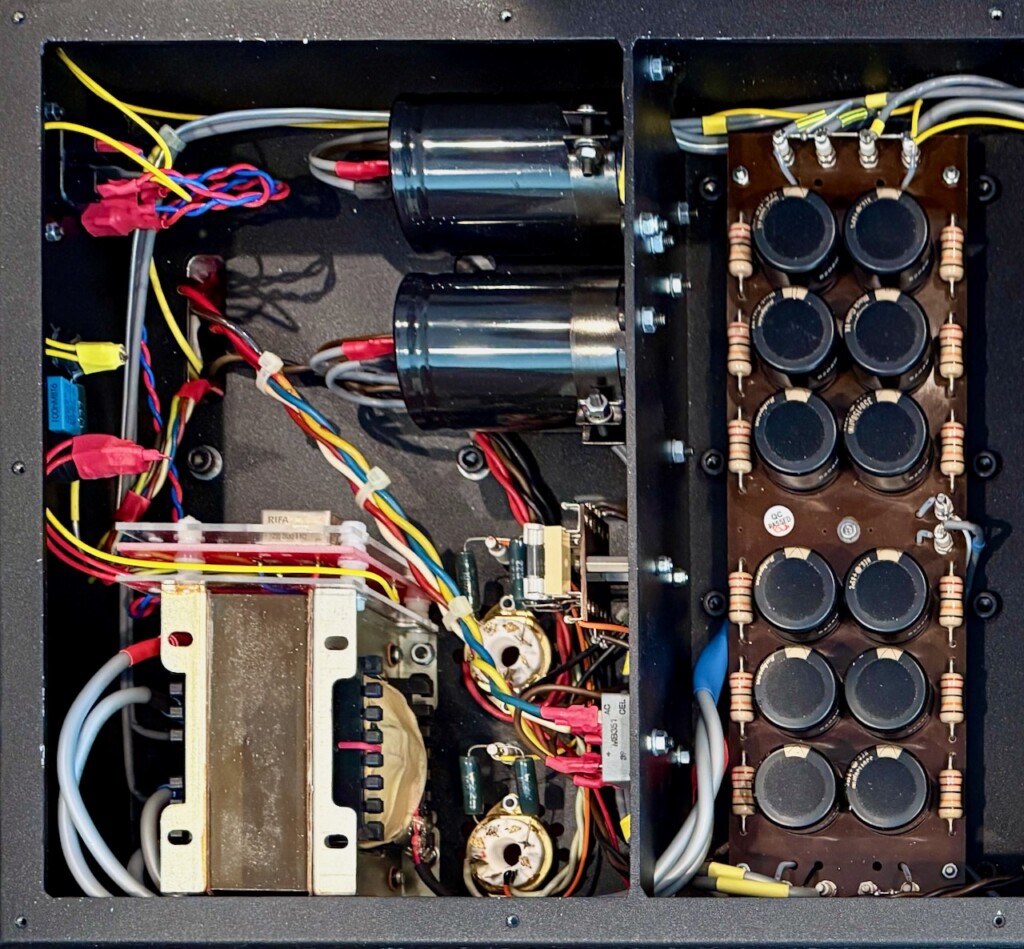
In the above photo, to the right is the aforementioned power supply with two banks of Black Gate capacitors, and at the middle top left of the you see two huge Black Gate capacitors that the Chatham Electronics JAN CAHG 5R4WGA rectifiers feed. Below that you see the valve sockets for the 5R4WGA, with the fully silver-wired HiB double C core mains transformer to its left.
Ok, so that’s my little “walk-through” of the Ongaku. Now let’s move on to my listening impressions.
Listening Impressions
Let me start with some of my general impressions and observations about the Ongaku.
First of all, I found the build quality of the Ongaku to be extraordinary, with the components that populate its circuits being the very best available, and most are custom-made by - or for - Audio Note (UK) out of exotic materials that perform well beyond the normal performance parameters one usually sees in high-performance audio.
When I turn on the Ongaku, I’m always delighted by the brilliant burst of light emitted by those large 211 output tubes. It feels like they’re joyfully illuminating my life as part of the Ongaku experience.
When I first heard the Ongaku in my audio system, I was essentially in a state of shock and awe at its level of performance.
I was so impressed that I didn’t know how to put into words what I was hearing and feeling while listening to music with the Ongaku.
I had to listen, listen, and listen some more, to try and understand what was happening. What I was hearing? What I was feeling? And how do I explain it, articulate it?
I pondered how this level of performance was even possible. In my nearly seven decades here on Planet Earth, I’d never encountered any amplifier doing what I heard the Ongaku doing. How was the Ongaku doing what it does?
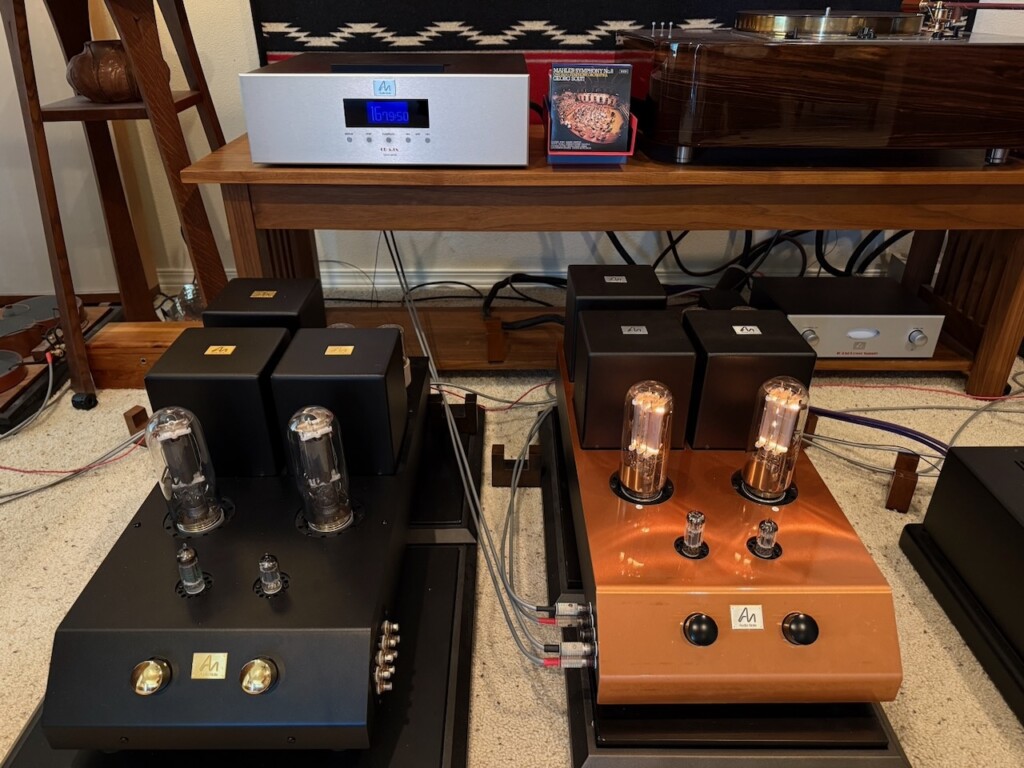
Above: Tomei 211 SET (left) and Ongaku 211 SET (right) integrated amplifiers.
If you read my Positive Feedback article in Issue 133 about the Audio Note (UK) Tomei 211 SET integrated amplifier, you know I was very deeply impressed by its Level Four performance.
The circuits of the Level Four Tomei and Level Five Ongaku are essentially the same design, with both featuring directly heated single-ended-triode circuits, with valve rectification, operating in pure Class A, with zero negative feedback, but what is different is the individual components that populate their circuits.
In a nutshell, both the Tomei and Ongaku populate their circuits with superb components, but where the Tomei uses a mix of copper and silver components in its circuits, the Ongaku goes "next level" by going "all silver."
So, to fully understand what the Ongaku was doing, I had to first look at its basic circuit design, and then look even deeper into the components that populate its circuits, in order to make sense of everything I was hearing and feeling.
In my world of high-sensitivity loudspeakers, directly heated single-ended-triode circuits, with valve rectification, operating in pure Class A, with zero negative feedback, are the highest performing amplifiers I have encountered. That’s the same design elements as the Ongaku, so two thumbs up on the Ongaku’s circuit design.
The only drawback I’ve experienced with SET amplifiers is their relatively low output power, which limits what loudspeakers you can pair them with. Only high-sensitivity loudspeakers need apply.
However, in the case of the Ongaku, it is capable of 20 watts of muscular vacuum tube power, which is enough to rattle my windows with any of my high-sensitivity loudspeakers. In fact, I’ve never even needed to go above about halfway on the volume control to get live-like SPL levels, and most of the time, I’m not even listening to program material that loudly. I suspect one could successfully pair the Ongaku to loudspeakers with even middling sensitivity.
But there’s more: In the Ongaku’s case, its circuit design elements didn’t get me all the way there in understanding its extraordinary level of performance, its remarkable level of refinement and sophistication in music playback.
I needed to drill down deeper - to the level of the Ongaku’s circuit components - to get a clearer understanding of how it achieves its level of performance.
Certainly, Peter’s focus on the use of circuit components that allow as much information from the audio signal to come through as possible, his high-contrast voicing approach, and his emphasis on accuracy, authenticity, authority, refinement, and emotional engagement in music playback, are paramount to the Ongaku's design.
My experience is that you can’t get close to the level of performance the Ongaku is capable of with the sort of typical high-quality audio components one usually sees populating an amplifier’s circuit, and I do mean high-quality. The “good stuff.” The components in the Ongaku go well beyond the performance that the “good stuff” is capable of.
I believe the key to understanding the performance level of the Ongaku is Peter’s - literally - next-level approach of manufacturing custom, ultra-quality, ultra-performing components, often utilizing exotic materials, that are specifically made to enhance each particular application in a circuit in sonically and musically meaningful ways: More clarity. More transparency. More contrast. More natural tone. More dynamic responsiveness across the audio spectrum. More … of everything.
The Ongaku’s materials and components can be summarized as follows: the choice of the best available new-old-stock (NOS), or new stock, vacuum tubes in the circuit for each particular application. The custom-made silver wire used in the circuits and transformers that lets more musical information through. The custom-made silver foil signal capacitors that do the same. The custom-made silver-wired transformers with cores made from exotic materials that provide more low-level details, color, and texture from the music signal. The Black Gate electrolytic capacitors used in strategic locations that enhance dynamic range, bass definition, clarity and detail, and sonic smoothness. The use of “tone king” non-magnetic silver tantalum resistors that deliver improved tone, increased texture, a darker background, and a greater sense of immediacy.
All of those high-performance attributes of Peter’s custom-made circuit components, plus his high-contrast approach to voicing, add up to the extraordinary performance level I’m hearing and feeling from the Ongaku, and it is stunning indeed.
Ok, well that’s my general introduction to the Level Five Ongaku. It’s bloody amazing to listen to music with. Now lets’s go through some listening examples related to key points of the Ongaku’s performance.
Let’s start with Peter’s comparison by contrast approach to voicing equipment, and how that high-contrast voicing style of the Ongaku affects what you’re hearing from your music collection.
First, think about the millions of recordings of musical performances that have been created by the recording arts since the invention of the phonograph in 1877.
Each era of recording—the acoustic (1877–1925), electrical (1925–1945), magnetic (1945–1975), and digital (1975–present) eras—all have their relative strengths and weaknesses in fidelity.
Personally, I look at the recordings from each era of the recording arts as distinct chapters in the evolution of the artistic expression of recorded music. Each album I love I consider to be a treasure that is a musical equivalent of a great work of art by Leonardo da Vinci, Michelangelo, Vincent van Gogh, or Pablo Picasso.
All of those millions of recordings are different, and none of them perfectly captured the sound quality and emotional drama of a musical performance in every way, although some came closer than others.
Each of those recordings was trying, as best as they could, to present the musicians and recording engineers’ vision for the musical performance to you, the listener, as a satisfying listening experience.
So the goal of a HiFi component or system is to accurately deliver the musical vision for any piece of recorded music to you, the listener. Or in Peter’s words, “The more accurate system is the one which reproduces more differences - more contrast between the various program sources.”
What that means to me as a listener is that I am hearing a lot more of the unique differences between the albums I listen to. As Peter has said, “… realizing differences between recordings is very likely more accurate; and in respect to all the other variables from recording to recording, may turn out to be more revealing of the performance.”
Essentially, what the high-contrast voicing approach does is make it possible for the listener to get a deeper glimpse into how recordings were created, their differences in fidelity, and to me, most importantly, to hear more of what was intended by the musicians and the recording arts for any given recorded performance, by delivering the highest degree of dramatic musical engagement from the recordings, and in the highest fidelity possible for any given recording.
Let me give you a couple of album examples.
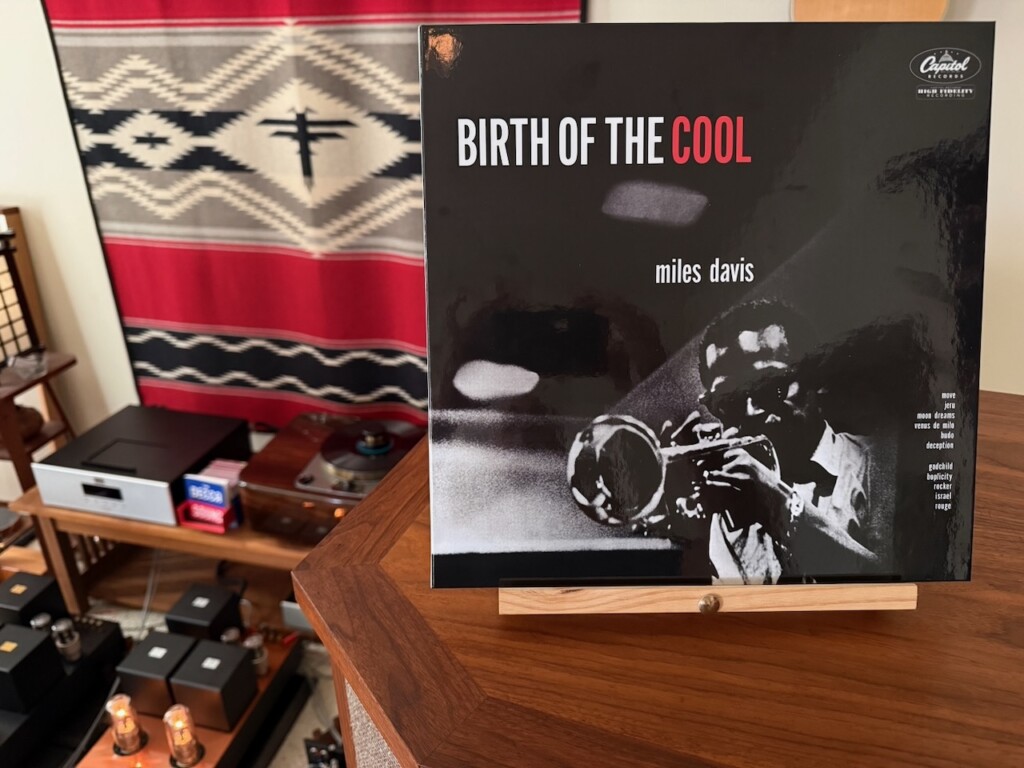
I’ll start with the electric era of recording, with Miles Davis’s Birth of the Cool album. What would come to be known as Birth of the Cool was originally sourced from direct-to-disc 78 recordings made from 1949 to 1950, then issued as 78 records to music enthusiasts.
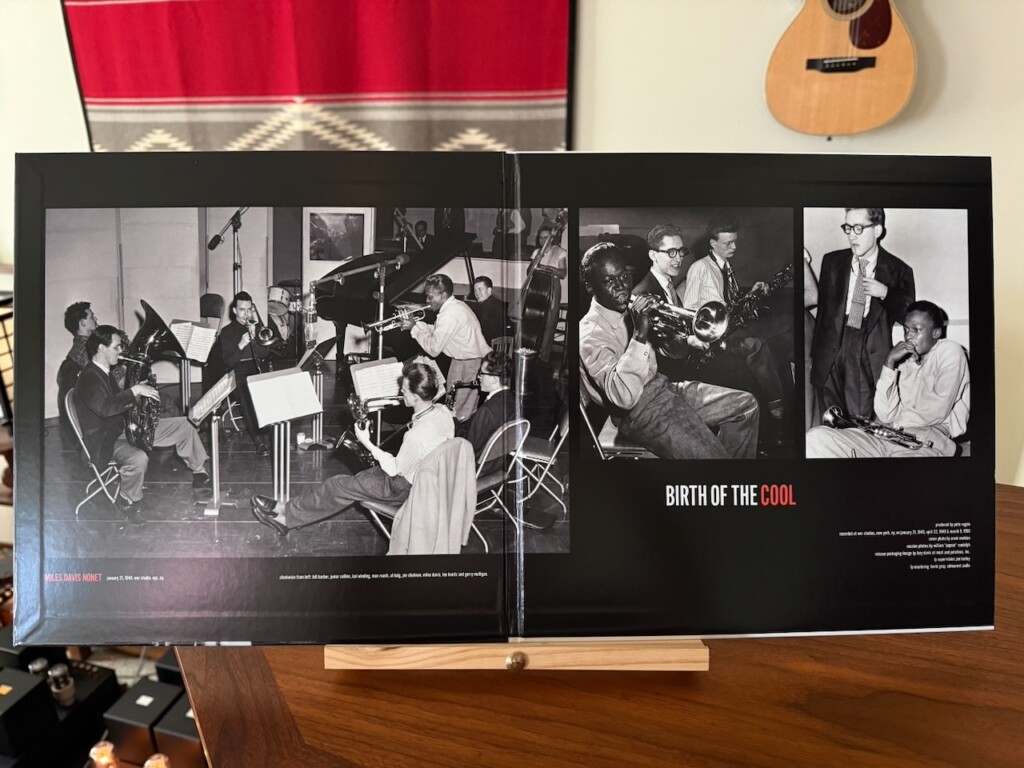
These were important releases in the history of jazz, as well as being great musical performances, and later these were compiled and transferred to tape for the Capitol Records release on LP in 1957 as Birth of the Cool.

I have the Tone Poet reissue of Birth of the Cool, which I think is probably about as good as you can get for these particular historic recordings on LP.
There’s more history about Birth of the Cool at the Jazz Research LINK for those who are interested.
So what does the Ongaku’s high-contrast voicing do when listening to these recordings sourced from the electric era 78s?
What I noticed first wasn’t the sound quality, but rather the feel, the dramatic engagement, the dynamic vibrancy of the music being played through the Ongaku. It's next level.
The music felt thrilling and exciting, and oh by the way, yes, the sound quality was impressive for these vintage recordings. These are, of course, monaural recordings during this time period, and the width of the recorded span of the audio spectrum wasn’t up to today’s standards, but what is there is brilliant.
Timbral textures were well resolved, the tone was realistic and gorgeous, and there was a dynamic realism across the frequency range that I found thrilling to hear.
The Ongaku renders the soundstage of these recordings as wide as you’d hear in many stereo recordings from the magnetic era, and the imaging was superb, with a lot of musical details emerging from the darkness in the depths of the soundstage.
If you look at the left photo inside the album cover, you can see most of the musicians circled around the main microphone. If you look back into the upper right of the photo, you can see the control room where the recording engineers were located. I really got a sense of this recording arrangement while listening. I could hear the way the horn players surrounded the main microphone, I could hear the piano, drums, and bass emerge from the background as backing instruments, or from the foreground when they soloed.
The bottom line was that the Ongaku rendered the recordings on Birth of the Cool as the 78 direct-to-disc era masterworks they are, full of feeling, excitement, beauty, and remarkably good sound quality for their era. I felt edified and enlightened by the Ongaku’s delivery of the music from Birth of the Cool.
One thing that occurred to me while listening to Birth of the Cool was that I wished Blue Note - or somebody - would issue a special commemorative 78rpm LP box set of this album that I could listen to on my Garrard, as the Ongaku hints that there is much more to get out of these recordings than the 33 1/3 rpm format offers. I can hear it hiding in there, waiting to be revealed in all its direct-to-disc glory.
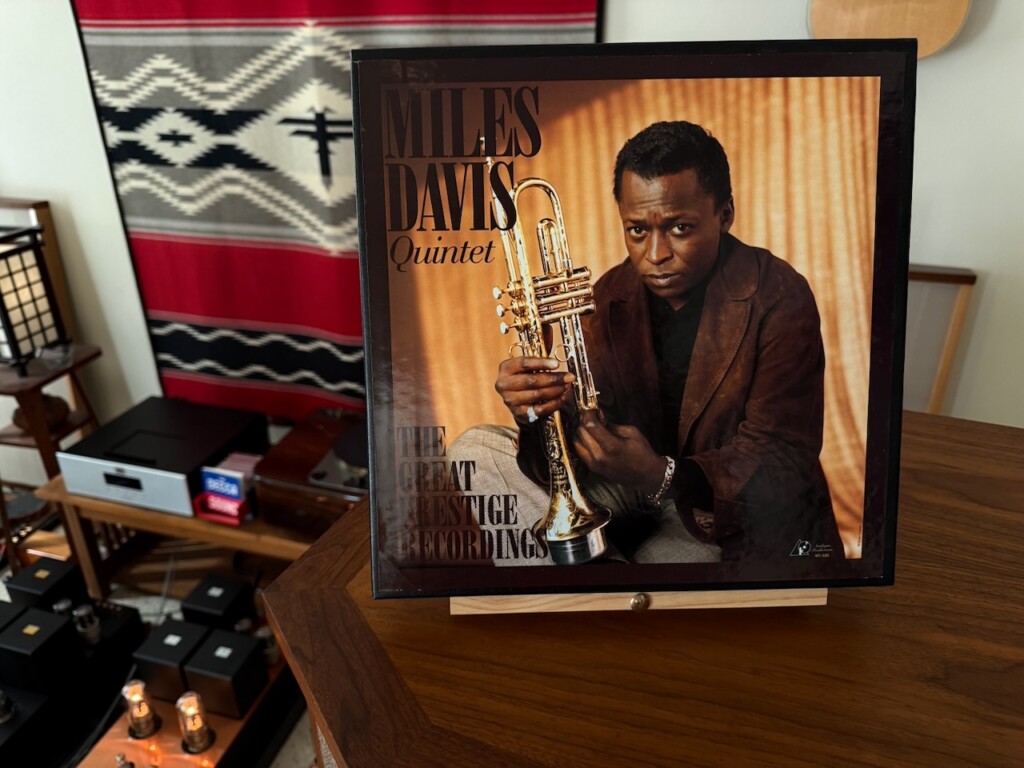
Let’s continue exploring the evolution of Miles Davis’s music and the recording arts, with Chad Kassem’s excellent 45rpm box set of the Miles Davis Quintet - The Great Prestige Recordings, that includes the albums The New Miles Davis Quintet, Cookin', Relaxin', Workin', and Steamin’.
These are some of my favorite Miles Davis albums, and they were recorded from 1955 to 1956. During this period, the recording arts had moved on from electric era recording methods to higher fidelity magnetic era recordings, and while stereo recordings were beginning to occur in the later 1950s, all of these Prestige recordings were monaural recordings done at Rudy Van Gelder's studio, so they have that magic Van Gelder touch upon the controls.
Rudy was secretive about his recording process, but the results were quite good, and the improvement in sound quality over the six- to seven-year period from Capital’s Birth of the Cool recordings to Rudy’s Prestige recordings was revealed by the Ongaku to be rather remarkable.
When Chad reissued this meticulously produced box set of these Prestige magnetic recordings, he offered them at 45 rpm, which also gave them a boost in sound quality over the 33s.
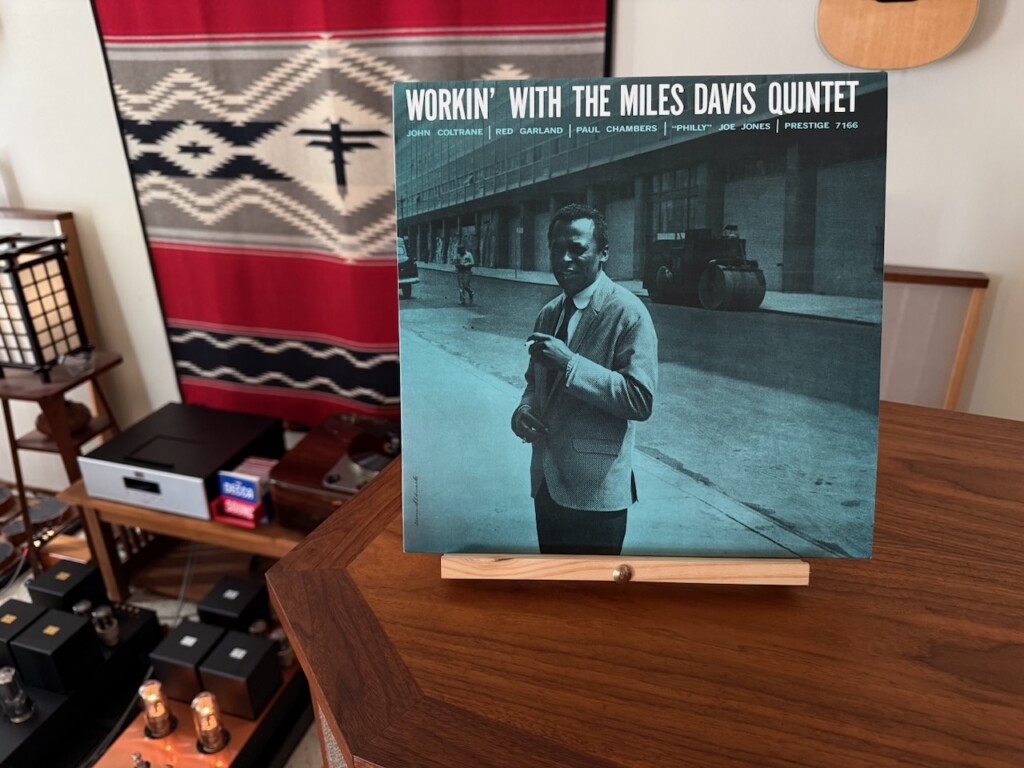
When playing Workin’, these monaural recordings were absolutely brilliant through the Ongaku, with beautifully rendered tonal colors and timbral textures. Oodles of musically important nuances were resolved, the music flowed and swelled with realistic forward momentum and dynamic drama, all of which gave me a strong sense of the feel that the Miles Davis Quintet was trying to convey through their music.
With this move to the magnetic era of recording, I noticed a big increase in the sense of the acoustic space captured in Rudy’s recording studio compared to that of the Capital 78 era recordings on Birth of the Cool.
Interestingly, the soundstage of the Prestige monaural magnetic recordings wasn’t as wide as was captured in the Capital 78 era recordings, but the images were more realistic, more live-like in their vivid flesh-and-blood presence in my living room. There’s more information recovered by the Ongaku on these Prestige recordings than with Birth of the Cool, and the sense of swing, the sense of dynamic realism, was extraordinary.
The Ongaku gets right to the core of the musical message, delivering the music with an intense feeling of emotional engagement, and the sound quality was the best I’d ever heard from these recordings. Utterly natural, realistic, nuanced, and eerily present as I listened in my living room.
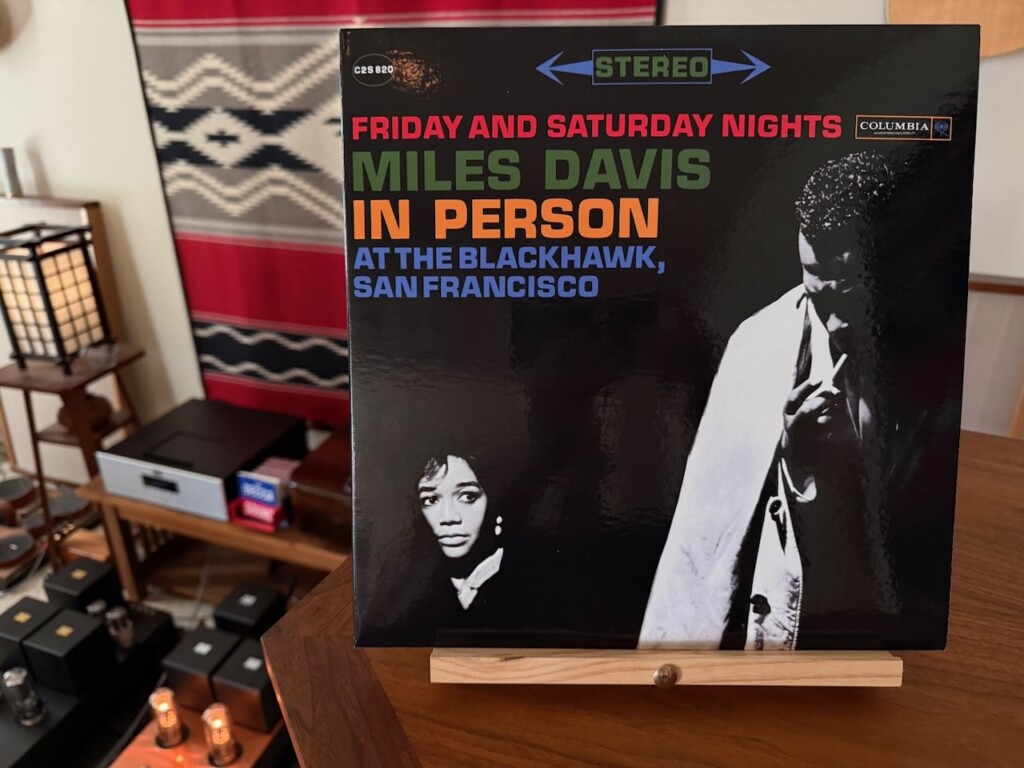
Now one last Miles Davis example, moving five years forward from the time of the monaural Prestige recordings, to the stereo magnetic era of recording, with Miles Davis In Person Friday And Saturday Nights At The Blackhawk, San Francisco (C2S 820).
Originally recorded in both monaural and stereo, my album version is the Impex Records stereo reissue (IMP6009) that was recorded live by Columbia records in 1961.
The Ongaku always locks onto the central emotional vibe of the music, delivering it to me as the listener with all of the flamboyance in style and live action that occurred at this club recording of Friday And Saturday Nights At The Blackhawk with an appreciative audience.
Obvious on first listen through the Ongaku was the huge increase in soundstage width, with aural images of instruments arrayed across the wide stage. While the sound quality was good, the Ongaku revealed that the clarity of the stereo recordings weren’t quite up to Rudy’s monaural recordings standard for Prestige, with lower resolution and less nuance in evidence. Oh, but the music, it’s so real, so dramatic, so mesmerizing, and I could feel its jazz spontaneity bloom as the music flowed in these live club recordings.
So that’s an introduction to what the high-contrast voicing of the Ongaku delivered to me as a listener, where it showed me all the differences of the recording styles and their differing fidelity, but most importantly, regardless of the fidelity of the recording, it delivered the music in an extraordinarily engaging fashion, bringing the musicians’ artistry to life with beautiful tonality, remarkable resolution, and an impressive dynamism that brought the music to full dramatic life in my living room.
My experience with the Ongaku has been that I can listen to nearly any recording from any period of the recording arts, of any fidelity, and I would get totally carried away in reverie at the Ongaku’s artful reproduction of the recorded music.
Some of the greatest musical performances in the history of the recording arts were not the recordings of the highest fidelity, but when I listen to them with the Ongaku in the system, it seems like they were, and they’re delivered with an authority that makes me feel like I’ve heard the best possible version of these albums. A true gift to the music lover.
That’s the power of Peter’s comparison by contrast voicing of the Ongaku, which gives it a high-contrast musical presentation that not only reveals all kinds of subtleties in the music and the recordings in superb high-fidelity, but unfailingly maximizes the dramatic content of the musical performances.
Clarity. When us audio nuts talk about clarity, at times we’re mistakingly referring to subtle boosts in the presence and brilliance regions of the audio spectrum - which gives us a feeling of more clarity, sparkle, and air during playback - as clarity.
But there’s real clarity, and there is fake clarity. Boosting in the presence and brilliance regions is fake clarity, as there really isn’t more clarity; it just seems like there is because of boosting the volume of the information present in those regions.
Real clarity is when one can hear deeper into the recording, hear more recorded information recovered over the span of the entire audio spectrum, all through the sub-bass, bass, low midrange, midrange, upper midrange, presence, and brilliance regions.
Real clarity is a result of more information coming through to the listener across the entire audio spectrum, and that is what the Ongaku accomplishes through its use of silver and other exotic materials in its circuit components that transmit more information from the source recording. Also, the improved signal-to-noise ratio those circuit components provide allows more nuances to appear that would otherwise be masked by the noise floor.
With the Ongaku I heard more clarity, greater recovery of musical information, and more nuance that’s usually hidden beneath the noise floor. That combined the high-contrast voicing allowed me to hear deeply into the source material, all the uniqueness of each recording, and yet the Ongaku never ever sounded analytical or forward due to its musically "flesh and blood" natural presentation.
I found it particularly intriguing that with lower-fidelity recordings, the Ongaku’s additional clarity and greater information recovery—which one might think would make a bad recording sound worse—actually filled in much of the missing information that made the recording sound worse in the first place, and as a result, lower-fidelity recordings sounded more complete, more natural, and more musically satisfying.
Given that there’s a lot more average recordings than superb recordings in our recorded music canon, I found those traits of the Ongaku to be particularly endearing. Everything sounds better, the great recordings as well as the clunkers!
In a studio where there is low background noise, close miking is employed to get a clean and detailed representation of singers and instruments, and if the recording chain is first-rate all the way through, you can get spectacular recording results.
But then there’s the live performances before audiences, where the background noise is much higher, the miking is perhaps less optimized, and the recording chain is a little more challenging to manage.
It's not unusual for us HiFi nuts to bitch about the fidelity of live recordings not being up to the lofty standards of studio recordings, but if you guessed the Ongaku was particularly adept at making live performances sound great, and well ... live, you’d be exactly right.
For me, what makes live recordings so amazing, is that when musicians are playing for a live audience they are more invested in the performance, making it more emotionally compelling for the audience, and there's a certain magic intensity that develops that only a few studio recordings can match.
The Ongaku has a preternatural ability to lock onto the physical energy of live performances, to deliver that higher level of emotional intensity, and to make me feel like I've experienced something of a miracle, with the emotional energy of the musicians spilling out of my loudspeakers, over and into me, to the very depths of my being.
There's lots of great recorded live performances, and three of my favorites from the genre of rock & roll are Neil Young's Live At The Cellar Door (1970), Paul McCartney's Unplugged - The Official Bootleg (1991), and Simon and Garfunkel's The Concert In Central Park (1981).
They all share great musical concerts with appreciative audiences, but where they differ are in the size of the venue where they were recorded, and the number of musicians at the helm.
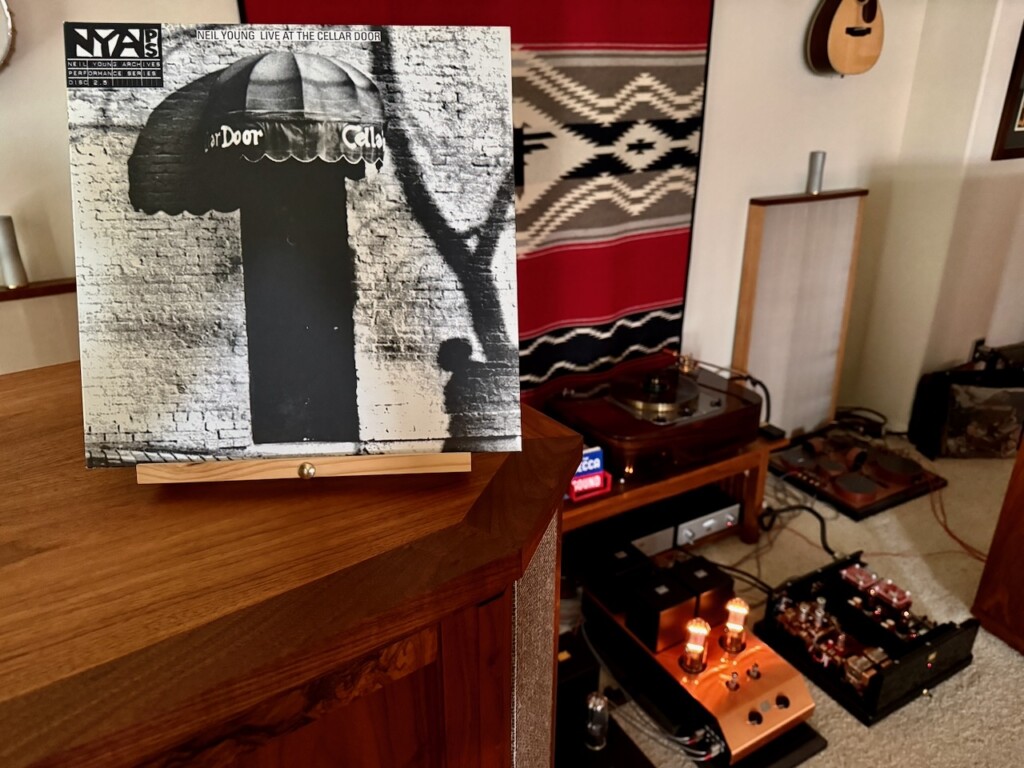
Above: Neil Young's Live At The Cellar Door
The Cellar Door was a 163-seat music club in the Georgetown neighborhood of Washington, D.C., where from November 30 to December 2, 1970 Neil Young was recorded solo, wowing the crowd with his virtuosity in songwriting, on the piano, and with the guitar.
Through the Ongaku I could feel the Cellar Door was an intimate setting, with my senses reaching out to touch the limits of that space, while in the midst of a smaller appreciative audience.
The Ongaku also revealed that the performances were relatively closely miked, and I could hear Neil working the piano pedals just like he was about 12 feet away, and the timbral and tonal properties of the big Steinway were beautiful to behold.
The recordings were of excellent quality, putting Neil, the powerful 9-foot Steinway, and his Martin D-45 right smack in the middle of my living room.
The drama that the Ongaku released in the music was extraordinary, and I felt like I was a witness to history being made in those recording sessions.
I was in a state of utter awe at the musical realism unfolding in front of me as I listened, courtesy of the Ongaku.
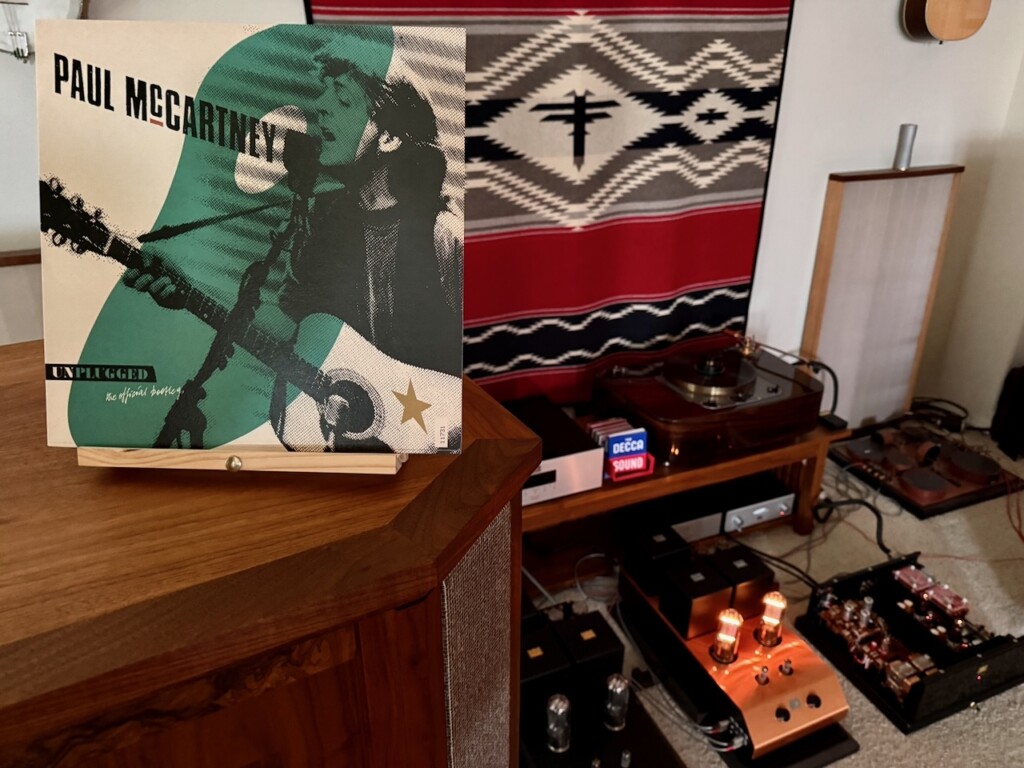
Above: Paul McCartney's Unplugged - The Official Bootleg
When Paul McCartney recorded Unplugged in Limehouse Studios in Wembley on January 25, 1991, there were 300 lucky fans there for the concert. Actually, there were 301 lucky fans there, because the Ongaku put this fan there with them.
Through the Ongaku I could tell the venue was a bit bigger than the Cellar Door, and I could hear an appreciative crowd expressing their joy for the music, just like when I attend a concert in person.
The Ongaku's ability to deliver the drama of the music kept me in a state of rhapsody, put the beat in Beatles tunes, and articulated all those little nuance clues that made this music spring to life in my living room.
Unlike the solo concert of Neil Young's Live At The Cellar Door, there were six world class musicians on stage: Paul McCartney, Linda McCartney, Hamish Stuart, Robbie McIntosh, Paul "Wix" Wickens, and Blair Cunningham.
Speaking of stage, in this case a soundstage, the Ongaku presented a wide and deep soundstage with vocalists and instruments presented across it and into its depths. With six world class musicians playing, there's so much to hear, so much to feel, it is almost sensory overload.
The Unplugged LP itself is cheaply made, of credit card thickness, and so it doesn't inspire a lot of confidence. The recording was not done as well as Live At The Cellar Door, with a bit of unnatural sibilance at times, but it is still decent and makes for an incredibly fun listening experience. The Ongaku unlocks Unplugged to deliver the full musical shivers, a musical miracle, in my living room. This is seriously good music, Unplugged is my favorite Paul McCartney album, and the Ongaku reveals it to be the work of art it is.
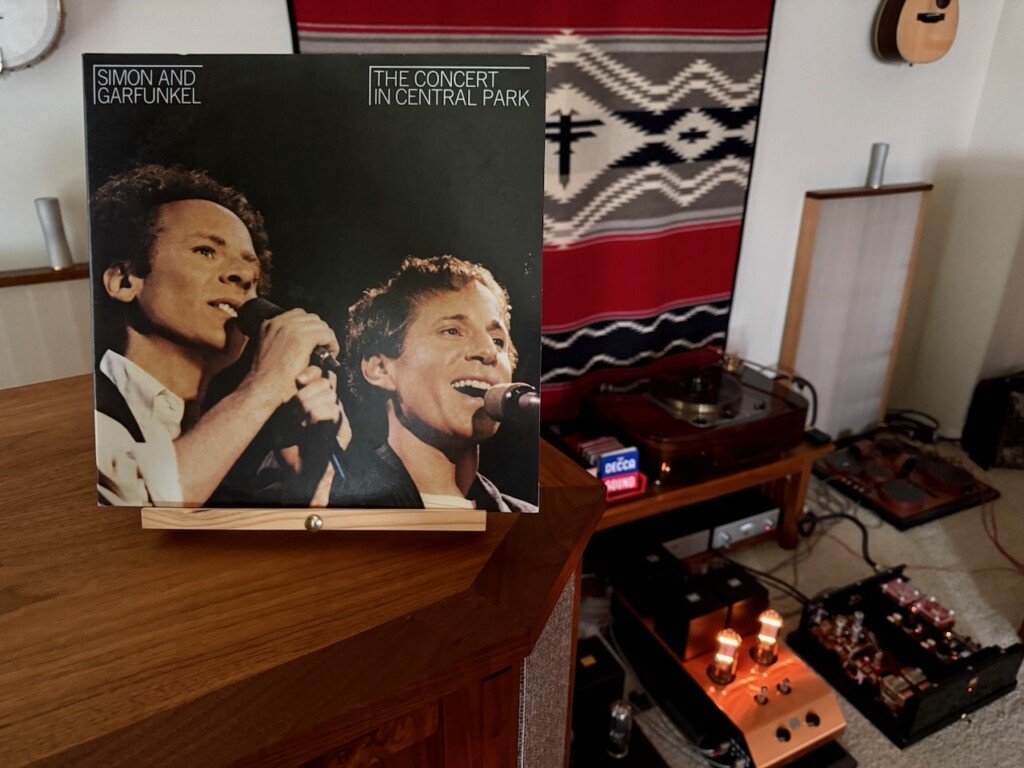
Above: Simon and Garfunkel's The Concert In Central Park
Over 500,000 people attended Simon and Garfunkel's The Concert In Central Park on September 19, 1981. It was a free benefit concert to attend, and the proceeds from the audio and video recordings went towards maintaining Central Park. This was back when altruism was still alive and well. Cool eh?
So not only was the attendance a half million people, but the Central Park venue was huge by concert standards, and there were thirteen world class musicians on stage: Paul Simon, Art Garfunkel, Pete Carr, David Brown, Anthony Jackson, Richard Tee, Steve Gadd, Grady Tate, Rob Mounsey, John Gatchell, John Eckert, Dave Tofani, and Gerry Niewood.
From the enthusiastic introduction on Simon and Garfunkel, the expansive cheers of the audience in Central Park were revealed by the Ongaku to disappear off into the distance at the outer limits of microphones' reach into Central Park.
The recording was quite good, actually miraculously good, considering the venue, and the sensation of music playing from a stage into the expansive space of Central Park filled my listening room to overflowing, and of course, I was once again wowed how the Ongaku could perform such an incredible magic trick.
Simon and Garfunkel's music struck me as profoundly wonderful, with the concert in Central Park being revealed as a historic event in the annals of live music recording, and the Ongaku transported me up out of my living room back in time to join the half million in Central Park for the concert in 1981. What an experience!
In all three of these live albums, Neil Young's Live At The Cellar Door, Paul McCartney's Unplugged, and Simon and Garfunkel's The Concert In Central Park, the Ongaku delivered the virtuosity, the drama, of the music in unparalleled fashion.
Due to the Ongaku's high-contrast presentation, I also was able to fully appreciate the how the recordings were made, from small, medium, and huge venues, and how incredible the recording arts were in partnering with the musicians in documenting these momentous concerts.
There's so much more music in recordings, music that one doesn't normally get to hear, but the Ongaku unlocks them and delivers more of the music, the drama, and the beauty of the recording arts to the listener. I found it to be a wonderful thing to behold. With the Ongaku playing the records, there's no such thing as death, as the musicians and music are all resurrected before my ears, in my living room, and in my heart. The Ongaku is where the magic occurs.
I had thought I'd go through another triplet of albums with female vocalists and opera singers for you with the Ongaku providing the juice, but then I thought that would be just gilding the lily.
When I'm evaluating a component I typically start with how well the component performs on the basic elements of music, so let me briefly mention that, and then I'll go on to the traits where the Ongaku outperforms any amplifier I've ever listened to.
I listen for timbral realism (the accuracy to the unique ‘voices’ of instruments), the resolution of tone color (the ability to distinctly hear the chordal variations resulting from adding additional pitches to three tone triads), melody (the tune you ‘whistle while you work’), harmony (treble & bass accompaniments to the melody), rhythm (the steady beat that determines the tempo), tempo (speed), dynamics (variations in loudness), and loudness (the ability to play naturally at live-like levels appropriate to a piece of music).
The Ongaku has exceeded every amplifier I've listened to with respect to performance on the above musical traits. Every amplifier. By a lot. On every album I listened to.
When it comes to those traits near and dear to us audiophiles, the non-musical attributes of the recording process, like transparency (the ability to ‘see’ into the recording), resolution (the amount of detail in the audio signal that is audibly presented), soundstage (the ability to discern the three dimensions of the recorded space in width, height and depth), the soundspace (the ability to convey the acoustic sense of ‘space’ of the recording venue), and imaging (the ability to localize instruments & musicians on the soundstage), the Ongaku readily exceeds those traits compared to any amplifier I've listened to. By a lot. The Ongaku is just stunning by any measure. I am in awe.
The Ongaku easily performs those dramatic feats at realistic SPLs for a piece of music, and yet even at very soft playback levels it does the same, which will be an asset for those with a desire to listen at lower SPL levels.
The Ongaku is also very agile in terms of dynamics, and not just with macro-dynamics, but all across they dynamic spectrum from the very softest to the very loudest, and across all the audio spectrum as frequencies change in real-time, infusing melody and rhythm with unprecedented drama and feelings.
The Ongaku does all this - as noted above - while realistically portraying timbral textures, tempo, and beat, to be more emotionally engaging and dramatically satisfying than any amplifier I've encountered ever. By a lot.
The Woo Woo State
There is another remarkable performance trait that emerged related to how the Ongaku integrates all of those performance traits I mentioned above. The Ongaku plays music in an extraordinarily convincing fashion, with performance attributes that I've found very difficult to describe, and which makes every single album sound and feel like I am experiencing a masterwork of the music and recording arts. Even with the clunkers. It's uncanny.
In my listening sessions, the Ongaku maximized the dramatic aspect of recorded music to evoke an extraordinary emotional response in me. Think of this trait as the audio equivalent of the highly elevated state that experienced Yoga Nidra meditation practitioners can achieve, an otherworldly state in the ether connecting me directly to the musicians, to create a new performance trait that I'll just call the "woo woo state," because it feels so preternatural, so surreal, so powerfully mesmerizing, that I don't really know how to articulate it. It is felt more than heard. Or is it heard more than felt? I don't know. With the Ongaku, opposites can be true at the same time.
The Ongaku infuses an energetic dramatic presence and naturalness into the music that creates a remarkable emotional reaction in me as I listen to music. All of the typical performance traits I listen for in audio just disappear from my awareness, and what's left is me experiencing a musical performance the way I think the musicians and recording engineers would have desired me to, as full of drama, beauty, life, and meaning.
But there's more, as the Ongaku projects the equivalent of a "musical sanctuary" into my living room, with an uncanny sense of spaciousness and natural warmth, where my usual thoughts fade from awareness, and I'm ushered into the sensations of the music in my body, in my soul, where the artistry of the music breathes life into me and fills me with joy.
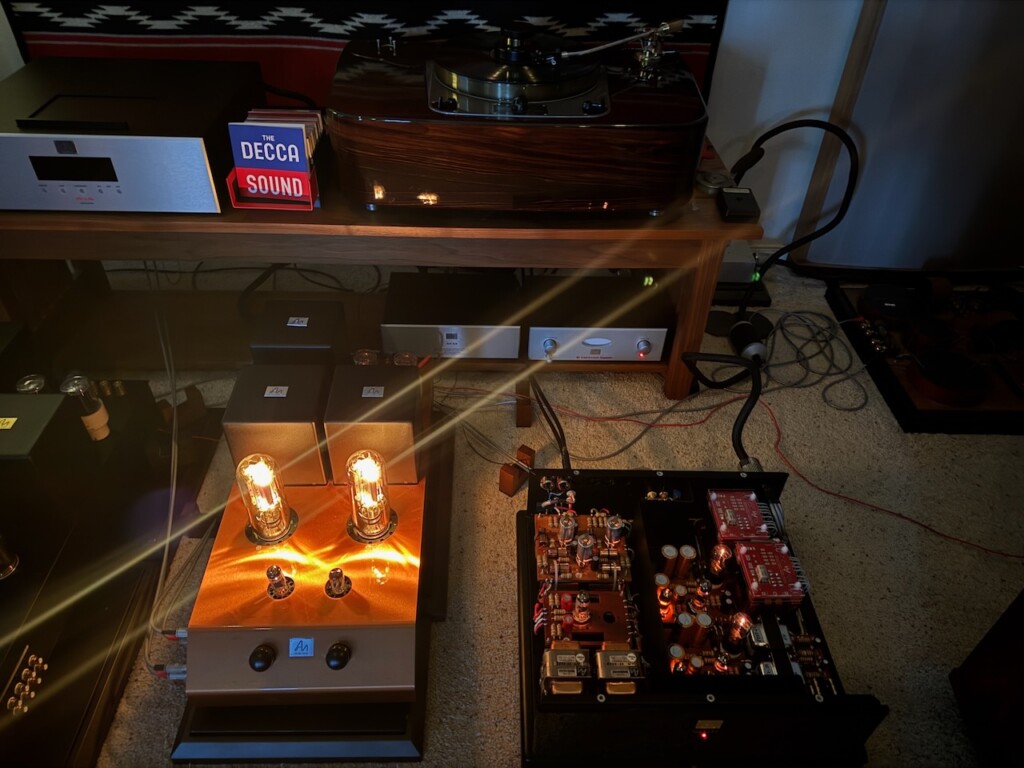
With the Ongaku, I am immediately aware that I am experiencing a very special musical experience, one that is full of aliveness and presence, easily delivering a distinctly "felt" emotional experience, and there's a certain liberating sense of joy that comes with that. My mind relaxes, my body feels at ease, and I melt into the essence of music.
Listening to the Ongaku, I realized that I didn't know what I thought I knew about audio, enlightenment occurred, and a much higher level of performance revealed itself to me, a level of performance that most of us have never experienced, and few will ever get the chance to. Welcome to the Age of Enlightenment!
Summary and Conclusions
If you've perceived that this is a rave review of the Audio Note (UK) Ongaku 211 integrated amplifier, you're exactly right.
The Ongaku is simply the finest amplifier I've ever encountered, by leaps and bounds. You've heard the statement, "The clothes make the man." However, with the Ongaku it's the other way around, it's "The man that makes the clothes." In other words, it is what is inside the Ongaku - the custom components that populate the circuits - that allow it to do what it does.
Previously, I found the Audio Note (UK) Tomei 211 integrated amplifier to be the finest amplification component I'd ever heard at my place, and yet the Tomei's chassis and circuit is essentially the same as the Ongaku's, but the Ongaku leaps far above the Tomei in a dramatic increase in performance.
This improvement in performance due to the components populating the Ongaku's circuits I found to be extraordinary.
The Ongaku’s Level Five components complement is where the magic occurs: the choice of the best available new-old-stock (NOS), or new stock, vacuum tubes in the circuit for each particular application. The custom-made silver wire used in the circuits and transformers that lets more musical information through. The custom-made silver foil signal capacitors that do the same. The custom-made silver-wired transformers with cores made from exotic materials that provide more low-level details, color, and texture from the music signal. The Black Gate electrolytic capacitors used in strategic locations that enhance dynamic range, bass definition, clarity and detail, and sonic smoothness. The use of “tone king” non-magnetic silver tantalum resistors that deliver improved tone, increased texture, a darker background, and a greater sense of immediacy.
That combination of components in the Ongaku is what allows its prodigious magic to occur, and given they're almost all in-house custom components made by Audio Note (UK), I don't think it's possible to achieve this level of performance anywhere else.
That level of exotica comes at a price. I waited to the last minute in writing this article to ask about the price so it wouldn't influence my impressions. I knew it would be expensive, but gasp, I was still shocked! The Ongaku costs a whopping $168,630.00 USD.
Yeah, it is way out of my budget range too, but the level of performance that the Ongaku delivers is so extraordinary that I don't know how you could get that level of performance for any less. I might add that even though most of us audio enthusiasts will never be able to experience an Ongaku at home, it's nice to know that there really is a much higher level of performance in audio that is attainable.
The automotive world has comparable exotica, like the limited production McLaren W1, with 1,258 horsepower, a top speed of 217 mph, a design focus on driver engagement, and a price of 2.1 million USD. I am glad it exists even if I can't afford it. Just like with the Ongaku.
A recommendation to those who are fortunate enough to be able to afford the Ongaku: pair it with the best components Audio Note (UK) makes, from source to loudspeakers. Hey, what's a half million or so when you're playing at this level? You'll be in rarefied air. You'll be glad you did this.
Then invite me over to your place for a Vespers martini, shaken not stirred. After a listening session let's take your McLaren W1 out for a drive. What fun!
I'd like to thank Peter Qvortrup for the extraordinary experience of being able to listen to his Ongaku 211 integrated amplifier and write about it for you here at Positive Feedback. Thank you, Peter!
What I didn't mention was how much the Ongaku elevated the performance of digital. It does. By a lot. You can read about this and my many other musings about the Ongaku by going to Jeff's Place and entering "Ongaku" into the search function. There's lots more to read.
Next up in the Audio Note (UK) review series here at Positive Feedback is the exotic top-of-the-line Audio Note (UK) Io Ltd. field-coil, moving-coil, phonograph cartridge and power supply, paired with the equally exotic top-of-the-line Audio Note (UK) AN-S9 step-up transformer, for some analog magic!
As always, thanks for stopping by, and may the tone - and the woo woo force - be with you!
Ongaku 211 Integrated Amplifier
MSRP Retail: $168,630.00 USD
Audio Note (UK)
Contacts for sales inquiries: Daniel Qvortrup and Peter Qvortrup.