Just days into my review of the active ATC SCM50 ASL loudspeakers, my wife and I were so impressed with them that I decided that they'd become my new reference speakers. However, responses from a few hi-fi traditionalist friends were less than enthusiastic.
"The audiophiles that use active loudspeakers are less than one percent!" one cautioned. For those unfamiliar, they're powered speakers that come with their own, built-in amplification, eliminating the need for external amplifiers. An established audio equipment designer, he vehemently insisted that most audiophiles prefer external amps and separates, and that I'd be shooting myself in the foot as a reviewer if I traveled down this dangerous path." But was I really?
A Sea Change Coming?
With its soaring prices, shrinking demographics – where over 40 percent of audiophiles are 65 and older, according to audioresurgence.com – and the loss of mid-fi gear, per GR-Research, and you have cause for concern. Add-in all the company consolidations and shutterings, and it's clear that the traditional high end hi-fi market is declining and at risk. On the flip side, there is a shift in consumer audio that includes more "all-in-one" lifestyle products, with sales pivoting more towards integrated streamers, simplified multi-room setups (like Sonos, for example), and, yes, active speakers! (Hifi Huff. "The Industry is Changing and Most Audiophiles Don't See It." YouTube)

Joe Corona, Manager at Saturday Audio Exchange in Chicago (photo from LinkedIn)
Here's a case in point: The long-standing Chicago hi-fi store, Saturday Audio Exchange, sells lots of ATC active speakers to its metropolitan clientele. Its manager and in-house audio expert, Joe Corona, tells me over the phone, "We get a ton foot traffic from of people who don't understand audio stores. We're four blocks south of Wrigley Field with DePaul, Columbia College, and Loyola University nearby. They see a bunch of turntables up front, and we have active ATC SCM40s with a sub in the back."
"We take them back, play 30 seconds of each song from a selection from four albums, and we have people take turns sitting in the sweet spot to give them an idea of what music can really sound like," he continued. "We tell them the first two songs were mastered on ATC and they will play back the way the artist intended it to be heard."
Like many other stereo shops, Saturday Audio Exchange is not an active speaker selling store, he notes. Nevertheless, he continues, "Now, we all know that all speakers can play loud, but how do they sound when you play them lower in volume?" – adding that many of their clientele live in multi-dwelling units. Cutting to the chase, he asks them, "How loud do you listen?" And here's the magic: "Active speakers give you the ability to not lose anything when you turn it down. People are astounded when we show how great music can be regardless of genre."
"Now ATC 40s and 50s are as big as they sell in this neighborhood," he asserts, adding that they don't sell speakers taller than three or four feet. "You'll never see Wilsons here!" However, these speakers fill a volume regardless of space, he says, adding, "Small plays big." "I have a pair of active 40s at home," he adds, the smile clear in his voice. "They're just remarkable!'

Steven Hill, President and owner of Straight Wire, Inc. (photo courtesy of Jerry Willsie)
Actives Rocking Adult Kids and Audio Cognoscenti Alike
When I mentioned my newfound SCM50 love to Steven Hill, president of Straight Wire, Inc., he exclaimed, "I love active speakers!" The amp sits next to the speakers, without lengthy cables and other encumbrances that detract from the signal, he explained, so the only concerns are proper electronic and vibration isolation. "My (adult) kids all use active speakers!" In fact, he said that many in the industry currently use powered KEF LSX monitors in tandem with subs in their home systems, adding that the active component "changes the game completely!"
In addition to KEF, companies like SONOS and Dutch and Dutch, and more traditional hi-fi speaker brands like Dynaudio, Focal, Bowers and Wilkins, and Klipsch are offering active loudspeakers in their product lines. That seems in keeping with the research in market trends.
In their industry report entitled, "Loudspeaker Market Size and Share Analysis – Growth Trends and Forecast" (2026-2031), the market research firm, Mordor Intelligence, noted that "active speakers dominated with 71.47% share in 2025 and will widen their lead, growing parallel to the total market at 6.50% CAGR (Compound Annual Growth Rate), adding that "Integrated class-D amplification, often based on Texas Instruments TAS57-series silicon, permits 90% electrical efficiency and sub-1% total harmonic distortion at rated output, eliminating bulkier external receivers." (www.mordorintelligence.com).
That same report acknowledged that passive speakers remain relevant to custom installers who prefer amplifiers in equipment racks for future proofing and heat management, as well as in "high-budget theaters and two-channel purist rooms where external amplification offers tuning freedom." It further states that the passive niche of the loudspeaker market won't vanish, but its growth "matches the average rather than leading it, as younger apartment dwellers favor minimalist setups that arrive fully amplified." (Ibid; italics mine)

Image courtesy of atc.audio
Meanwhile, ATC has been quietly serving a long list of artists, composers, studios, and consumers with their active loudspeakers since their advent of their SCMA50s and SCMA100s some 40 years ago (vintageking.com). However, instead of using internal Class D amplification, the SCM50's amp pack employs a low-noise balanced input paired with a precision 3-way electronic crossover and three separate class A/B power amplifiers – a 200-watt bass amp, 100-watt midrange amp, and 50-watt tweeter amp – running purely in the analog domain with zero digital/DSP conversion.
But why no built-in DSP – or internal DACs, for that matter? By omitting complex firmware, digital boards, and onboard DAC chips – which tend to become obsolete and are prone to failure faster than robust analogue circuits – ATC keeps their electronics modular, repairable, and backed by longer manufacturer warranties. (audiosciencereview.com) Moreover, ATC maintains that a well-engineered, low distortion speaker set in an acoustically well-treated room doesn't need DSP shaping or digital room correction; conversely, aggressive digital EQ can compromise and degrade the loudspeaker's impulse response and direct sound. (vintageking.com)

The late ATC founder, Billy Woodman (photo courtesy of atc.audio)
Introducing ATC and the SCM50
ATC stands for Acoustic Transducer Company, a business founded by the late Australian engineer, Billy Woodman, in the 1970s (you can read more about him in my review of the ATC SCM40 speakers HERE); SCM stands for Studio Control Monitor, and the number following (like SCM40 or 50, for example) represents the internal volume of the speaker's cabinet in liters; and the ASL is short for Active Super Linear, which means that they're Active, featuring built-in power amps and active crossovers precisely tailored to their acoustic drivers, while the term, Super Linear, refers to their proprietary "Super Linear" (SL) magnet and bass driver technology design to drastically minimize distortion. (atc.audio)
Billy Woodman ran a brisk business designing loudspeaker drivers and building them in his factory in Stroud in Gloucestershire, England, supplying drivers OEM to audio manufacturers like Proac in the consumer market and clients like Yamaha in the pro audio realm, says Brad Lunde, owner and founder of TransAudio Group and Lone Mountain Audio which imports ATC (Acoustic Transducer Company) Loudspeakers on the pro and consumer sides, respectively, into the United States. Sadly, Billy Woodman passed away on July 21, 2022, at age 76, following a prolonged illness. His son, Will Woodman, left behind a successful career in corporate law and took over the helm of ATC Loudspeakers as its managing director.

Brad Lunde, at right, is seen talking with a photographer based out of L.A. at the ATC suite at AXPONA 2025 (photo by Juan C. Ayllon)
"The 50 was the first model Billy developed that grew out of his driver manufacturing business he began in the 70s," Lunde wrote via email. "The 50 was the platform to sell the unusual 3 inch mid dome concept that was unique at the time (and still is). This in-house built mid dome enabled several performance features unavailable through traditional parts, such as wide dispersion and low distortion. He built the 50 as a studio monitor, large enough to play loud but with low distortion. Using drivers manufactured in house, building an analog 3 channel plate amp he made himself, and cabinet assembled in house enabled him to make whatever he needed. Swapping out different sized LF drivers (9, 12 and 15 inch sizes) would give the speaker different low-end capability, but the same sonic footprint in the midrange and the top end. Building the right sized cabinet to maximize efficiency and have the same sized plate amp drive all three variations. This electronic crossover operated at line level (not speaker level), combined with individual driver dedicated analog amplifiers is what is called the "active system."
 Pink Floyd's David Gilmour, at left, who purchased the Astoria Boat and installed a recording studio featuring ATC monitors (see the top right photo) in it that was used in some Pink Floyd and other records (images courtesy of the "David Gilmour The Legend" Facebook page).
The SCM50's became very successful, he said, "And a lot of England's best musicians sought him out and bought his product." Including Pink Floyd's David Gilmour, who installed them on the Astoria houseboat that he purchased and eventually converted to a floating recording studio which was used in some later Pink Floyd and other recordings. (You can read more about that HERE.)
Acoustic Specifications
Bass/mid driver: 1 x 9"/234mm, SB75-234SL 8Ω
Mid Driver: 1 x 3"/75mm, SM75-150S 16Ω
High Frequency Driver: 1 x 1"/25mm, SH25-76S 6Ω
Low Frequency Cut-off: 38Hz (-6dB)
High Frequency Cut-off: 25kHz (-6dB)
Matched Response: +/-0.5dB
Crossover Points: 380Hz and 3.5kHz
MaxSPL: 112dB
System Sensitivity: TBC
Electronic Specifications
Balanced Input: 1 x Rear panel mounted female XLR, pin 2 hot
Input Impedance: 20kΩ (differential)
Input CMRR: >75dB (at 10kHz)
Input Sensitivity: 2.2dBu/1Vrms (Re. full power)
Input Sensitivity Control: 0db, -3dB, -6dB, -9dB (via rear panel DIP switches)
Bass Shelf: 0dB, +1dB, +2dB, +3db (via rear panel DIP switches)
Crossover Filters: 4th Order Linkwitz-Riley
Amplifier Type: Grounded Source MOSFET, class A/B, convection cooled
Output Power: Bass 200W (8Ω), Mid. 100W (16Ω) H.F. 50W (8Ω)
THD+N: <0.0011% / -98dB (1kHz, 1 dB below rated power, 90kHz BW)
Frequency Response: <10Hz to>175kHz (-3dB)
Limiter: ATC Active FET Momentary Gain Reduction
Electronic Amp Protection: Amplifier d.c. offset and over-temperature (both indicated by rear panel LED)
Mains Input: 220-230V or 115V, factory set. Please observe panel markings and labels!
Power Consumption: Idle 34W/51VA. 1/8th Power 149W/198VA. Full Power 345W/426VA
Heat Output: Idle 116BTU/hr, 1/8th Power 423BTU/hr, Full Power 495BTU/hr
Physical Specifications
Net Weight: 47.05kg/103.7lbs
Speaker & Stand Dimensions (HxWxD): 969 mm x 304 x 480 mm – or 38 1/8" x 11 15/16" x 18 7/8" (stands spikes add 25-40mm/1" - 1 3/5" to height)
Speaker Dimensions (HxWxD): 716x304x480mm / 28 3/16 x 11 15/16 x 18 7/8"
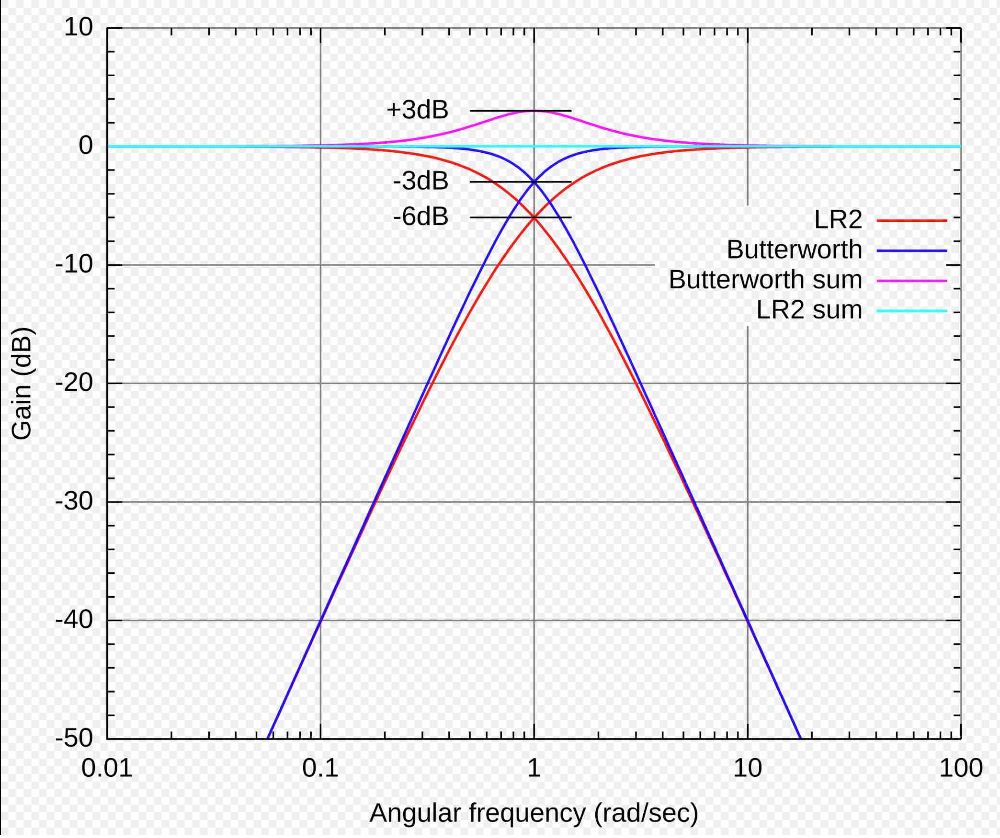
Comparison of the magnitude response of the summed Butterworth and Linkwitz–Riley low-pass and high-pass 2nd-order filters. The Butterworth filters have a +3dB peak at the crossover frequency, whereas the L-R filters have a flat summed output. (https://en.wikipedia.org/wiki/Linkwitz%E2%80%93Riley_filter)
The Secret Sauce in the Actives: the Linkwitz-Riley Filter Network Active Crossovers and Three Separate Amps in Their Amp Packs:
One of my initial hesitations about active loudspeakers was the potentially complicated issue of servicing their internal amps if and when they need work. However, ATC amp packs are removable so that they can be shipped separately (versus shipping the entire loudspeaker) for servicing, saving you shipping costs. This feature has been really useful to recording studio engineers, who often run their speakers long and hard, and really appealed to me from a pragmatic, dollars-and-cents standpoint. However, what's even more exciting is what's inside the amp packs.
"The crossovers used in the ATC active amp pack is a Linkwitz Riley design," Lunde explained. "Here is the best explanation I can find for this."
Lunde's linked information included the following excerpt below:
A Linkwitz–Riley (L-R) filter is an infinite impulse response filter used in Linkwitz–Riley audio crossovers. It is named after its inventors Siegfried Linkwitz and Russ Riley and was originally described in Active Crossover Networks for Noncoincident Drivers. It is also known as a Butterworth squared filter.
A Linkwitz–Riley crossover consists of a parallel combination of a low-pass and a high-pass L-R filter. These filters are typically designed by cascading two Butterworth filters, each providing a −3 dB gain at the cut-off frequency. The resulting Linkwitz–Riley filter has a −6 dB gain at the cut-off frequency. This means that when summing the low-pass and high-pass outputs, the gain at the crossover frequency is 0 dB. As a result, the crossover network behaves like an all-pass, exhibiting a flat amplitude response with a smoothly changing phase response. This is a primary advantage of L-R crossovers compared to even-order Butterworth filter crossovers, whose summed output has a +3 dB peak around the crossover frequency.
Since cascading two nth-order Butterworth filter filters creates a (2n)th-order Linkwitz–Riley filter, theoretically any (2n)th-order Linkwitz–Riley crossover can be designed. However, crossovers of order higher than 4 may be less practical due to their complexity and an increasing peak in group delay around the crossover frequency. (https://en.wikipedia.org/wiki/Linkwitz%E2%80%93Riley_filter)
"The reason this is important is that the 'active system' offered better Sonics to a passive crossover design," Lunde added.

Ben Lilly at AXPONA 2026 (still image from Avcat YouTube Video)
Corresponding via email, Loudspeaker Technology Ltd. (ATC)'s Technical Sales Manager and former R&D/transducer engineer, Ben Lilly, elaborated on the 50s active crossovers and several other questions.
"The SCM50ASL uses 4th order (24dB/Oct.) Linkwitz-Riley crossovers. To optimise the phase response through the crossover regions, the crossover circuits also feature two all-pass filters, one at each crossover point. They are manufactured in-house by ATC as part of the ATC 'Amp Pack' that is fitted to the loudspeakers. The 'Amp Pack' features a balanced input followed by said 3-way active crossovers, and then three power amplifiers, one dedicated to each drive unit. The crossovers operate at line-level and, as they utilise active circuits, can provide gain (amplification) if needed and attenuation. The active circuits operate a relatively high impedances so capacitor value can be kept small and both low and high-pass filters can be created using only capacitors. As the filters are isolated from the loudspeaker drivers, their performance is not compromised by the complex impedance of the loudspeaker drivers which varies with both frequency and drive level."
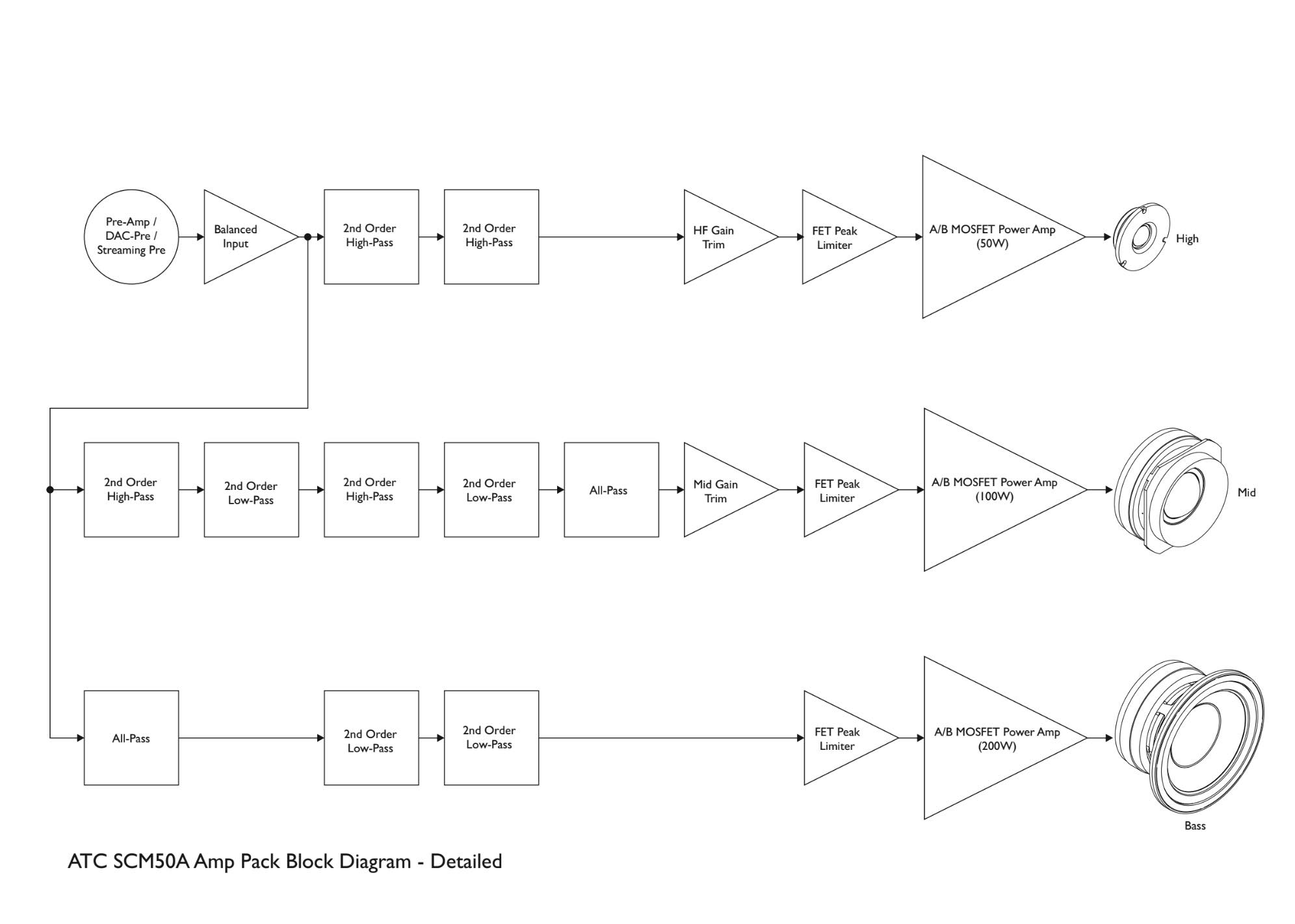
Diagram courtesy of Ben Lilly/ATC
On how the 50's tri-amps operate and optimize playback phase and accuracy – versus passive loudspeakers
"The phase response of both passive and active crossover filters is tightly linked to the filter frequency, order and Q-factor. Modifying any of these filter parameters will also change the phase response, which may result in an undesirable phase difference at the crossover point. Further subsequent changes to improve the phase response will lead to compromises elsewhere. Within an active system we can include additional all-pass filters. These are circuits which pass all frequencies equally but change the phase relationship between different frequencies, therefore offering the ability to optimise the phase response through the crossover region. In addition, the active filters are isolated from the drivers so their phase response is not affected by the loudspeaker driver impedance, which changes according to the input power. Increased power (higher listening levels) results in voice coil heating which will increase the driver impedance. With a well-engineered active system, the crossover filter and resulting active loudspeaker system will have a superior phase response to the passive equivalent, with an improved tonal balance, and far superior imaging."
Aren’t they the same amp units employed on the larger SCM100A's and 150A's?
"Yes, we use the same amp to drive the SCM50A, 100A and 150A, but the settings (calibration) of the amp differs according to which speaker it is driving. The active filters include gain controls and adjustable all-pass filters so we can optimise the amp for the speaker model. Setup for the smallest SCM50, we have a higher level of attenuation on the mid and high-frequency channels. For the largest SCM150, the bass driver is more efficient so the mid and HF attenuation is reduced. These same gain controls are used for a final fine 'tuning' of the active speakers. This allows us to optimise the response of each individual speaker that leaves the factory."

ATC's engineer from their factory in Stroud in Gloucestershire, England, Richard Newman, holds the hefty S midrange driver of the SCM50, SM75-150S soft dome midrange driver at AXPONA 2025.
On what makes their midrange and bass detail sound so good and how the “S” version, like the SM-75-150S midrange driver used in the SCM50s and above makes such a difference; and how the Super Linearity magnet technology works
"There is no single feature that results in the stunning levels of detail that the SCM50A can resolve. It's a combination of exceptionally good drive units paired with very well executed active crossovers and very high-performance power amplifiers. In addition, an active system may seem complex, but we work hard to ensure it's as simple as possible. Using drive units with very low distortion and a well-controlled frequency response is key, as it means complex signal processing is simply not required.
"The 'SL' technology consists of a pair of rings, one inside and one outside the vice coil. They are manufactured from a specialised ferrite material which has high magnetic permeability but also high electrical resistance. They reduce the modulation of the permanent magnetic field by the field generated by the voice coil, and the benefit is reduced 3rd harmonic distortion.
"Again, with the SM75-150S mid-range, there is no single feature that is key, but rather a combination. The large 3" voice coil can handle huge amounts of power and does not heat quickly, so thermal compression is minimised. The 3" diameter dome, offers wide dispersion and a crossover around 3.5kHz which, gives the tweeter an easy life. We use a very large magnet which totally saturates the steel pole and front-plate, virtually eliminating any flux modulation by the coil, minimising 3rd harmonic distortion. The motor also uses a short coil operating in a long magnetic gap which means the force driving the dome and the coil inductance remains very stable, regardless of excursion/drive level. This again minimises distortion."
(Note: You can read Ben Lilly's previously published treatise on the benefits of active versus passive loudspeakers in an addendum at the end of this review.)
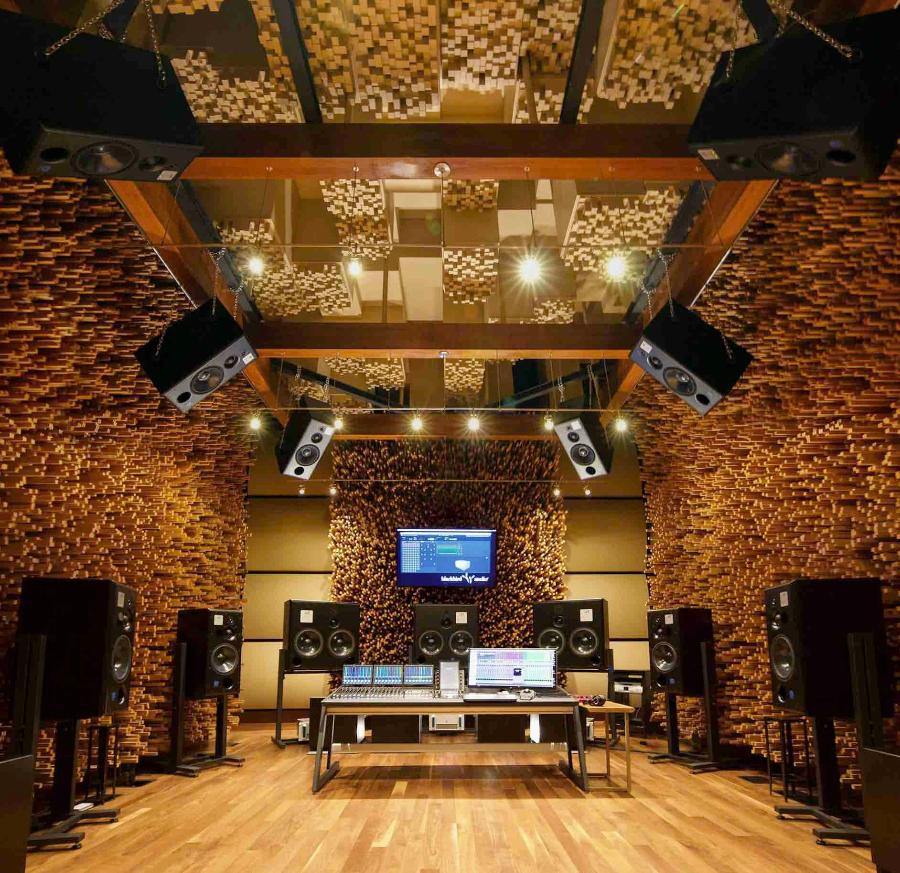
Brad Lunde lights on the ATC speakers used at the famous Blackbird recording Studio C in Nashville, TN (image courtesy of blackbirdstudio.com):
When I mentioned that I spotted SCM50s in photos from the famous recording studio, Blackbird, Lunde corrected, "100A's are used at Blackbird in studio C the big ATMOS room. Eight individual 100s provide all the Dolby Atmos channels beyond the left center right ATC 300s and 6 subwoofers surround channels. These are the same as 50s except they utilize a 12-inch woofer instead of the 9 inch in the 50s. Sonically these two models sound the same except for more low end with the 100."
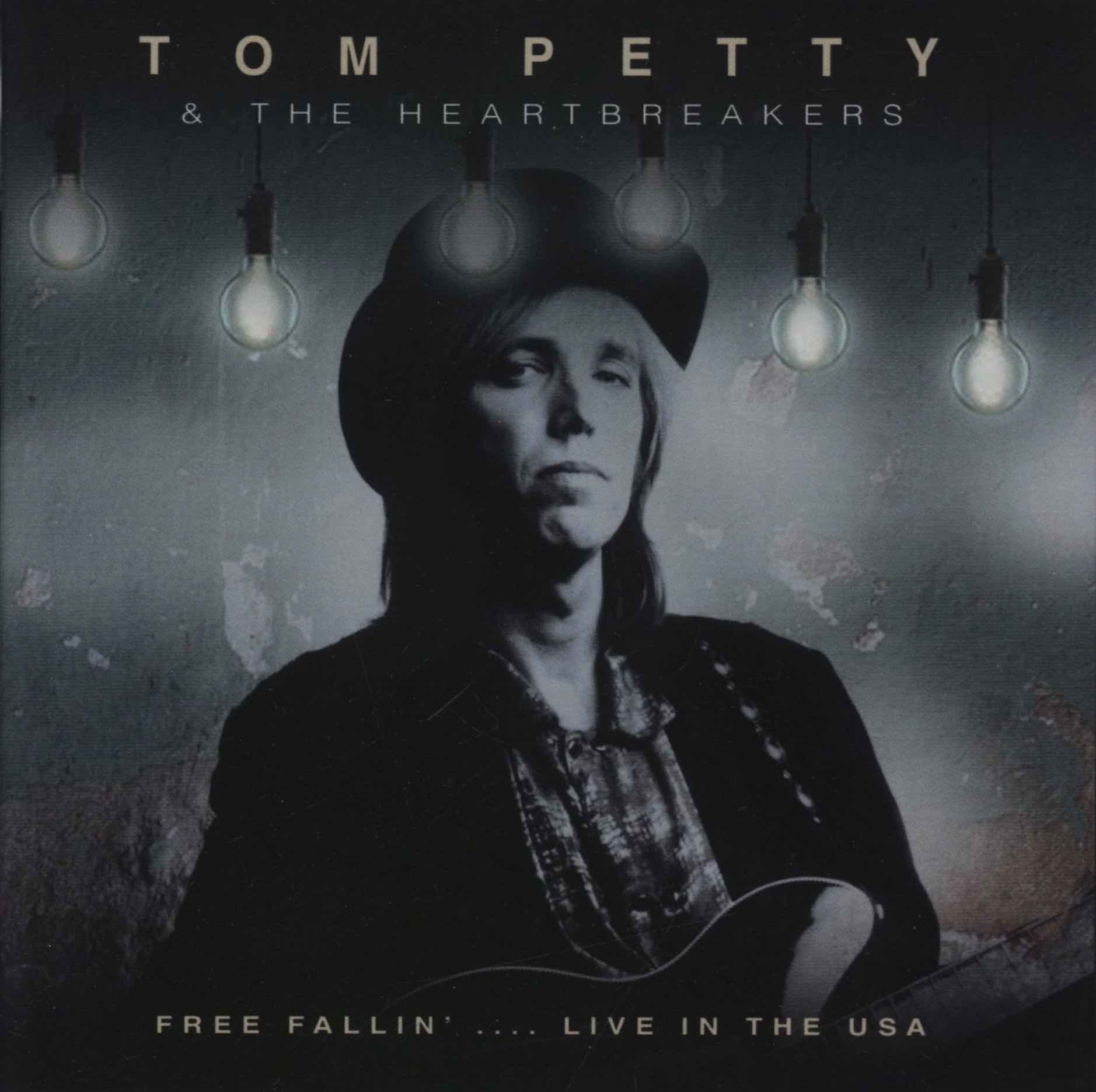 Tom Petty (image from rarevinyl.com)
My bad. However, he did mention, "One of my most exciting days was when I got a check from Tom Petty for the 50s he had ordered for his house!" They must have made quite an impression on the late Rock and Roll Hall of Fame artist and icon.
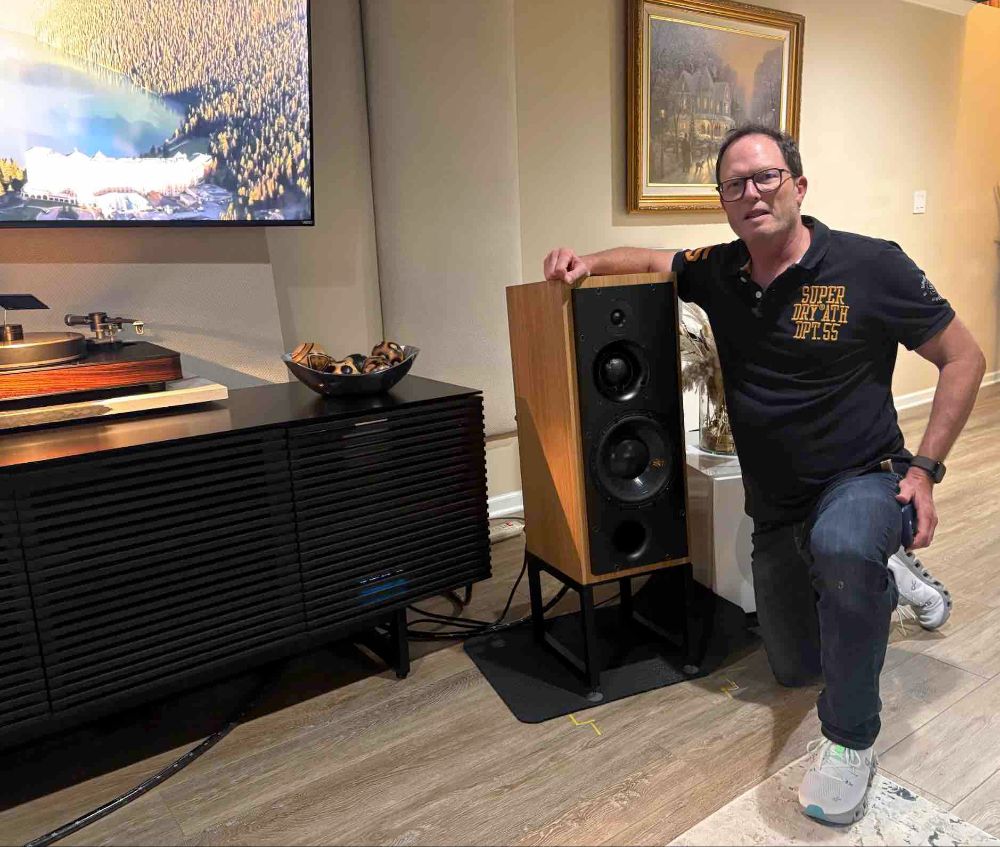
Leland Leard, the Chief Business Development Officer for Lone Mountain Audio (U.S. distributor for ATC Loudspeakers), takes a moment during initial setup at my house.
The Setup
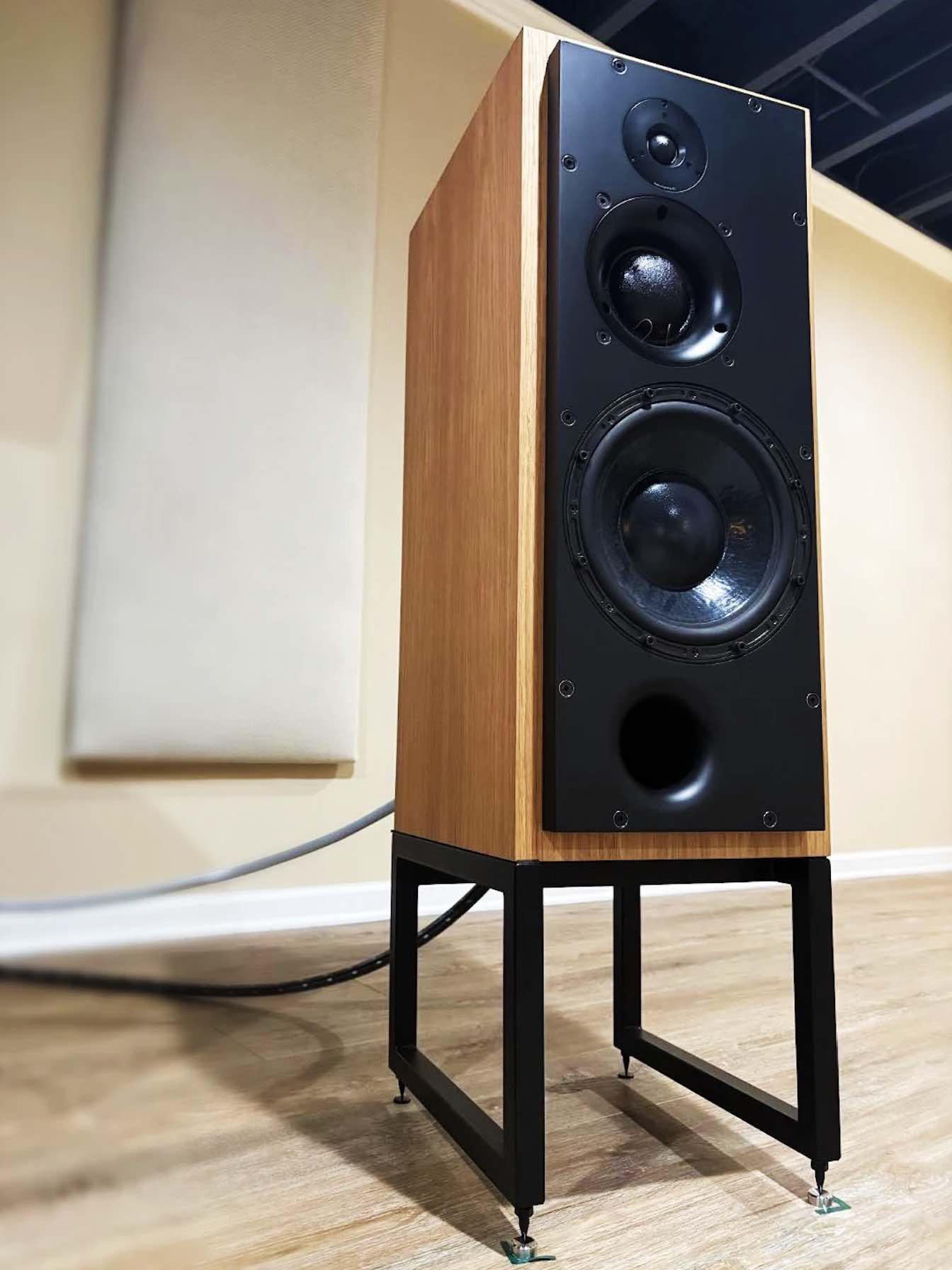
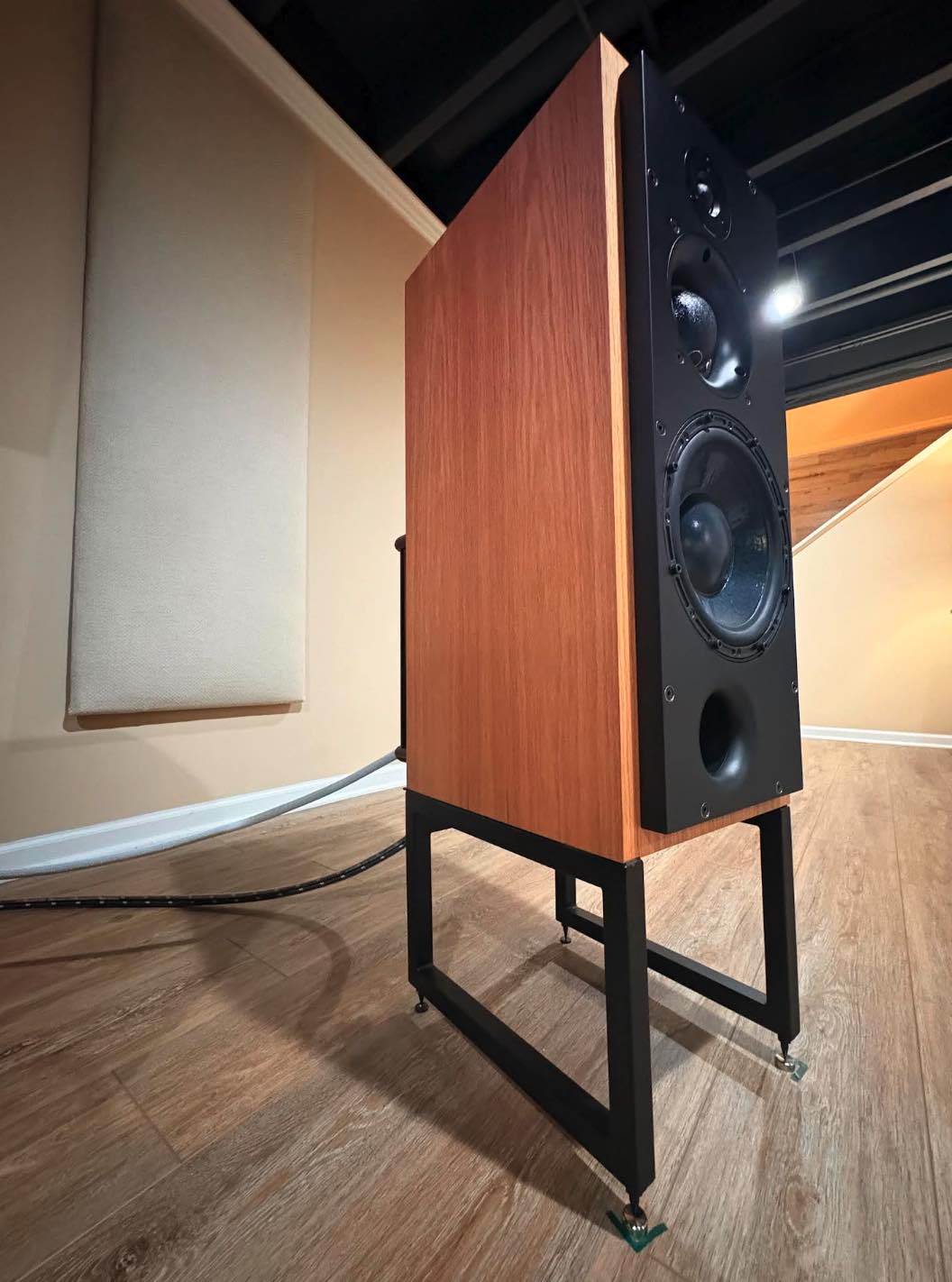
One Sunday in July, I met with Leland Leard, Chief Business Development Officer for Lone Mountain Audio, when he demoed the SCM50s at a Chicago Audio Society meeting in Mount Prospect, Illinois. They were well-received. Afterwards, we boxed and loaded them into a rented van, grabbed dinner, and drove them back to my house, where we carried them down the steep stairs to my basement listening room. Well packed in large, double boxes, they were surprisingly heavy and cumbersome – especially at the bottom of the stairs, where there wasn't much room set them, much less to turn or move them. (It turns out my wife was upset with me later because she felt that being the man on the bottom end going down the stairs, I struggled and put my health at risk). Together, Leland and I unboxed them, gingerly lifted and mounted the speakers on their stands, and placed them on mats for easier sliding while finding the optimal speaker placement. Leland did the initial setup, screwing speaker spikes on the bottom front of the stands, and leaving the rear portions sans spikes, angling the front up roughly 10 degrees. This is how he set them up for shows like AXPONA and dealer demonstrations, which makes sense, since a lot of people are forced to stand. We ran a pair of Straight Wire Crescendo 3 balanced cables from the Pass Labs XP-12 preamplifier to loudspeakers, connected a stock pair of power cables (which I've subsequently replaced with Straight Wire Pro Thunder power cables), plugged them into the wall, and got a vividly-detailed, engaging, immersive, and more viscerally engaging presentation than I expected. Standing roughly 39" tall, on its stand with spikes on, 12" wide, and 16" deep (with an additional 3" deep amp pack on back) and weighing 103.7 lbs., the SCM-50ASLs sport a ruggedly handsome retro look. Upfront, its nine-inch bass driver, three-inch soft-dome mid-range driver, and one-inch soft-dome high frequency tweeter are ATC's premium proprietary components, designed and engineered to maximize dynamics and minimize coloration. The baffle is 25 mm thick – or just under one inch. (theabsolutesound.com) It comes with an attractive, removable fabric-wrapped grill bearing the ATC logo in the upper right hand corner.
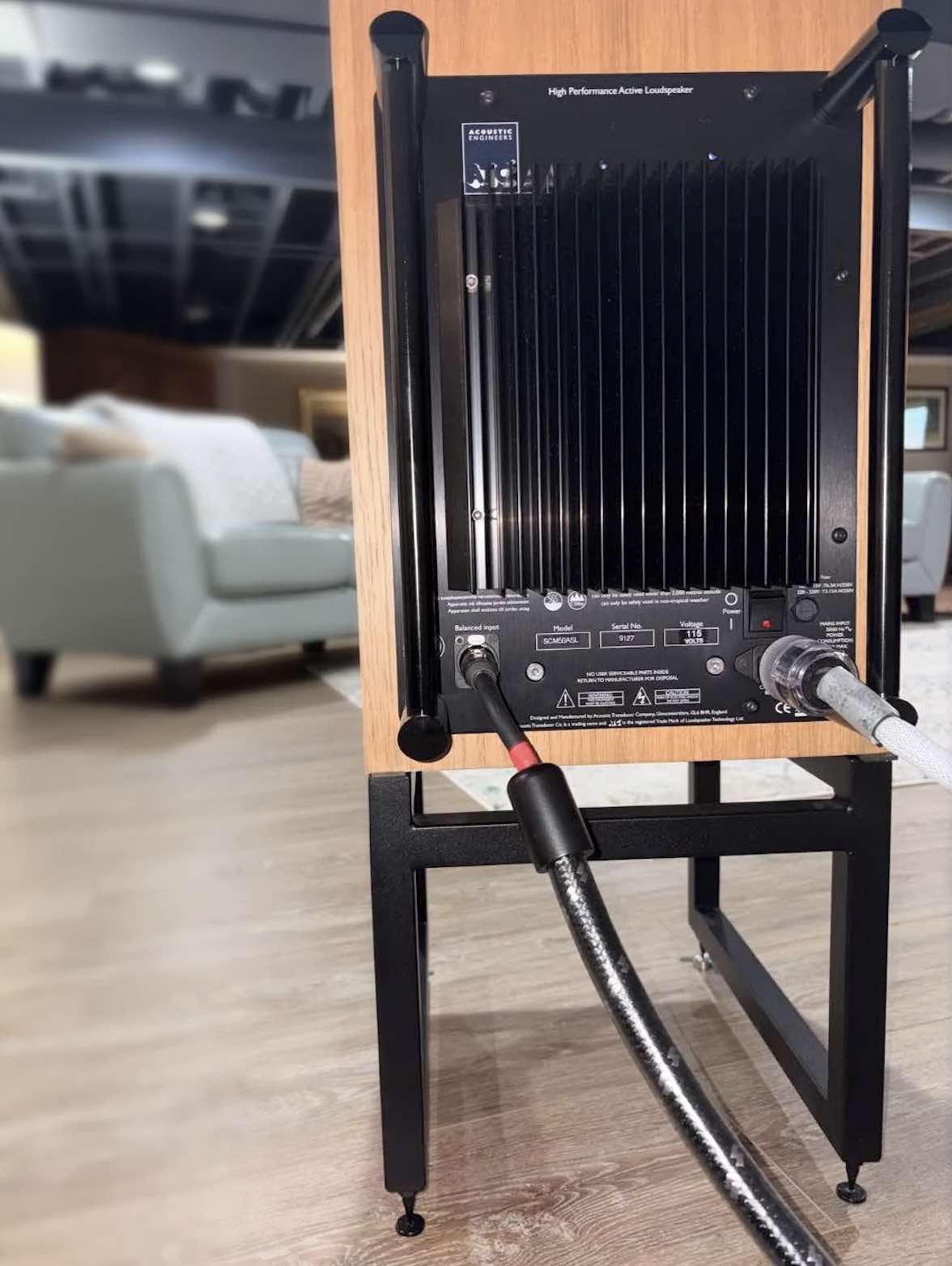
Straight Wire's Crescendo 3 balanced cable and their Pro Thunder power cable are shown feeding signal and power, respectively, to the SCM50ASL speaker
On the back sits an amp pack sporting an impressive bank of black heat fins, with a balanced XLR input on the bottom left, and an IEC power input and an on/off switch below that on the bottom right. During my experience so far, after run for hours, the fins got warm to the touch, but they were never hot.
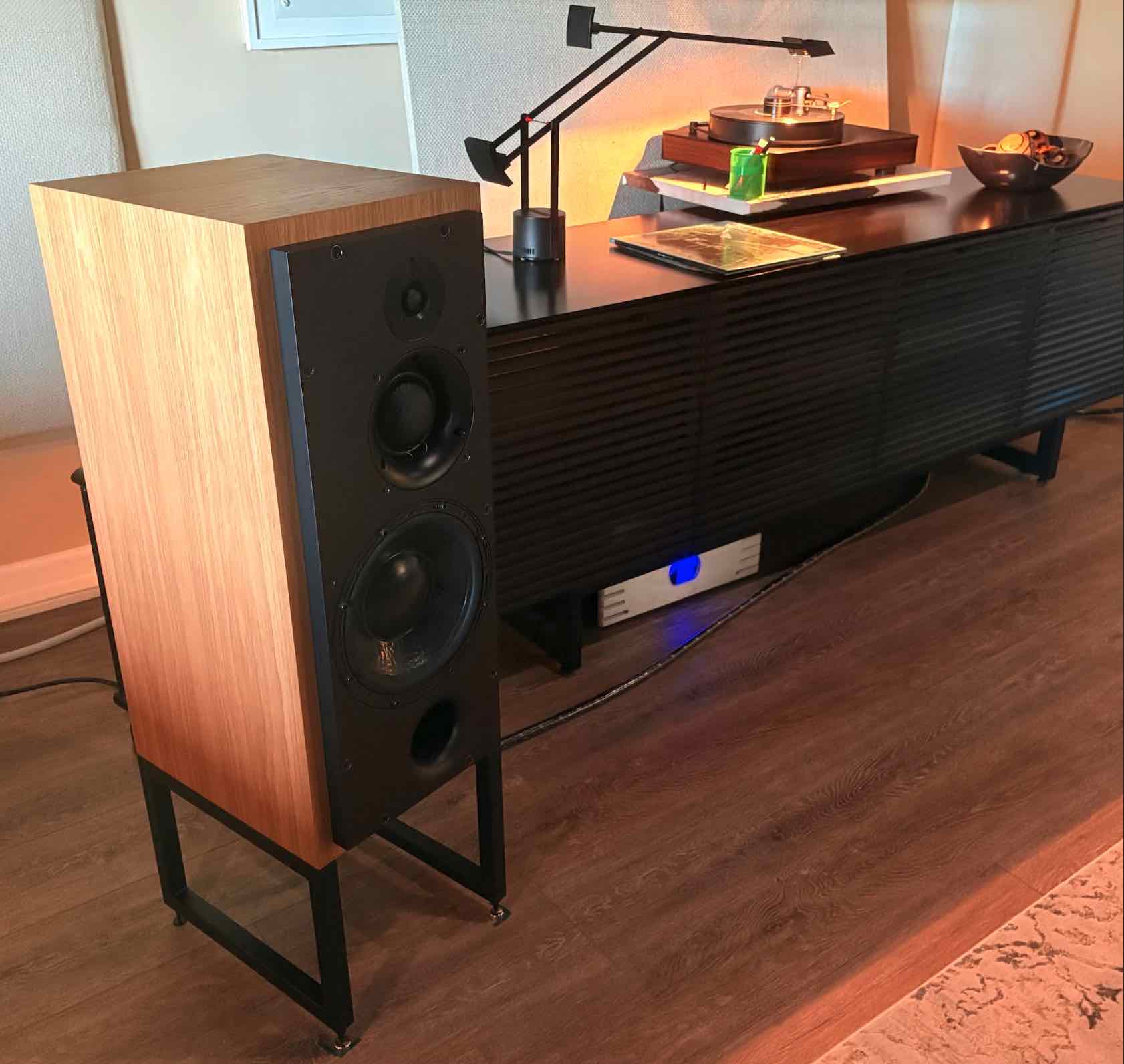
The cabinet is heavily braced and damped for suppressing panel resonances and further minimizing coloration. Acoustically, it's designed and constructed for optimal low-frequency loading for its nine-inch SL bass driver, but comfortable integration into a wide range of rooms – including mine, which is a lightly acoustically-treated (it has a ceiling cloud, acoustic absorption panels and bass traps) 32′ D x 22′ W x 9' H space, with an exposed, painted ceiling.

Joe Jurzec, seen here doing an earlier setup in my listening room several years ago.
Later, when I had friends over, we fine-tuned the speaker placement and flattened the upward tilt of the speakers by using spikes on front and back, but placing the front on spike floor protectors while using thinner metal protector discs under the rear, resulting in a more shallow angle aimed at ear level, but roughly an additional shoulder's width from the sweet listening spot on the couch. As with other speaker setups, my friend, Joe Jurzec, a computer software consultant and former partner in Purity Audio Design and Jam'n Audio, did a lot of the work, which I tweaked to my taste after he left.
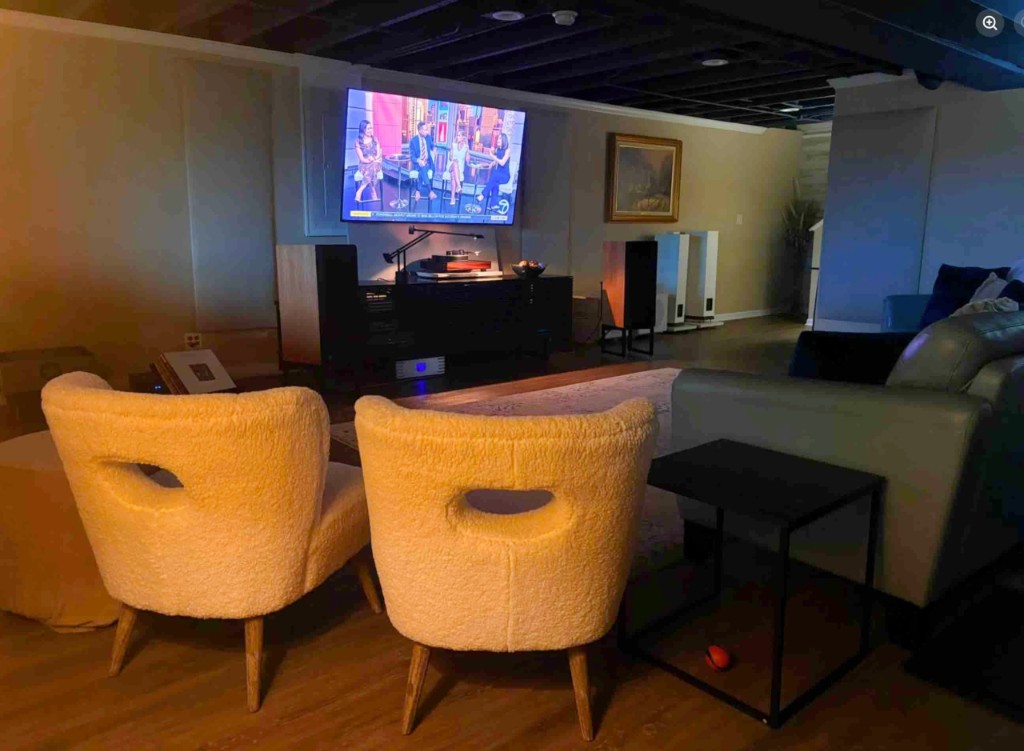
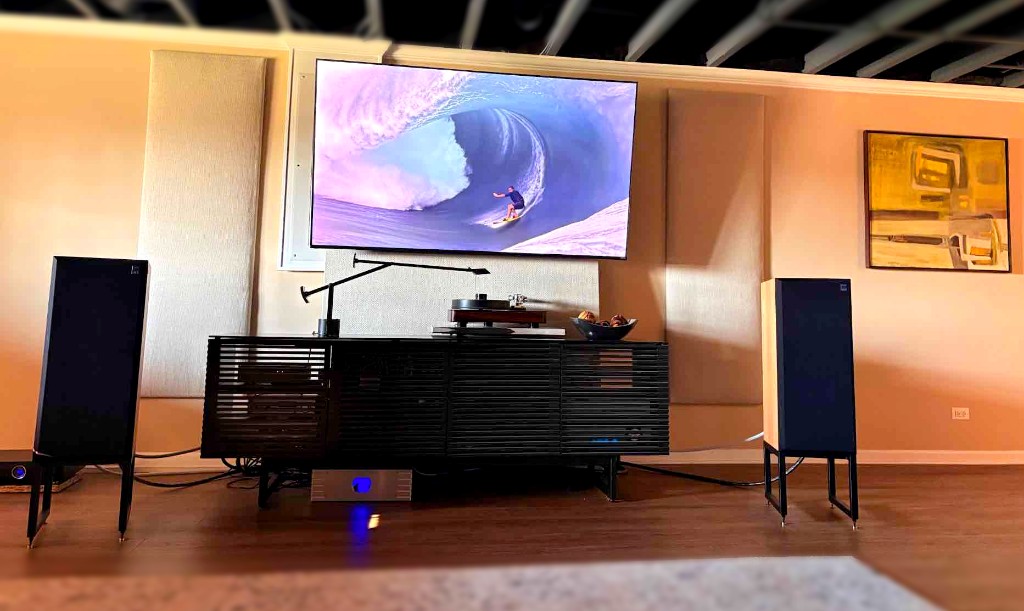
The SCM50 ASL Classics make for a gratifying A/V experience in our household. You can see my former white ATC SCM40s facing the front wall at right.
Initial Impressions
I've had a fascination with ATC SCM50s since my friend, Fred Kat (the former owner of Katli Audio and Usher U.S.A., who also sold ATC speakers), advised me that if I could afford it, I should get the 50s instead of the 40s for their more refined sound, adding, "discriminating audiophiles can tell the difference." Due to budgetary constraints, I ended up purchasing the passive 40s along with a pair of white REL S/812 subs, which sounded great. However, Fred's remarks always stuck with me.
When the opportunity came to review the SCM50s, I figured that I’d listen to them, write my review, and ship them back. No harm, no foul. I didn’t count on falling in love with them. But it was my wife, Belle, who especially surprised me!
A quick word on my wife: She's a minimalist who hates clutter. When it comes to stereo equipment, the fewer big boxes and dangly cables, the better! In fact, the reason we spent $3,000 on our BDI Corridor media console several years ago was to hide all of that – and to this day, she still says it’s one of our best investments. Given the opportunity to replace the visual vexations lining our front wall (the exposed amp, anaconda-like speaker cables, tall speakers, and massive subwoofers) with a sleeker solution we both love, she is completely onboard.
Now, at our home, we use my stereo setup for both music and HD TV. To my surprise, everything sounded noticeably better. I had been told that the SCM50s could be unforgiving, and I anticipated TV viewing as being extremely fatiguing and etched-sounding. However, it was quite the opposite. Tone, timbre, and detail for dialog, music, and overall auditory presentation were noticeably improved and more fleshed out. When we switched audio playback from the 40s to the 50s, Belle repeatedly raved about how much more she liked the sound from the 50s. Moreover, I was also surprised at how much more she wanted to sit and listen to music – be it digital or vinyl. It was uncanny. Although she harped on my excessive spending on audio and insisted that I bring that to a halt, she encouraged me to sell whatever gear I needed to in order to buy the 50s – and be done with it! Well, okay then!
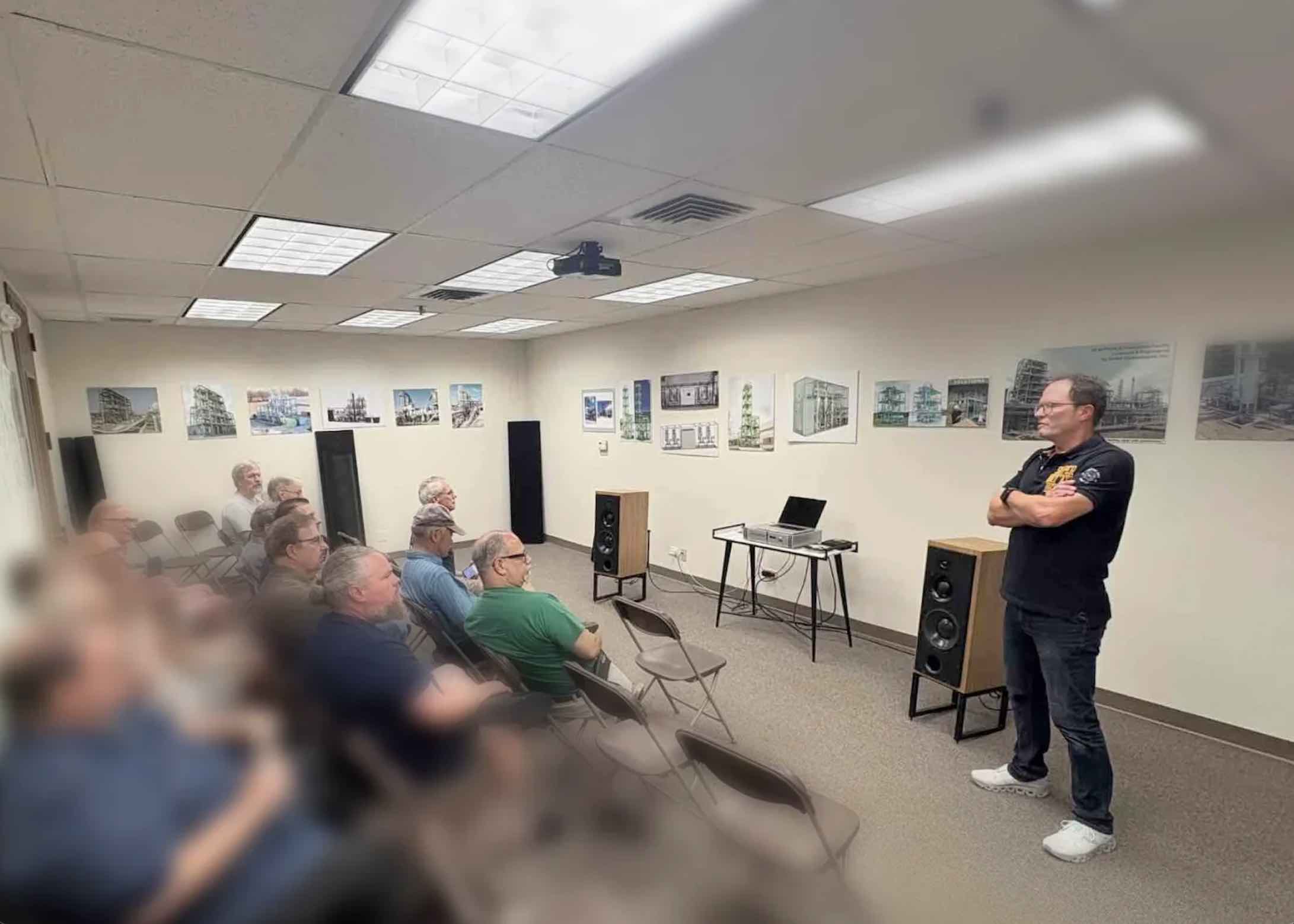
Lone Mountain Audio's Leland seen here demoing the ATC SCM50ASL speakers at a Chicago Audio Society meeting last July.
A Small Caveat
Now, making the move wasn't without a little pain. The SCM50 ASLs go down to a reported 36 Hz – which is plenty low for most speakers (keep in mind the chest bump you feel is around 60 Hz). And in order to afford the purchase, I would have to sell my REL S/812 subwoofers, which go down to a 19 Hz, making them an excellent companion for rendering subterranean bass from an organ, for example, bass-heavy dance music, or ultra-low home theater rumble. However, in weighing my options, I considered my priorities, which favor excellent music detail and delivery above low-end rumble.
When I discussed the SCM50s lower end with John Brunner, who provided the meeting space for their demo at the Chicago Audio Society last July, he said, "They had plenty of bass! In fact, they rattled something up in the ductworks overhead during the meeting!" Another friend, John Lumley, who builds his own amps out in Evanston, said, "There's not that much musical information below 40 Hz." And, if I really miss that, I reasoned, perhaps I can engage in a little horse trading for a subwoofer down the line. Maybe, but maybe not. Honestly, so far, whether listening to music or watching HD TV, that hasn't been a real issue. Thunderous bass or large screen explosions are more than satisfying and palpable with the SCM50s holding court sans subwoofers!
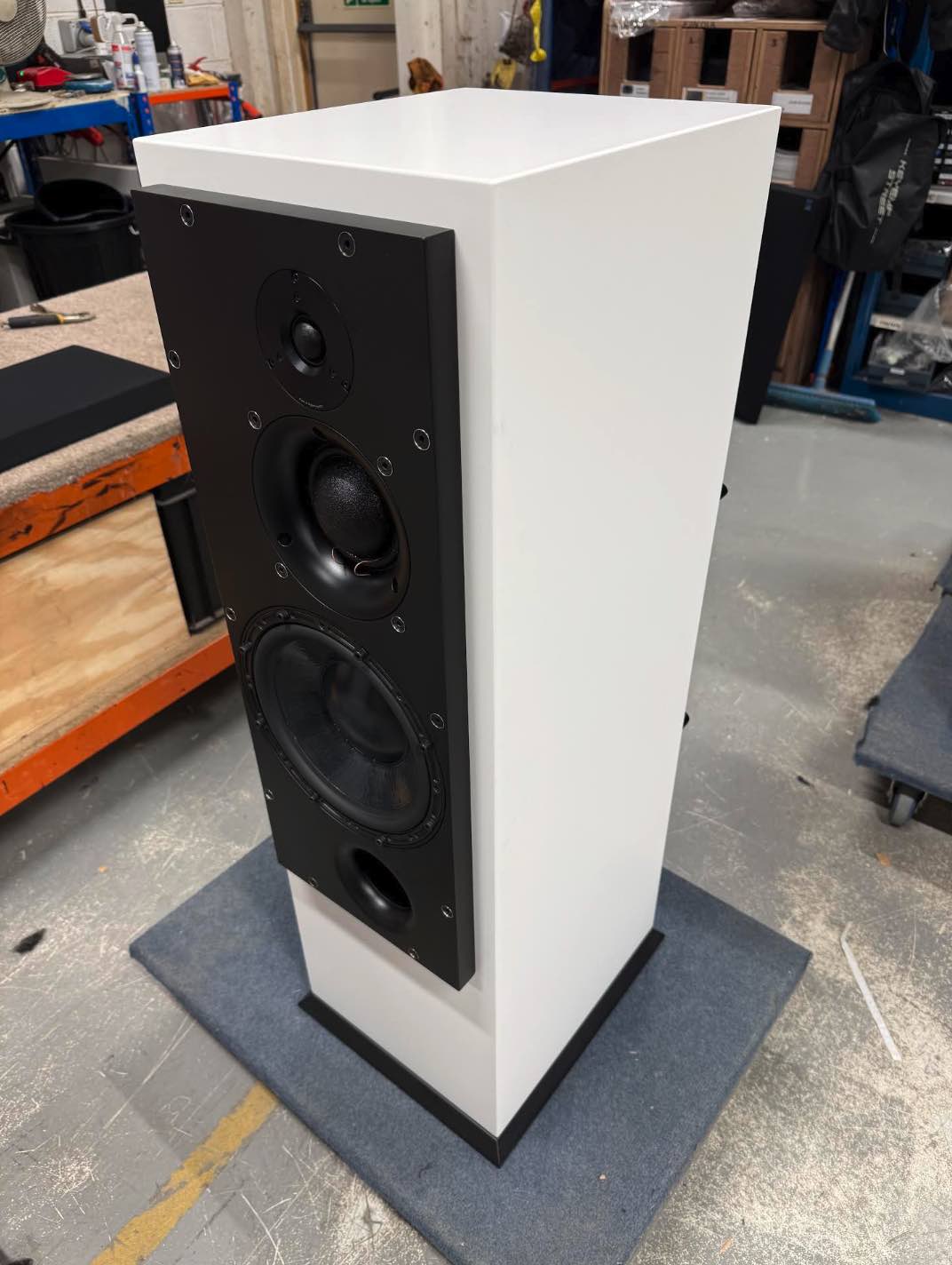
This is a snapshot of an ATC SCM50 ASLT tower speaker on the factory floor that Leland shared with us that we briefly considered (photo courtesy of ATC)
As we discussed our options, Belle initially wanted the full-length SCM50 ASL towers in white. Unfortunately, even though they sound identical, the towers cost several thousand dollars more than the Classic 50 review sample because of the extra wood and carpentry costs involved by extending their cabinets to the floor. ATC SCM50s are available in the Classic (stand mount) design, tower format, Active (ASL), and Passive versions. They also offer standard veneers of Cherry, Walnut, Oak, and Black Ash, or standard paints like Satin Black and Satin White. Soon, Belle decided she really liked the demo pair for their chic Oak veneer (natural wood is trending in 2026 interior design circles, I'm told), the Classic 50s monitor look, and the lower cost, so I did the math, listed some gear up for sale, and after several months, had the funds to purchase them.

My former reference, the ATC SCM40 passive loudspeakers, flanked here by REL S/812 subwoofers, were compared with the SCM50ASL speakers in the official listening tests.
Official Listening Tests

Listening to Eva Cassidy's "Take Me to the River," on the ATC SCM40s, her vocals are clear, Chris Biondo's driving bass line is meaty and well-articulated, Keith Grimes' guitar attack bright, and Raice McLeod's ride cymbal shimmers while his drums are punchy and hard-hitting Eva Cassidy. (Nightbird. 33 1/3 LP. Blix Street Records - G8-10210, November 13, 2015). With the 50ASLs, the presentation is bolder. The bass line, drums, and guitar are more forwards and live sounding. Ditto for Eva's vocals. Detail is more finely articulated, allowing you to hear more clearly into the mix, while affording you a more visceral experience.
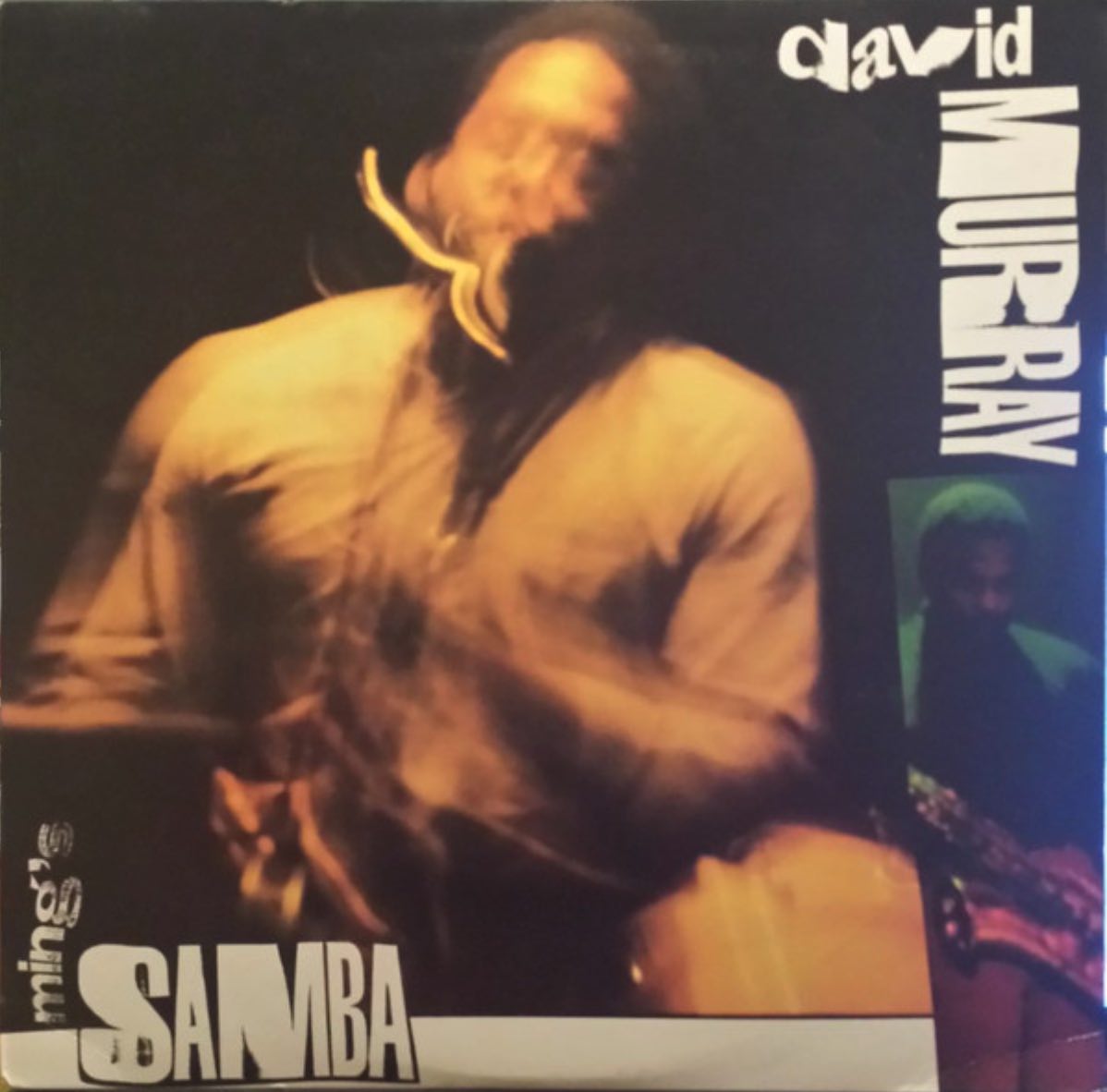
With the SCM40s, in David Murray's "Ming's Samba," Ed Blackwell's cowbell, snare, toms, and cymbals are crisp, and dynamic, while Murray's tenor saxophone's low squawks to its reedy highs are vivid, and John Hicks' piano comps and runs pack plenty of weight (David Murray. Ming's Samba. 33 1/3 Vinyl. CBS Records/Portrait Records, July 20, 1988. No. 44432). In contrast, the SCM50 ASLs renders punchier drums and more elucidated textures in the piano, cowbell, and drum heads. The aural presentation is a little more transparent. Murray's sax sounds crisper with a harder-edge – as is Hick's attack on the keys. Delineation between notes is a little more pronounced. The end result is a slightly more mesmerizing, impactful, with a live feel.

With the SCM40s, the attack and decay of Murray Perahia's piano in "Allegro" in Piano Sonata in B flat major "Hamerklavier" op. 106, is very clear, with a natural timbre and sense of space (Perahia, Murray. Beethoven: Piano Sonatas op 106 "Hammerklavier" & op 27/2 "Moonlight." 33 1/3 Vinyl. Deutsch Gramophone. 2018). With the SCM50s, Perahia's attack and on his piano is more authoritative, delivered with more weight and slightly more detail – particularly in the sustained notes and decay. The result is magnificent, extracting that extra bit of information throughout the sound spectrum. This is significant, because ATC's founder, Billy Woodman (who played the piano, himself), used a piano extensively to voice his speakers.
Concluding Thoughts
I intended to include more A/B comparisons for my official listening tests. However, just days later, a buyer enthusiastically plunked down a stack of cash for the SCM40 passives after hearing them bring Murray Perahia's 'Allegro' to life on the Dr. Feickert Analogue Woodpecker turntable. My comments stand.
The SCM50ASL loudspeakers bring an added depth of detail without sounding clinical or harsh. Textures are more vivid, and there's an enhanced air of naturalness in the midrange and highs, while a rendering a more palpable and lifelike presence down through the upper and mid-bass. Vocals, piano, percussion, strings, woodwinds, horns, acoustic bass, the precision bass, and drums are rendered with stunning clarity, timbral accuracy, and proper weight. Furthermore, last night, when dancing with Belle to Billie Eilish's "Birds of a Feather" cranked up loud, the thumping programmed and real drums, percussive loops, and Liverpool-styled bass were impactful, while Eilish's layered lead and background vocals – drenched in tape echo and reverb – teamed up with synthesizers, analog pads, acoustic and electric guitars, and a thermin for a punchy and intoxicating aural cocktail worthy of a small, high fidelity dance club experience. Mind you, I've heard speakers that are fuller-sounding, play a lower octave, or pack a wetter delivery. However, to my ears, those options are either far too expensive or introduce unwanted coloration – something I avoid as a reviewer and enthusiast. Meanwhile, some of the newer, trending notables sound a touch too synthetic for my taste.
And, as my designer friend pointed out, by going with an active speaker as my reference, I lose the ability to tune or test them with separate amplifiers. However, I really like the sound of them with their proprietary amp packs, and when it comes to occasionally reviewing other amps or speakers, I have my means. Bottom line, the SCM50s speak the truth with authority. They tell me what's in the recording and inform me of the impact of equipment introduced into the signal path with superb fidelity, which is invaluable to me as both an audio enthusiast and reviewer. At roughly $25,000 retail, they're certainly not inexpensive. However, if you can afford them, the ATC SCM50ASL loudspeakers are outstanding performers worthy of your consideration, and I not only recommend them, but have put my money where my mouth is; I purchased my review sample.
ATC SCM50 ASL Loudspeakers
Retail: $24,999
ATC
Lonemountainaudio.com
ATC.Audio
Addendum: A Short Treatise on Passive versus Active Loudspeakers By ATC's Ben Lilly
Ben Lilly previously wrote this short paper entitled, "Passive vs Active Loudspeakers," explaining the benefits of an active system in a short paper below. Now, if you're already familiar with the technical fundamentals – or simply want to skip the breakdown – feel free to skim ahead."
What are the differences between passive and active loudspeakers?
Passive loudspeakers employ crossover filters that only use passive components: capacitors, inductors, and resistors. They can attenuate the signal, and whilst amplification is achievable over limited frequency bands, it is only via resonant ‘ringing’ circuits which are undesirable. The position of the filters within the signal chain is between the power amplifier(s) and loudspeaker drive units, so they operate at ‘high level’ and are exposed to high voltages and currents, resulting in components that are physically large and with high power handling. The filters are loaded with relatively low impedances, so the component capacitance and inductance values are high. The combination of high-power handling, large size and high component value results in expensive parts. Active loudspeakers employ active (powered) crossover filters that can attenuate and amplify the signal. They may also include filters that affect the phase/timing of the signal plus limiters to ensure amplifiers do not ‘hard clip’. The position of the filters within the signal chain lies between the pre-amplifier and the power amplifiers. Their nominal operating level is around 1 volt, and the filters operate at relatively high impedance, resulting in filter components of modest size and value. Each loudspeaker frequency band has its own dedicated power amplifier; typically, two in a 2-way system and three in a 3-way system. Small to medium sized active loudspeakers typically feature all the electronics within their loudspeaker enclosure. Larger systems featuring more powerful amplifiers may have a separate enclosure(s) for the electronics. While it is possible to design a high-performance loudspeaker using passive components – and ATC make some outstanding passive systems - an active design will always outperform its passive equivalent due to many benefits. These are listed below:
- More Accurate Crossovers
1.1. Typical loudspeaker loads - or impedances – found in commercial products are 4, 6 and 8 ohms. When designing passive crossover filters, the component choices are based on the load the crossover filter ‘sees’ which, in the case of a passive loudspeaker, are the loudspeaker drive units. Herein lies a problem as the load a loudspeaker driver presents to a passive filter varies with both frequency and temperature. When the listening volume and amp power increases, so does the driver voice coil temperature. This results in a passive filter with a crossover point and damping factor that changes according to the listening level and input power and results in a loudspeaker system which has a different ‘voicing’ at lower vs higher volume levels. Conversely, the performance of an active filter does not change with listening level and input power as they are not connected directly to the loudspeaker drive units. Instead, they are connected to the active speaker power amplifiers which provide a fixed load and consistent listening experience, regardless of volume level.
1.2. The phase response of both passive and active crossover filters is tightly linked to the filter frequency, order and Q-factor. Modifying any of these filter parameters will also change the phase response, which may result in an undesirable phase difference at the crossover point. Further subsequent changes to improve the phase response will lead to compromises elsewhere. Within an active system we can include additional all-pass filters. These are circuits which pass all frequencies equally but change the phase relationship between different frequencies, therefore offering the ability to optimise the phase response through the crossover region. With a well-engineered active system, the crossover filter and resulting active loudspeaker system will have a superior phase response to the passive equivalent, with an improved tonal balance, and far superior imaging.
- Wider Practical Choice of Crossover Type/Shape
The large value, high power components used in passive crossover networks are bulky and expensive. As a result, if the ideal filter choice is of a more complex design, practical space and cost considerations may lead to a compromise. Once the choice has been made to implement an active crossover, increases in circuit complexity result in modest space and cost increases, and the final design is unlikely to be compromised, resulting in higher performance and a better listening experience.
- Greater Dynamic Range
Passive crossover filters are driven by power amplifiers and operate at ‘high level’ and low impedance. Even if a designer is willing to ignore practical limitations in relation to physical size and cost, the large high-power inductors required for passive filters will have series resistance that results in a reduction in system efficiency (power dissipated as heat in the inductor). Active crossovers filters are located before the power amplifiers and operate at line level loaded with relatively high impedances. As a result, the circuits offer virtually zero loss, and an active loudspeaker system will offer improved dynamic range when compared to its passive equivalent.
- Ideally Matched Amps and More Efficient use of Power
Amplification for passive loudspeaker systems is usually selected based on customer and retailer experience, alongside the loudspeaker manufacturers published data. Due to a lack of clarity, amplifiers can easily be under-specified, resulting in poor performance, or over-specified, resulting in far higher costs. As an active loudspeaker system is designed and engineered by a single company with the greatest level of insight into the requirements of the loudspeaker; all aspects of the amplifier performance can be perfectly matched. Not only that, but as power is not wasted in passive crossover networks, the designer has the option to use smaller amplifiers or alternatively, to offer greater dynamic range.
- Improved Frequency Response and Stereo Matching
Passive loudspeaker frequency response and stereo matching relies on drive unit and crossover component tolerances. The adjustment of production units to match a ‘golden reference’ would require the replacement of large, soldered components. In practice, this is too difficult and time consuming. Within an active system, it is simple and cost effective to implement individual gain trims for the two, three or four amplifiers involved. This allows fast and effective fine tuning of the loudspeaker response, ensuring that active systems have better stereo matching, a flatter frequency response, and are more enjoyable to listen to.
- Better Driver Control
Any electrical resistance that exists between an amplifier output and drive unit input reduces an amplifier’s damping factor and its ability to control the drive unit motion. A conventional passive loudspeaker features series inductors within the crossover circuit and, typically, 3 metres (10 feet) of speaker cable between the amp output and driver input. Both resistances reduce driver control and, at worst, can result in undesirable ringing/resonance over certain frequency bands. An active speaker employing active crossover filters and on-board amplifiers results in the best possible driver control, as there is only a short length of speaker cable between the amp output and driver input.
- Lower Intermodulation Distortion
Passive systems are usually driven by a single amplifier that operates over the full audio band. The amplifier is burdened by the heavy workload of low frequency reproduction, whilst also having to amplify the subtle details in the mid and high-frequency range. The high power demands from the low frequencies can cause the amplifier to clip, generating subsequent loss in quality in the higher frequency bands. Not only must the amplifier drive the speaker, it must also act to damp any voltage generated by the driver(s) in operation. High-performance amplifiers are designed to have a very low output impedance and subsequent high damping factor, so their output is affected as little as possible by voltages generated by the loudspeaker drivers. But they must also contend with intermodulation distortion caused by nonlinearities or time variance in the signal processing, which produces additional components (spikes) in the frequency response. Inserting a resistive passive crossover between the driver and amplifier is likely to increase intermodulation distortion. Active systems feature multiple amplifiers dedicated to each frequency band, and as the amplifiers are located after the crossovers, they operate over a limited bandwidth. In addition, the amplifiers have the lowest possible resistance connection to the drive units, leading to optimal damping of reverse voltages generated by the drivers. This reduces intermodulation distortion, and, in comparison to a passive system (even a bi or tri-amped passive system) an active system will show 15-to-20dB lower intermodulation distortion, resulting in greater clarity and less listening fatigue.
- Better Value
For a very long time, improvements to a Hi-Fi system have relied on small incremental improvements to separate components within a system, whilst often overlooking the fact that the loudspeaker (and its environment) are the weakest elements. Active loudspeakers offer a significant improvement in performance to the weakest link in the signal chain, resulting in outstanding value. In addition, because an active system is designed, engineered, and manufactured by a single company into as compact a package as the design allows, cost is saved on electronics case work and packaging. The manufacturer can invest in real performance enhancing changes or pass the saving on to the customer."