

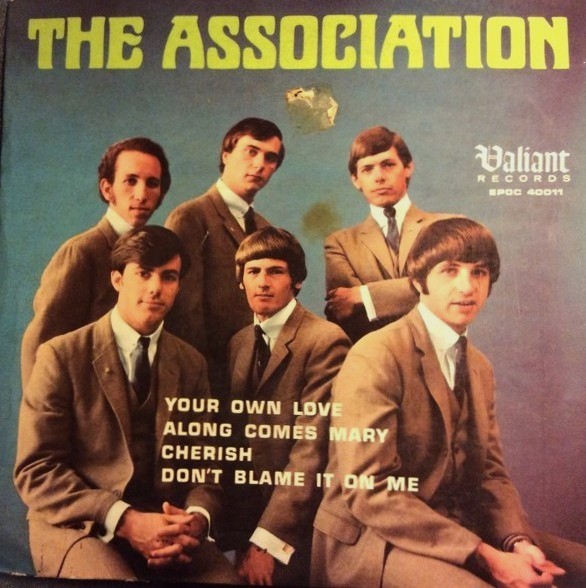
This review of The Association’s debut album, And Then...Along Comes The Association (Valiant VLS 25002), has been a long time coming. Why did I take so long? The only lame excuse I have is this: I like this album a lot, and didn’t feel like doing the needed homework that the title deserved.
I wish there had been more live TV performances of The Association in their prime. They were on plenty of TV shows, but sadly most of them featured the group lip-syncing their hits. But then...there’s their performance from The Monterey International Pop Festival. It’s incredible! More on that later.
Mostly known for the delightful sound of their combined voices, The Association were excellent musicians, but their perfectly crafted hits were played by studio musicians. In fact, when they signed with Warner Brothers, and recorded their third and fourth albums, they were required to work with The Wrecking Crew. Eventually, Warner Brothers softened their grip and allowed them to record playing their own instruments, but by then the hits were behind them. Their story is one of interest, but this article pertains to their finest creation: their debut album for the independent label Valiant.
The six-member band emerged from the Los Angeles folk scene in 1965. At the time they recorded their debut album, the members were Terry Kirkman on vocals and woodwinds, Jim Yester on vocals and guitar, Jules Alexander on vocals and guitar, Russ Giguere on vocals and guitar, Brian Cole on vocals and bass, and Ted Bluechel on vocals and drums.
And Then...Along Comes The Association is a fine album, one that’s been a part of my life for more than forty-five years. It features flawless vocal harmonies, very good songs, excellent musicianship, and the severely underrated work of a brilliant nutjob producer, Curt Boettcher. It also sports excellent sound quality. Whether you think of The Association as vocal pop, soft-psych, chick rock, progressive folk-pop, or family-friendly schlock, I’m going to tell you why I love more than half of this album.
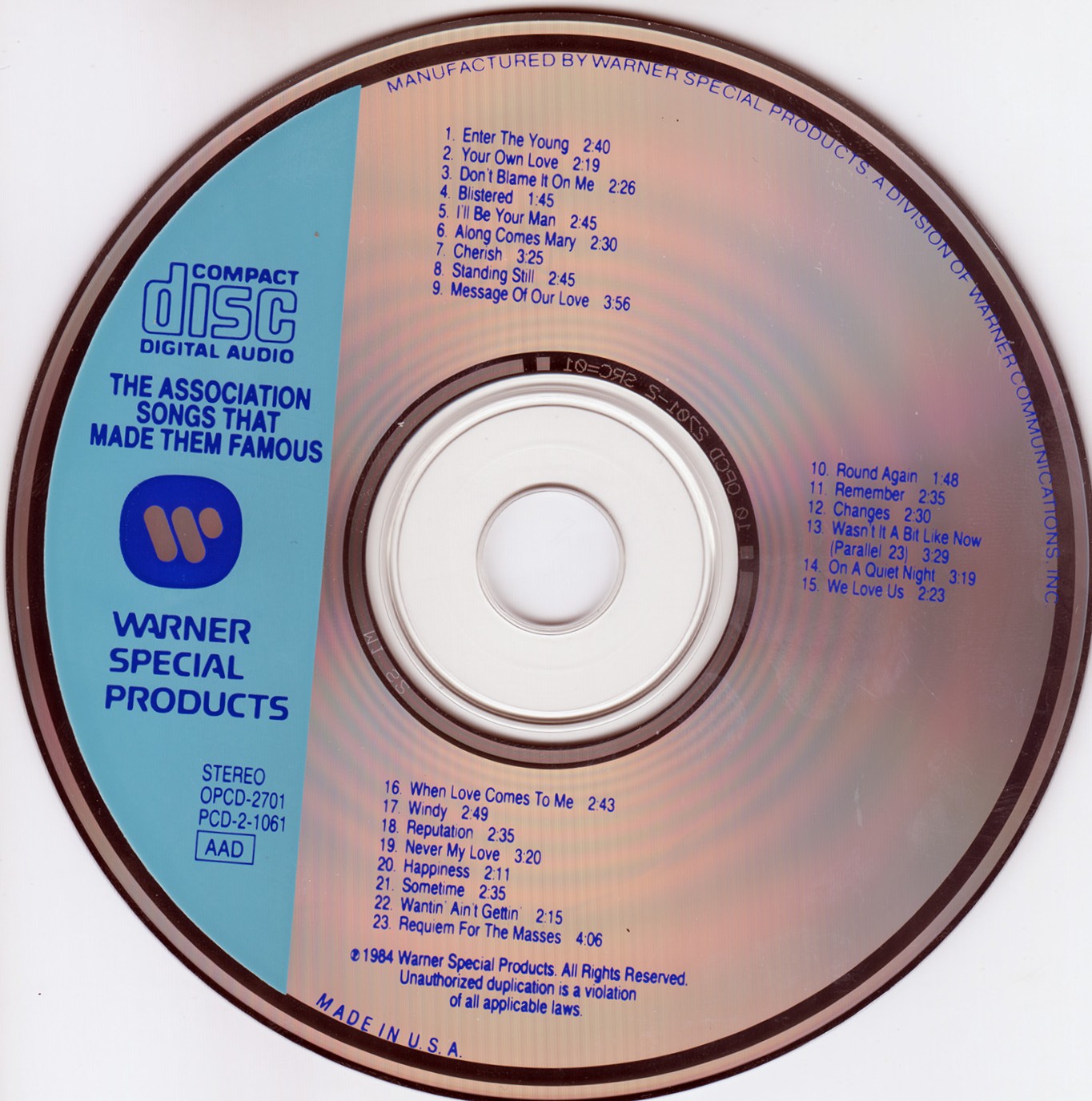
For most of the time I spent writing this review, I listened to the superbly mastered CD from Pear Records, Songs That Made Them Famous (Pear PCD-2-1061).
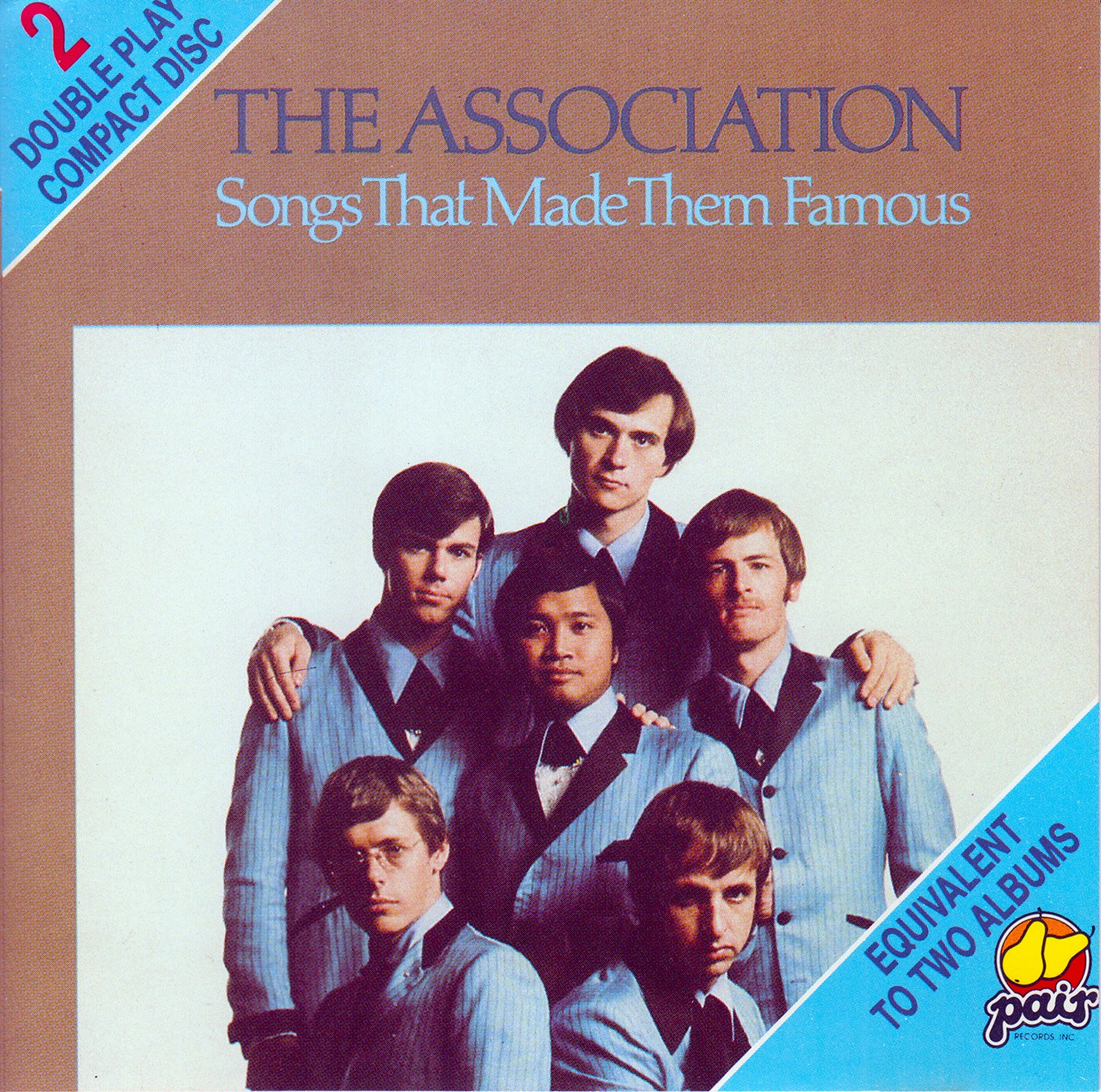
Pear, once a division of Warner Special Products, made CDs from pairs of albums. The two albums on this CD are And...Then Along Comes The Association and Insight Out. Even though I own three pristine copies of the Valiant LP, playing the CD wasn’t just convenient; it was fun! It’s exactly how an analog-sourced CD should sound: completely free of doctoring. Another way of describing it is: true to the master tape!
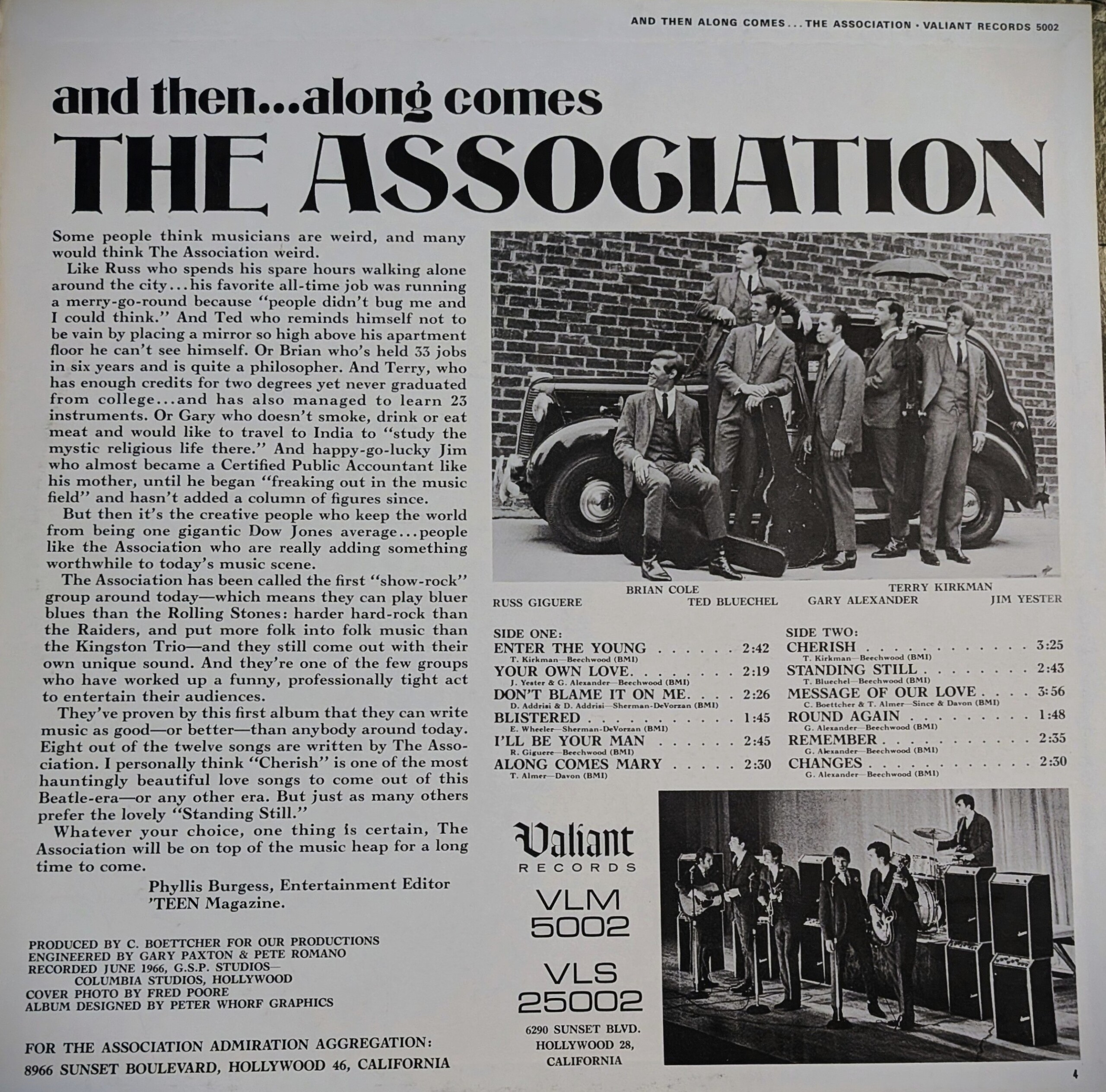
And Then...Along Comes The Association opens with the totally groovy “Enter The Young.” Composed by Terry Kirkman, it’s two minutes and forty seconds of unbridled groovyness. The lyrics, which are sung in unison, sound simultaneously assertive and uplifting. The song is a positive message for young people facing the new and complex world of responsibility. It encourages them to think independently, and to climb the ladder of life “rung by rung.” As the album was issued in July of ‘66, it’s lyrically a perfect opening track for a summer release. Listen to it and you’ll understand why this is so.
Playing “Enter The Young” after years of being away from it feels like coming home. I love it and I love the way it sounds. It’s a perfect example of stereophonic excellence. The first thing you’ll hear is the downbeat from an electronic keyboard on the left, and soon-to-be Music Machine organist Doug Rhodes playing a celeste on the right. (I wrote about The Music Machine HERE.) Also on the right is a vivid tambourine. Six seconds marks the arrival of what sounds like four voices singing “Here they come” placed in the center. The most prominent instrument is a keyboard. It sounds like either a Fender Rhodes or a Vox Continental. The drummer is excited and I get excited every time I hear Alexander’s searing lead guitar. And when all six members finally join in, you’ll hear what made The Association great.
Cut two, “Your Own Love,” is just plain awesome. It explodes with bright colors and those velvety vocals. And then...there’s the percussion. The drumming is tight and clean, and I wish I knew who played the tabla. This, along with the almost simultaneously recorded “Love You Too” by The Beatles, makes it one of the earliest uses of tabla in pop music. This is one of the many examples of Boettcher’s unique musical vision.
Cut three, “Don’t Blame It On Me,” composed by the songwriting brothers Donald and Richard Addrisi (who also composed “Never My Love”), is a teensy bit of a guilty pleasure. It’s a little sappy, actually really sappy, but I love it. It also satisfies me as an audiophile. It opens with the sparse sound of two widely spaced drummers. The drummer on the left makes small sounds on his high hat and on one of his toms, while the drummer on the right thumps a delightfully fat kick drum. The two drummers are assisted by some tambourine shakes emanating from the right, with some subtle underpinnings of an electric bass. All of this happens for seven seconds before Kirkman sings the first verse by himself. His arrival comes with another percussionist playing vibes on the left. The rest of the group sings in the second verse while being joined by another piece of percussion: a triangle on the right that will tickle your ear. If you're proud of your tweeters, it will make you prouder! I couldn’t find any information regarding whose idea it was for the minimalist percussion backing. The brilliant vocal arrangement was by Clark Burrows of the Hi-Lows. (Burrows also arranged “Never My Love.”) Although this isn’t in any way rock ‘n’ roll, it’s nonetheless excellent pop. Playing it on headphones is a euphoric audiophile experience.
Cut six, “Along Comes Mary,” is one of the greatest rock songs ever created. It’s also one of Mr. Records’ favorite crank-it-up-to-eleven demo cuts. Jim Yester’s rapid singing is flawless. His tenor voice is fabulous, and he accomplishes the unimaginable: He sings the complex nonsensical lyrics without a hitch. How crazy are the words? They’re insane, and trying to decipher them is a waste of time, because the effort takes your mind off the infectious groove. What does “when vague desire is the fire in the eyes of chicks whose sickness is the games they play” even mean? Better said: What’s this crazy song about? Here’s the answer: It’s about the “fails and tribulations” that “no one ever sees,” and smoking weed. Boettcher, and, of course, every member of the band, puffed the magic dragon. Luckily for The Association, and the rest of humanity, the song’s provocative lyrics flew right past the censors. Boettcher shared plenty of “mary” with his pal Brian Wilson, whose music was a huge influence on The Association.
The man who wrote the trippy lyrics was Tandyn Almer (1942-2013). Almer was a good friend of Boettcher and Wilson, and had the honor of being interviewed by Leonard Bernstein on TV. Almer, along with Van Dyke Parks, helped Wilson write The Beach Boys’ hit “Sail On, Sailor.”
The sound on “Along Comes Mary” is truly awesome. However, if you play it loud, like you should, and like I just did on my Sherwood S-7650-driven Sennheiser HD650s, you’re going to hear a few sonic warts. Most sixties rock recordings have them, and attempts to fix them never work. This is a hard-rocking group of musicians pounding the inputs of an old school tubed recording console. And then...there’s Kirkman’s recorder. It’s a crazy sounding woodwing not commonly heard in rock music. It’s reminiscent of the ocarina solo in “Wild Thing” by The Troggs. And then...there’s the opening riff. It’s freaking awesome, and it’s played twice, the second time in a higher key. And it returns, midpoint, in a modified form. The opening also features a bass line that’s one of the grooviest ever recorded. After playing it countless times, I finally had to know who played it. It was none other than studio legend Jerry Scheff, who, up until now, I only knew from his work with Elvis. How did Scheff create his standup bass-like sound? I couldn’t find an answer, but I’d surely love to ask him. His amp sounds like it was mic’d in a corner, or it was placed near a wall, but neither explains how he achieved his acoustic bass-like pluck. I wonder if, perhaps, he was helped by an uncredited musician playing an acoustic bass. According to all the available info, the only bass on the record was Scheff’s electric bass. In short, “Along Comes Mary” is the result of the perfect rock ‘n’ roll recipe. It has great keyboard work, kick-ass bass playing, irresistible hand claps, a prominent cowbell played by the incomparable Hal Blaine, amazing vocals, a peculiar woodwind, insane lyrics, and a groove that won’t let go. It truly is as “sweet as the punch.”
I’ve had a decades-long love/hate relationship with cut seven, “Cherish,” which is also side two, cut one, on the LP. It’s so sappy, and yet it’s so uniquely perfect. It's also an omnipresent piece of western culture, so I decided to make peace with it. Surely it must be the greatest use of chimes in all of pop music. The lyrics were by Kirkman. Although the backing musicians were all hired hands, the vocal arrangement was by Alexander. And, of course, you know it well. It’s also a uniquely layered recording, not unlike what The Beatles were creating at roughly the same time. I think it’s interesting that Boettcher and his cohorts were exploring some of the same musical ideas as the Fab Four, and they were doing it at the same time. Perhaps it was the drugs. Playing it on the CD was enlightening for me. Without having to turn the LP over, I heard it right on the heels of “Along Comes Mary.” This made the contrast in production between the two songs even more striking.
The iconic chime on “Cherish” is an interesting subject, or at least it is to me. Some sources say that the sound was electronically created. Yeah, right. I’m with the others who claim that a real chime (a tubular bell) was struck. In addition to the chime, I hear an electronic sound played in unison. Another noteworthy subject is the use of the celeste. Doug Rhodes is again credited as the celeste player, but unlike “Enter The Young,” where the sound of a celeste is easy to identify, I’m struggling to hear one on “Cherish.” At the opening I hear a slightly weird-sounding piano. Is this the celeste that Rhodes is credited with playing? Maybe there’s a mute pedal on some celestes that makes them sound closer to a piano.
I love cut eight. “Standing Still” has all the hallmarks of The Association's classic vocal sound. It was composed by drummer Bluechel. Since my recent reacquaintance with this album, I’d love to know who’s singing the lead vocal, but I was unable to find this info. Meanwhile, the sound is interesting. It has a vintage crudeness that I latch onto. Although I wish it had the lush enveloping sound that was achieved one year later on Insight Out (Warner Brothers WS1696), the drums are impactful and everything is tonally correct. (The entire album has great bass.) The twangy guitar (probably Alexander) and the tambourine give it the wild and crazy sixties sound that I’m hooked on. And it has bongos!!! Sonically, it has all of the groovy traits of an all-tube, second tier studio recording.
Alexander’s “Remember” has always been a favorite of mine. Despite the adolescent lyrics, Boettcher's trippy production is insanely cool with its wide-open spaces and eerie electronic sounds. Yester’s solo vocal is downright inviting. It’s easy to love his voice on this cut. It’s also easy to love the recorded sound. A lot of music, great sounding records, and audio system upgrades have happened since I first encountered this LP. And yet, “Remember” still delivers the sonic goods. Yester is perfectly focused in the middle, and he’s helped by a room-rattling kickdrum and tinkling chimes on the right. Two other singers accompany him in this song. I’m playing it as I type. I wish everybody reading this could hear what I’m hearing, but there’s only room for one in my headphones.
A few cuts are awful. Most great albums have bad cuts, and I prefer to skip them. On the awful cuts, I wonder if the guys ran out of ideas, or if Boettcher took the night off, left them with a babysitter, and went to Brian Wilson’s house to get loaded. I can’t stop anybody from playing the closing cut, “Changes,” but it left a bad taste in my mouth. It is, however, played by the actual band, rather than studio musicians. To the completeists out there: Playing every cut on this album is a buzzkill. This album has seven great cuts that will play in your head for hours. I did the simple math and realized that And Then...Along Comes The Association has more great cuts than any album by Bob Dylan or The Byrds. This doesn’t mean that I like The Association better than their contemporaries, but a strong album is a strong album.
The recording of this album is very interesting. All of it was recorded in Los Angeles. The rhythm tracks were recorded in a makeshift four-track home studio owned by producer Gary Paxton. Paxton, another eccentric in Boettcher’s circle, had produced, along with the infamously eccentric Kim Fowley (who discovered The Runaways), “Alley Oop” by the Hollywood Argyles. (Paxton also produced and recorded “The Monster Mash” by Bobby Boris Pickett.) The studio musicians, with some help from Kirkman and Alexander, laid down the basic tracks. The basics were then mixed down and dumped onto another four-track machine at Columbia’s studio. This is where the vocals and additional overdubs were added. While all of this information is readily available, what is not available is the recording dates of each cut, and what exactly was recorded in the two different studios. Most of the album has the classic bounced-tracks sound typical of many mid-sixties rock albums. My ears tell me that while “Cherish” has a groovy, slightly tarnished, bounced-track sound, “Along Comes Mary,” with its solid bass, greater dynamic range, greater clarity, and Hal Blaine’s vivid cowbell, sounds cleaner. Again, I wish I had access to the recording dates.
Is the vinyl better? No and yes. I’ve been through a lot of copies of the Valiant stereo LP, and currently I have three. On most cuts the CD kept right up with the LP. On my super hot LP copy, “Enter The Young” has better bass. Could this be the mysterious magic of vinyl?
Having dived way deeper into this album than I ever thought possible, Jim Yester's talent became apparent. His brother, Jerry, was part of The Modern Folk Quartet (MFQ), and I love the MFQ, but I digress. Jim is a great lead singer, a great guitarist, and a pianist. His vocal on “Along Comes Mary” is only one thing: perfect. And he sang it just as well on stage. The Monterey performance of “Along Comes Mary,” the one that’s in the Rhino 4-CD box (R2 70596), is worth the entire set, and their performance of “Windy,” is almost as good. But if you can’t play it loud, leave it on the shelf until you can. You need to crank it beyond eleven so you can hear The Association rocking their hearts out. Folk great Larry Ramos (1942-2014), formerly of The New Christy Minstrells, had just joined the band. He and Yester played dueling lead guitars, and their playing on this particular date was electrifying. Hearing The Association, whom we think of as a vocal group, rocking hard, and sounding like The Jefferson Airplane, is only one thing: unbelievable!
It's a mystery why Boettcher never produced another massive hit album. He did, however, produce some hit singles for Tommy Roe, including the ever-enjoyable “Sweet Pea” and “Hooray For Hazel.” They feature the same musicians who played on And Then...Along Comes The Association. And so does Roe’s followup album, It’s Now Winter’s Day (ABC 594), which I used to have. Boettcher’s short life (1944-1987) would be the perfect subject for a documentary. And Then...Along Comes The Association was not only his first as a producer, it’s his masterpiece.
Lastly, check out The Professor of Rock’s excellent interview with Alexander and Yester HERE.