


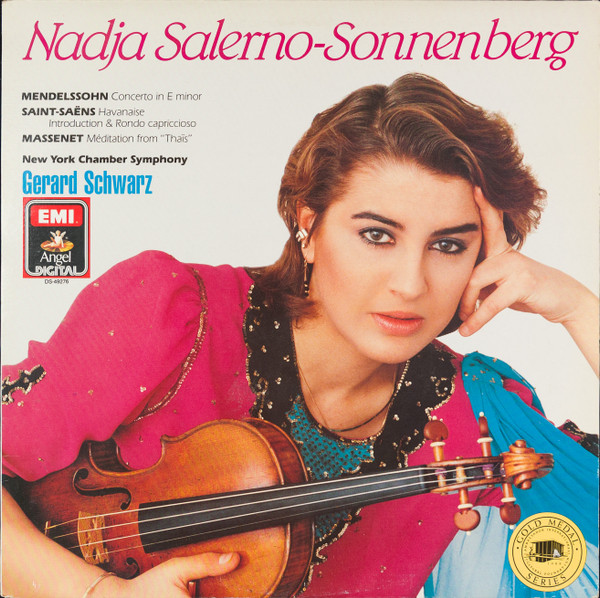
MENDELSSOHN: Violin Concerto; SAINT-SAËNS: Havanaise; Introduction and Rondo capriccioso; MASSENET: Thaïs: Méditation
Nadja Salerno-Sonnenberg, violin; New York Chamber Symphony/Gerard Schwarz
EMI CDC 549276 (CD, 1988). TT: 60.08
In a few recent blog posts, I've discussed what I call the shifts in the culture over time: the way in which a creative figure, after looming large, can fade into obscurity within a few decades. First, I considered Morris West, a high-profile, literary mass-market novelist from the '60s through the '80s; now, I doubt Millennials have even heard of him. Later, I examined conductors Riccardo Muti (still active today, but no longer the back-to-the-score innovator of his early hype) and Bruno Walter (still a discographic presence in my teens, but his star faded where Toscanini's didn't).
The present soloist fits into the same category. The violinist Nadja Salerno-Sonnenberg gained some notoriety in the '80s, not just for her accomplished playing, but because she – ahem – “made faces” while she performed. I'm always suspicious of conspicuous grimaces and such; I also recognize, conversely, that the Heifetz fish-on-ice demeanor isn't for everyone. Oddly, I'd managed not to hear her until now.
The Mendelssohn tells us most of what we need to know. The soloist is marvelously adept in the runs, has a wide dynamic range, and brings a strong tenuto feeling to the lyrical sections. But many of those heavy tenutos impede the flow without actually being expressive; and the delicate pianissimos don't float, or really sing. (I began wondering whether the facial tics were meant to simulate an intensity and expression missing from the actual playing.) The orchestra is professionally competent, but Maestro Schwarz could have been more help: a clumsy ritard or two in the first movement probably reflects unfinished stick technique more than any deliberate artistic choice.
On the other hand, the Havanaise that follows is the best thing on the program: it comprises mostly rapid figurations, giving Ms. Salerno-Sonnenberg no time for ponderous pondering – she just has to play, and she rips through the passagework brilliantly. Unfortunately, the slower bits of the Introduction and Rondo capriccioso – “rondo cacciatore,” as one of my teachers called it – revert to the concerto's belabored manner, though the main theme gets some lift.
I'm afraid the M馘itation is the nail in the coffin. The soloist probably thinks she's lavishing love on the main theme, but she's merely rendered it inert. (Neither does she obviously inflect it: every note comes at more or less the same intensity.) Here, Maestro Schwarz almost saves the day in the middle section — pacing it rather faster, moving the players along in a unified sense of purpose. But he lets us down at the coda, if you're listening carefully: half the players, more or less, don't enter immediately.
Perhaps some shifts in the culture represent an improvement....
Stephen Francis Vasta
stevedisque.wordpress.com/blog