
Creating A New Contender
While the obvious goal of attending a world-class Audio Show like this past April's AXPONA, or this June's inaugural High End Vienna, is to experience all the new and exciting toys, one of the more enjoyable aspects of such events, for me at least, is getting to spend time catching up with colleagues and friends I only get to visit with at these shows.
So when I walked into the Mobile Fidelity suite at AXPONA, hosted in the large Schaumburg B room, I was only too happy to run into Peter Madnick. Imagine my surprise, and the degree of engaged curiosity I felt, as he rather excitedly began to share the details of his latest creation for MoFi electronics with me, the UltraPhono Pro phonostage.
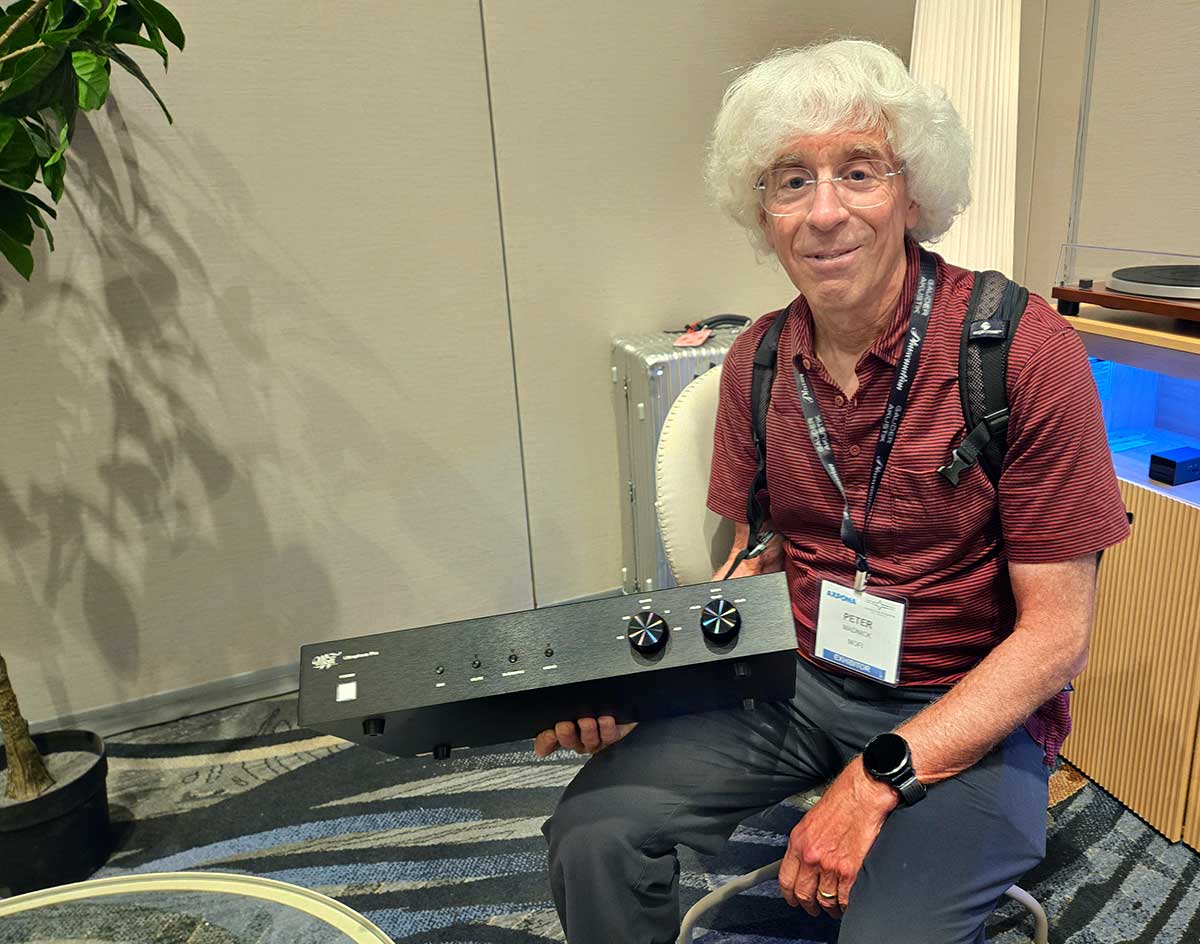
MoFi Electronics Lead Audio Products Electronics Design Engineer, Peter Madnick, holding their new UltraPhono Pro Phonostage at AXPONA 2026
Though we didn't actually meet until the late 1990s, I've known Peter through his work since he and Mark Schifter co-founded Audio Alchemy in 1989, a brand that soon reset the bar for producing groundbreaking, budget-friendly external DACs, digital processors, and other audio electronics.
Peter has been working his craft for some four decades now, and has designed or collaborated on something like 450 audio products! Ranging from the disruptive Audio Alchemy gear that garnered such acclaim in the early 1990s, to creating the cutting-edge, high-end reference Constellation electronics in the early 2010s, he has most recently joined the design team at MoFi Electronics as their Lead Audio Products Electronics Design Engineer.
Followers of my work will recall that I reviewed the first phonostage he crafted under the MoFi Electronics badge, the MasterPhono, with Episode 207: MoFi Electronics MasterPhono Phonostage (HERE) at the close of 2024, and with the print version here at Positive Feedback, with Issue 137 (HERE) in the first days of 2025.
Creating A MasterPhono LITE
Now, if you haven't already seen my take on the MasterPhono, I'd ask you to have a look, and I will quickly offer this spoiler. That beast not only represents an elegant and brilliantly effective design, with superb execution, offering more features than you'd have any reason to expect, but it delivers an unexpected level of accomplished performance; it is a paradigm of overachievement. Yes, it is something special!
So, as Peter was introducing me to the UltraPhono Pro, I was not surprised to learn that it was, mostly, simply a pared-down version of the MasterPhono. Where it scales down its less-essential feature sets and broader versatility, it still uses essentially the identical exemplary passive RIAA equalization and fully balanced, discrete JFET amplification circuitry to find its remarkable voice.
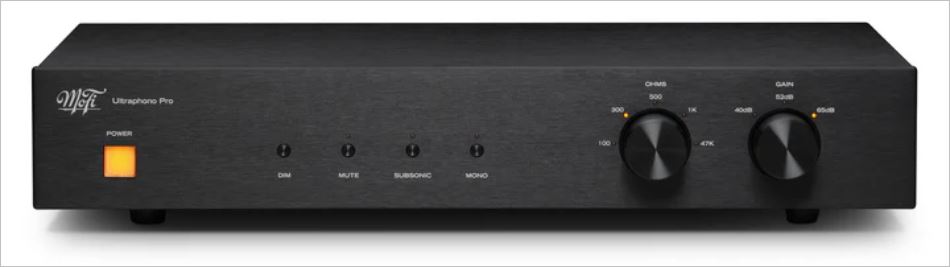
Working from the superbly accomplished MasterPhono as a template, the UltraPhono Pro was realized primarily by reducing some of its flexibility and by the omission of a few less "crucial" features. In Peter's own words, "UltraPhono Pro really is a Masterphono with the "non-essential" stuff removed or modified so it can sell for less. The DNA of it is really untouched."
He expands on this with, "The outside changes of no meters, no wood side panels so the chassis can be shorter and less deep are obvious, especially that the open gap between the power supply section and the audio circuitry is gone. From the back, you no longer see the current, the second voltage input, or either of the balanced input jacks.
Internally, the circuitry is now on a single PCB, instead of the original three - the input board and the power supply are now part of the main board. That single board allowed us to get rid of a substantial number of plug-in wire harnesses. There are fewer loading selections, and thus the very expensive relays which had been required to enact a selection.
So what's left? Basically, everything that is important. The voltage input stage is identical, the existing loading selections are enacted the identical way. The passive RIAA is the same topology and uses the same parts. The output stage is the same as well. The switching power supply is the same, but does have one fewer set of voltage regulators."
Make It Sound The Same, Just Not As Expensive
First, the choice to conflate the multiple PCBs into a single, more compact and strategic assembly, eliminates the need for the added space, physical isolation, and multiple connections between the audio circuitry section and the power supply. As a result, at seventeen inches wide, just two and a half inches tall, a scant eleven and a third inches deep, and weighing in at just seven pounds, the UltraPhono Pro weighs half as much, offers just three-quarters of the footprint, and occupies just half the volume of the more expansive MasterPhono.
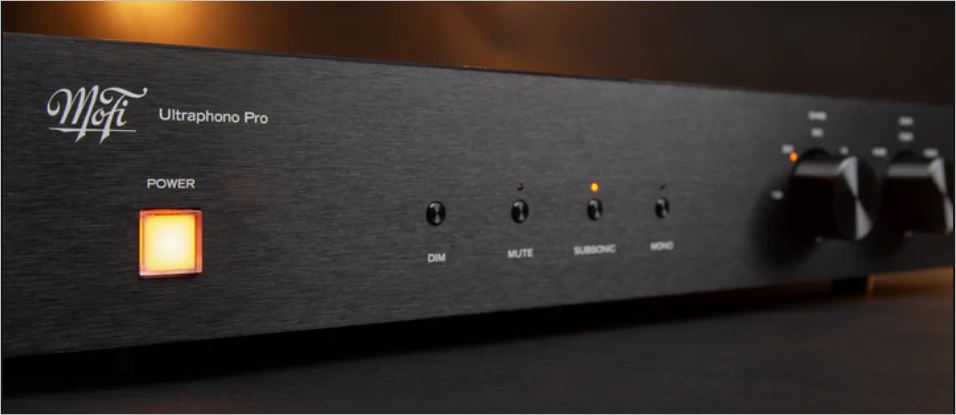
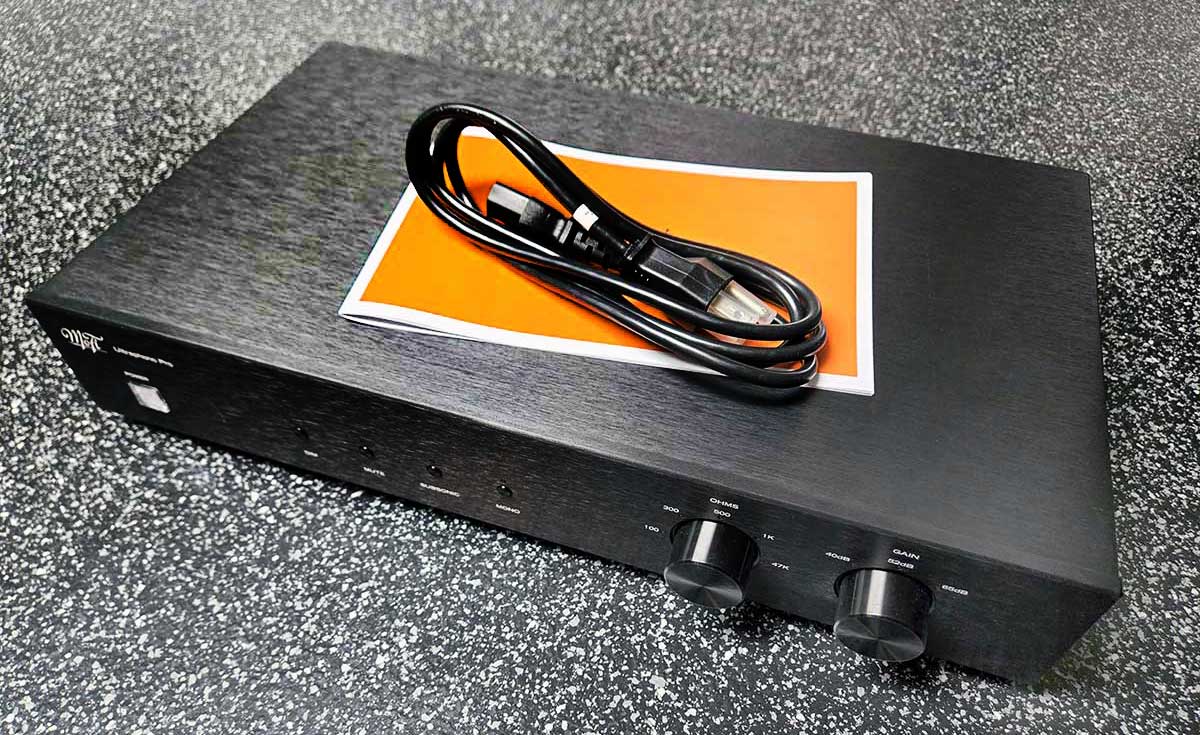
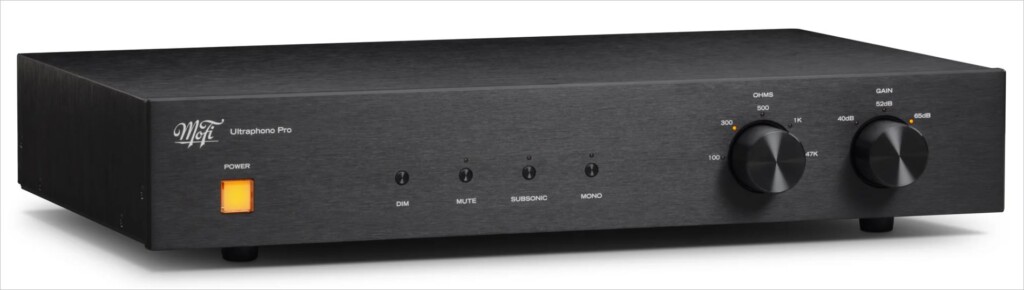
To the left of its faceplate is the square, illuminated push-button power switch. To the right, we have two rotary selectors, one each for cartridge loading and overall gain. The loading choices include 100, 300, 500, and 1K Ohms for MC carts, and the standard resistive 47k Ohms for use with Moving Magnet (or Moving Iron) carts, while Gain choices include 40, 52, or 65 dB when using the single-ended outputs. When connecting to your linestage using the true differential output (the XLR outputs), you gain 6 dB of output per setting, for either 46, 58, or 71 dB of gain. Essential, not extravagant.
Between the power switch and the loading/gain knobs are four small, round push-button switches. The first switch, closest to the power button, does not have an indicator LED. It is the DIM button, offering four levels of brightness (but not off) for the power switch and all other front-panel illumination. It is followed by a Subsonic, Mono, and Mute button, each with its own LED to indicate engagement.
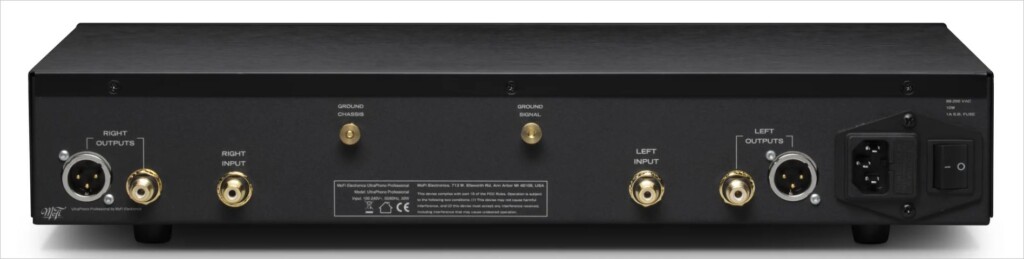
At the far right of the rear panel, we find the unified power inlet jack, with its IEC socket for its included (or your optional) power cord, its rocker power switch, and integrated fuse holder. Next, spaced symmetrically across the remaining unused portion of the rear panel, are the two sets (one balanced and one single-ended) of left and right outputs to connect to your linestage. Immediately inside the left and right single-ended outputs are the single-ended input jacks. Between them, we find both a chassis ground, for 'tables using a single ground, or to ground the motor and plinth on 'tables with multiple grounds, and a signal ground for your 'table's tonearm.
Who Needs All Those Whistles and Bells
The UltraPhono Pro's choice to limit the feature set should be especially attractive to vinylphiles who will never need to accommodate multiple tonearms or turntables. Users with just one primary 'table, which would be the overwhelming majority of such listeners, don't need, or want, to pay for versatility they have no intention of using, such as multiple sets of, or balanced, inputs. Then too, though the UltraPhono Pro will work equally well with either moving magnet, moving iron, or moving coil cartridges, keep in mind that an optional transimpedance input like that found on the MasterPhono applies only to low-output moving coil varieties, so is of no value to music lovers who will never use moving coil transducers.
Although the UltraPhono Pro sacrifices ultimate versatility by omitting the remote control, the meters and their calibration functions, and the slightly more granular loading and gain options, these choices were made exclusively to cut costs, with essentially zero impact on real-world sonic performance for the most typical vinyl enthusiast.
Make no mistake, its more diminutive proportions and select set of options in no way diminish its ability to render the music from the LPs it is asked to decode. What remains with this more streamlined preamp is all the essential functionality and control one needs, presented in a sleek and appealing package, allowing it to deliver the equivalent knockout sonic performance of the MasterPhono—but at less than half the price! Let's talk about that...
The Sounds of a Super Star
Given the UltraPhono Pro's class and likely audience, I first dropped it into my "Second Space" system (HERE), my more realistically priced rig set up in my home's living room. This more affordable system is where I conducted most of my evaluations, using my vintage Micro-Seiki DD-30 'table and Monster Cable Sigma Genesis 2000 moving coil cart.
Starting with the foundation, as with its larger, more inclusive sibling, bass is tight, solid, and rendered with exceptionally well-defined pitch. Timbre throughout the lower registers is remarkably authentic, delivered not only with excellent tone and texture, but with genuine weight, impact, and impressive slam.
Among the UltraPhono Plus's most significant and considerable attributes are its faithful presentation of midrange tone and texture. Everything, from human voices to pianos and strings, to horns, and even the crisp snap of a snare, is presented with a natural purity, tonal accuracy, and seemingly effortless resolution.
Treble is pure, clean, and detailed, and perhaps most importantly, very well resolved. Its remarkably natural presentation of the uppermost octaves extends smoothly beyond the 20kHz region, contributing to its delightful expression of extension and "air," never softening or in any way compromising its focus.
Combining its lovely broadband tonal purity with its supple musical transparency, it delivers remarkably swift transients, conveying credibly honest scaling as well as an abundance of microdynamic resolve and expressiveness. Its engaging ability to uncover detail, texture, and to recreate "space" down deep, even in the quietest of passages, a result of its remarkably low distortion levels and incredibly low noise floor, is simply exceptional, and highly seductive!
Exposing Its Limits
After extended listening to the UltraPhono Pro with more compatible peer-class components, I decided to give it a quick stint in my reference rig (HERE). There, it assumed the duties normally provided by my Dynamic Sounds Associates Phono III Plus phonostage, receiving its source signal from either my Kronos Pro LE or Kronos Perpetual 'tables, both fitted with a Kronos Discovery RS tonearm and an Etsuro Gold moving coil cart. Keep in mind, in this rig, even the associated Kubala-Sosna Ovation input and output interconnects cost more than this phonostage! Time for a ruthless test of its abilities…
I'm here to tell you, the UltraPhono Pro is one special preamp! After confirming the impressions formed by its time in my Second Space system, I really had the opportunity to discern its strengths and limitations. Spoiler alert! It made an undeniably impressive showing.
With that in mind, while it may fall short of the last word in resolution or transparency, especially when compared with many of today's $30,000 plus über phonostages, what it delivers in this regard is simply exceptional. From its abundant dark quietness to its tonal vibrance and honesty, through its authentic presentation of scaling to its refined microdynamic expressiveness, it expertly bested all my expectations. The UltraPhono Plus serves up remarkably precise leading-edge transients, subtly portrayed ambient trail and decay detail, providing a remarkably complete view into the performance under its interpretation, making it the absolute go-to for value-conscious vinylphiles.
Finding More Value
While two considerably more affordable phonostages are available from the MoFi Electronics stable, the UltraPhono and Headphone Amp ($499), and the StudioPhono ($349), what MoFi Electronics has achieved with these two most recent and noteworthy efforts from senior electronics engineer Peter Madnick, is the realization of two of the most exceptional performing, authentically musical, resolving phono preamplifiers in their respective classes, providing a remarkable set of “bookended” options in this product category.
The MasterPhono, with its superb versatility and attention to detail, is an expression of their uncompromising commitment to the art of the phonostage - an ability it comfortably demonstrated during my time with it dropped into play in my reference system. But with the deletion of many often unneeded or unnecessary feature sets or options, yet retaining the exceptional core sonic performance envelope first delivered by the MasterPhono, the UltraPhono Pro represents a similar devotion to the category, offering a product as equally committed to the goals of sonic excellence as its more feature-rich flagship phonostage.
The UltraPhono Pro's true gift is that it brings a newfound, sophisticated, and unrivaled level of performance to a substantially more cost-effective product range. As such, it provides an exceptionally refined level of performance at a price point more readily accessible to the wider audience of vinylphiles who have long been craving such a complete and immersive experience.
At this point, it should come as no surprise that this reimagined and less costly entry represents yet another expression of MoFi's commitment to the LP format. In case you haven't been reading between the lines, this is a stand-out phonostage! It offers an elevated level of performance that most vinyl lovers will never outgrow. You can spend considerably more somewhere else and not get anywhere near its level of musical insight, expressiveness, and engagement. It is a true joy to listen to. As such, it earns my highest recommendation. Get one and forget about future upgrades…just enjoy the music.
UltraPhono Pro Phono Stage
Retail: $2495
MoFi