

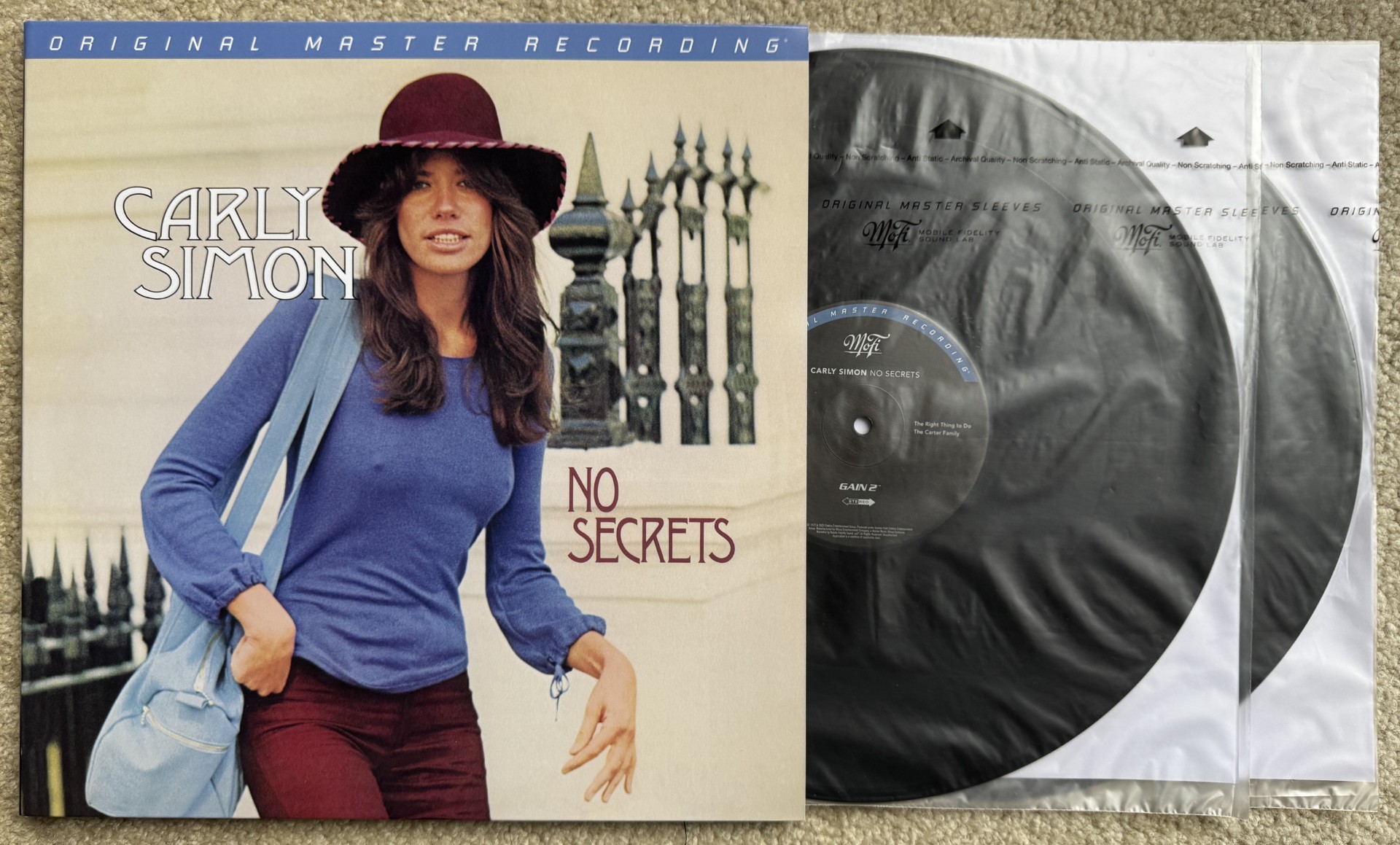
I was twelve when Carly Simon released her third album "No Secrets." Even at that age, I was not into commercial pop music much, so I never owned this album until now. However, I did not change the channel when Carly Simon came on. She had unmistakable talent; voice and composition. Simon achieved international fame with this one. No Secrets sat at No. 1 on the Billboard 200 for five weeks and became Platinum. The first album single, "You're So Vain," sat at No. 1 on the Billboard Hot 100 for three weeks, and earned Simon four Grammy nominations, including Record of the Year, Song of the Year, Best Pop Vocal Performance (Female), and Best Engineered Recording.
Behind the Album
Simon's first attempt at the album began with producer Paul Buckmaster, known for his work with Elton John. These sessions included a version of "Angel from Montgomery" featuring James Taylor and Danny Kortchmar, but Elektra rejected the material, believing Buckmaster wouldn't deliver a hit.
Elektra founder Jac Holzman brought in Richard Perry, who had long wanted to work with Simon. Perry had hits starting in 1967 with Captain Beefheart, the Fifth Dimension, Tiny Tim, Fats Domino, and more recently Harry Nilsson's "Nilsson Schmilsson," and Barbera Streisand's "Stoney End." Perry had a track record of hits, had built a core group of LA session players and engineers that worked well together, and he had successfully modernized Streisand. He had a reputation for casting musicians much as would a film director.
For Carly, he wanted to give her a harder edged sound, more rhythmic and radio-ready. To do this, Perry wanted to capture American punch and groove with musicians, and British air and polish with electronics. He accomplished this by flying L.A. musicians to London to record, then remixing back in L.A.
I remember at the time, that many of the English imported LPs sounded cleaner than their American counterparts. It seemed to be a combination of electronics and engineering at the time. Around this era, the American engineers (in general) leaned towards heavier compression, more tape saturation, aggressive EQ, tighter and drier drums, and were using more tubes in the signal path. While the British favored natural dynamics, less compression, more room tone, stereo width, and vocal transparency.
The American-based Musicians
- Carly Simon plays piano, synthesizer, and acoustic guitar
- Drums: Jim Gordon- crip, articulate pop-rock pocket.
- Jim Keltner- further back, more soulful feel.
- Andy Newmark- popular session player and part of Carly's band
- Piano: Nicky Hopkins- though English, he was currently working as an L.A. session man working for Columbia Records. Probably the most underpaid musician in rock history.
- Slide Guitar: Lowell George- Only plays on Night Owl. One of my favorite musicians from one of my favorite bands, Little Feat.
- Jimmy Ryan- member of Carly's band
- Organ: Billy Payne- also of Little Feat.
- Keys and orchestral arrangements: Paul Buckmaster
- Saxophone: Bobby Keys- best known for his work with the Rolling Stones, Beatles circles, and Joe Cocker's Mad Dogs & Englishmen tour.
- Backing Vocals: Bonnie Bramlett, Doris Troy, Harry Nilsson, James Taylor, Carly and Joanna Simon (sister)
The British-based Musicians
- Bass: Klaus Voorman (German) plays electric bass on every track.
- Acoustic guitar: Paul Kough, primarily a keyboard player, but plays acoustic guitar along with Carly on We Have No Secrets
- Percussion: Ray Cooper
- Strings and woodwinds arranged and conducted, Electric piano: Kirby Johnson
- Backing Vocals: Paul and Linda McCartney, Mick Jagger, Liza Strike, and Vickie Brown
Carly wrote all the songs on the album, except Night Owl, which was written by James Taylor. The two were dating at the time, and in fact, married November 3, 1972, right after the album was completed. Released November 28, 1972, No Secrets became her biggest selling album.
The second single, "The Right Thing to Do," reached No. 17 on the Billboard Hot 100 and No. 4 on the Adult Contemporary chart. The album was officially certified Platinum by the Recording Industry Association of America (RIAA) on December 12, 1997. It was certified Gold by the British Phonographic Industry (BPI) on November 11, 2011. In 2001, "You're So Vain" ranked No. 216 in RIAA's Songs of the Century. In 2004, "You're So Vain" was inducted into the Grammy Hall of Fame.
Trident Studios, London
Tracking was done from mid-September through October 1972 at Trident Studios, London. Trident was already famous for The Beatles' White Album, Bowie's Space Oddity, and early Elton John records. In 1972, Trident was one of the most technically advanced studios in the world. The Trident sound is recognizable: wide stereo image, crisp top end, and a slightly forward midrange—all hallmarks of the A‑Range console used.
- Producer: Richard Perry
- Chief engineer: Robin Geoffrey Cable, with Mark Berry assisting.
- Console: Trident A-Range (custom, discrete Class-A, transformer-coupled)
- Outboard gear likely: UREI 1176, LA‑2A, Pultec EQP‑1A, EMT 140 plate
- Tape deck: 16-track Ampex MM1000 or 3M M56
- Monitors: Lockwood-modified Tannoys
AIR Studios, London
Producer George Martin's facility in London. Though most tracks were recorded at Trident, all the lead and background vocals (with Mick Jagger) for "He's So Vain," as well as the tracks and all vocals with Paul and Linda McCartney, etc. were recorded for "Night Owl" in Studio B. The album was mixed here in Studio C its entirety. This stage likely added the smooth, slightly warmer midrange and more polished vocal blend compared to raw Trident mixes.
- Engineer: Robin Geoffrey Cable
- Console: Neve 8014/8048 consoles (Class‑A, Marinair transformers)
- Tape deck: Studer A80
- Reverb: EMT plates and live echo chambers
Remix at Sound Labs, Los Angeles
The album was remixed again (except for "You're So Vain") at Sound Labs in Hollywood by Bill Schnee, one of the most meticulous mix engineers of the era. The studio was known for extremely well-controlled acoustics. Schnee's mix likely made the low-end tighter, more precise vocal placement, cleaner transient definition, and reduced room spill. Schnee said that the multi-track was extremely bright, so he rolled off the top of many instruments. Sound Labs in 1972 typically included:
- Engineer: Bill Schnee
- Console: Custom API/DeMedio consoles (fast, punchy, transformer‑based)
- Tape Decks: Ampex ATR‑100 mastering decks (later in the decade; early 70s used Ampex AG‑440).
- Tape formula: Ampex 406
I reached out to Bill to confirm, and he told me that he used a Scully tape machine, could not remember what tape formula (and MoFi does not indicate as it sometimes does with a photo of the tape box), and used an EMT 140 plate reverb.
The Sound
Simon is said to have been worried early on that Perry would make her record too slick, but he pushed her towards a more, in his words, "rock-influenced sound, with a particular emphasis on the drums". The combination of American musicians and British engineering works very well. It does sound polished, a bit slick in my opinion, and very well produced. All the pieces fit.
This MoFi 45 RPM LP sounds wonderful and offers the best fidelity I have heard from this album, bringing interest and fun that I had not experienced before. Carly's voice is rich and pure, drums have more punch, strings are more lush, the piano is big and harmonic, the electric bass if full and present. The trippy fade out of the last song can be experienced in its entirety for the first time on vinyl without distraction. The album sounds like a live band-in-the-studio performance in size and soundstage, not pieced together.
Though I do not own the original Doug Sax Mastered LP. I do own the 1975 Best of Carly Simon Volume One, which was mastered by Dennis King of Atlantic Studios in NYC (likely Neumann VMS-66 or 70 lathe), and plated and pressed by Specialty Records Corporation in Olyphant, PA. By comparison, the Best Of sounds small, boxy, and the vinyl is noisy. The MoFi sounds glorias, like you're at the studio listening to playback in 1972.
MoFi Technicals
- Mastered by Krieg Wunderlich at Mobile Fidelity Sound Lab, Sebastopol, CA using the GAIN 2™ Ultra Analog mastering chain
- Source: 1/4" / 15 IPS Stereo Dolby A analog master → DSD256 → analog console → lathe
- Plating by: RTI
- Pressed by: Fidelity Record Pressing in Oxnard, CA (FRP is a sister company of MoFi)
- Packaging: (2) LP 180g, 45 RPM, Stoughton Printing gatefold jacket (limited to 3,000 copies)
- (MoFi also offers a monaural Hybrid SACD version)
- Vinyl surface noise: Excellent
- Vinyl centricity: Very Good to Excellent depending on side
- Vinyl warp: Very Good; some ripple on both LPs, small dish warp in one LP