


Recently, while doing some research, I discovered the existence of an album that in all my decades of obsessive record collecting I had never seen nor heard of. The album is called Red And Ernie (Decca DL 8298). Not to be confused with Burt and Ernie, Red and Ernie were music legends Red Foley (1910-1968) and Ernest Tubb (1914-1984). It just so happens they were close friends and this is the only compilation of the music they recorded together. During the fifties, Decca's catalog featured many compilations like this one. Prior to the release of Red And Ernie, the only source for this material were 78RPM and 45RPM singles. As I've been a Foley fan for decades and lately I've been deep-diving into Tubb, the discovery of this album was perfectly timed. Thanks to eBay, I was able to find a copy, and I'm thrilled to report that it's as good as I expected it would be. And because I'm your favorite music historian, I need to tell you about it!
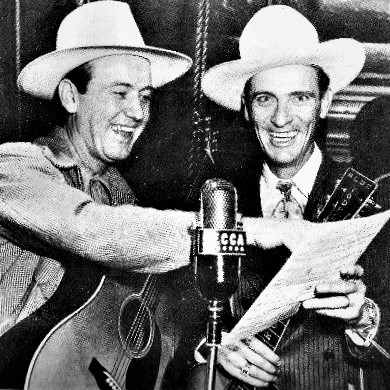
Red Foley and Ernest Tubb were extremely popular in the forties, and well into the fifties. Foley left us too soon in 1968, but Tubb recorded and concertized until 1982. Foley's most famous records include "Smoke on the Water" from 1944, the incredibly catchy (and very well recorded) "Chatanoogie Shoe Shine Boy" from 1949, "Careless Kisses" from 1950, and the first million-selling gospel crossover record, "Peace In The Valley," from 1951. He was also the first country star to host a network TV show, The Ozark Mountain Jubilee, which broadcasted on ABC from 1955-1960. His daughter, Shirley (1934-2019), was married to pop singer Pat Boone. And I own four of Foley's albums. The easy-going baritone with the soothing voice was sometimes called the barnyard Bing Crosby.
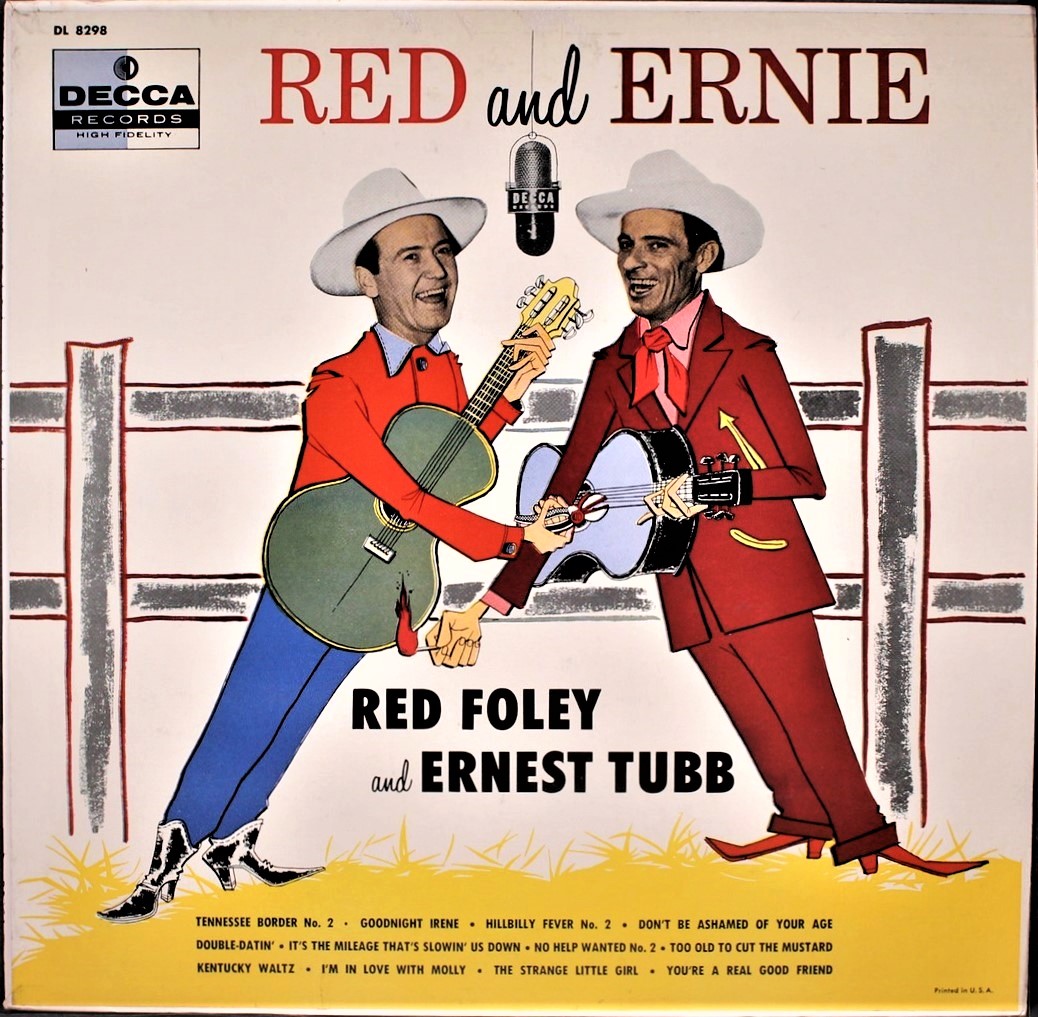
Tubb's best music is just plain awesome. His records from the forties were the first in country music to use an electric guitar. For years, I liked him only in passing, but now I'm crazy about the man who was known as the Texas Troubadour. Currently, I own two of his albums, or three if I include Red And Ernie. (Needless to say, I need more Tubb in my LP collection) His most famous records include "Walking The Floor Over You" from 1941, "Drivin' Nails In My Coffin" from 1946, "You Don't Have To Be A Baby To Cry" from 1950, and "Half a Mind" from 1958. One of his great achievements was having one of the tightest-sounding touring bands of any country star, The Texas Troubadours. In the late fifties and throughout the sixties, when most country stars made their records exclusively with studio musicians, Tubb's records often featured members of his band. During The Texas Troubadours' decades of touring and personal changes, some of the finest electric guitarists in all of country music (frankly, all music) played with them. The list of top-tier electric guitarists who played with Tubb includes Billy Byrd (1920-2001), Leon Rhodes (1932-2017), and pedal steel guitar maven Buddy Emmons (1937-2015). Tubb, who also owned The Ernest Tubb Record Shop in Nashville, was also responsible for jumpstarting the careers of Hank Williams and Loretta Lynn. You may recall his cameo appearance in the 1980 biopic Coal Miner's Daughter. When it comes to country music, Tubb, like Foley, is one of the towering figures of the genre.
Red And Ernie, released in 1956, was created from sessions that took place in 1949, 1950, 1951, and 1953. Nashville's Castle Studios, located in the long-gone Tulane Hotel was the location for all of the sessions. This is the same studio where Hank Williams recorded most of his hits for MGM.
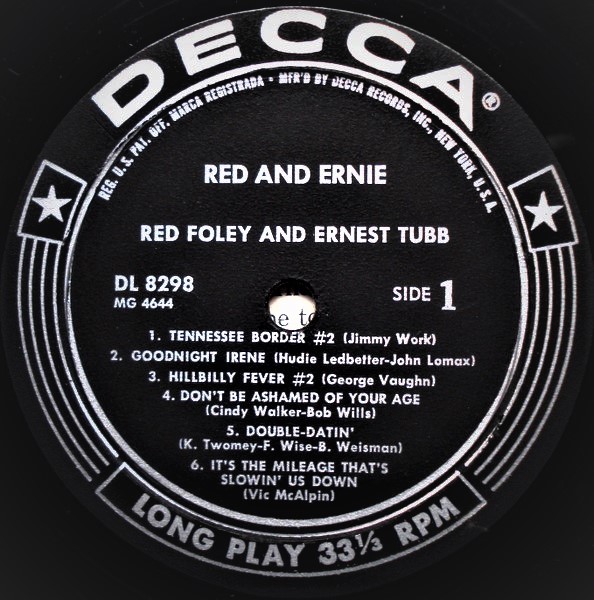
Side one opens with "Tennessee Border No. 2." The "2" refers to the lyrically revised version of the song "Tennessee Border." Recorded on 11/9/1949, it peaked at number one on the country charts in 1950. The composer was singer-songwriter Jimmy Work who recorded it in 1948. Shortly after Work's record was released, the country-jazz-comedy duo, Homer and Jethro, changed it into a humorous novelty song, similar to what Weird Al Yankovic does. To me, it's interesting that the Foley-Tubb recording with the humorous lyrics outsold Foley's fabulous solo recording using the original lyrics. His solo record was released only a few months prior. I can't decide which one I prefer. Compare them out and see what you think.
"Tennessee Border No. 2" opens with a super tasty and harmonically rich steel guitar played by the famous Hawaiian lap steel virtuoso Jerry Byrd (1920-2005). At nine seconds, Foley and Tubb arrive, singing their hearts out together. Other parts of this savory Hawaiian cowboy stew include Billy Byrd's lead guitar and Sammy Pruett's flawless Freddie Green-like rhythm playing on acoustic guitar. (Pruett (1926-1988) was one of Hank Williams' Drifting Cowboys.) I wish I could identify the bassist. The mono sound is breathtakingly rich, detailed, and vivid. Sometimes stereo recordings blur the immediacy of musical instruments. There's no blurring on this perfect example of mono! The string bass sound is remarkable. Rather than the sterilized high end demo room sound of fingers, strings, and wood, heard as separate entities, we are treated to a tonally rich, room-filling string bass that provides the recording's entire foundation. Please note: If it looks like I'm more impressed by the sound than the music, that's untrue. I'm equally impressed by both.
Cut two is a performance of Lead Belly's "Goodnight, Irene." Although Lead Belly (1888-1949) recorded the song in 1933, the record that everybody knows is by The Weavers. (The Weavers' 1950 single achieved the number one pop chart position and it stayed there for a hard-to-believe thirteen weeks!) I like The Weavers, but only in small doses, and those doses rarely include this song. To me, The Weavers often sound cloying, and "Goodnight, Irene" sounds like sticky sap warmed by a steaming electric blanket. However, when my buddies Foley and Tubb brought their combustive energy up to the microphone (mics were usually shared back then), the old blues-turned-into-a-folk-pop standard became fun. Their recording was also made in 1950 (6/30/50 to be exact), and it became a number one hit, albeit on the country charts.
I could not find reliable personnel info on "Goodnight, Irene," but the differences between the musicians on it and those on "Tennessee Border No. 2" are easy to hear. To my colleagues who like me weren't introduced to The Weavers until the eighties, thanks The Absolute Sound's Harry Pearson, you're going to love it! Regarding the sound, I hear a touch of compression on Tubb's voice that I didn't hear on cut one. Perhaps it's a limitation of my playback gear, or it's just that Tubb's edgy voice was harder to record than Foley's smoother voice. (Microphones are finicky beasts and some singers mate better with them.) Having said this, the sound is still marvelous.
Cut three is a smokin' number called "Hillbilly Fever." This is a country boogie that'll fuel your butt into action. If it doesn't, call a paramedic. Recorded on 6/23/50, every musician in the studio was on fire, including those wild and crazy guys Foley and Tubb. This cut features two electric guitars played by Hank Garland (1930-2004) and Jack Shook (1910-1986). I was surprised by the absence of a steel guitar, but it doesn't need one. Another key element was drummer Farris Coursey (1911-1968) who kept the rhythm going with his snappy snare drum. This cut is two things: fun as hell and marvelous sounding, especially if you turn it up to eleven. It was originally issued as the b-side of "Goodnight, Irene."
Cut four is worth the entire album. It's "Don't Be Ashamed Of Your Age," composed by the incomparable lyricist Cindy Walker (1917-2006), with some help from the king of western swing, Bob Wills (1905-1975). This is a perfect example of Ernest Tubb's sparse and swinging sound. I can't decide if this is the best cut on the album or if it's "Tennessee Border No. 2." Musically, it's out of this world. And so is the sound. Billy Byrd's guitar leaps into my listening room, and Mr. Tubb's iconic voice is right there, in between my speakers. This was the b-side of "Tennessee Border No. 2," recorded on the same day.
Side two opens with "No Help Wanted No. 2." It was recorded 2/27/53. So what does the "No. 2" stand for this time? Nothing in the lyrics as far as I can hear, but the style of the musical is different. The song started its life as proto rockabilly by a group called The Carlisles in 1952. The Carlisles' version (led by the song's writer Bill Carlisle) is a jumping affair, and it deserves a place in our music collections. Foley and Tubb sing it as a country boogie, and the fun they brought to the studio is infectious. Tubb even breaks into a laugh. Foley was very close to doing the same. It's extremely well-recorded and it's also the b-side of the silly song, "You're A Real Good Friend."
A funny thing happened when I first played cut two, "I'm In Love With Molly." I ignored it. Lyrically, it's weak, and the lackluster sound on the LP failed to grab my attention. But then I played it on YouTube on my lowly laptop. Then it caught my attention. The YouTube source is a 78RPM single and a somewhat noisy one at that. This isn't my first time hearing a 78 with more life than an LP. Played on my laptop, the fiddles jumped into the room. On the LP, they just sat there.
The album closes with "You're A Real Good Friend," recorded on the same day as "No Help Wanted No. 2." It's not a great song, and for some reason it lacks the dynamic range of the a-side. Foley and Tubb brought more to this lightweight song then it probably deserved. Nobody should ever judge the great Buck Owens by his studio recording of "You're A Real Good Friend," which he made with his son, Buddy Alan. It's not very good either, but I watched them perform it on Hee Haw, from 1971. This time I heard what I think is the song's definitive performance. Buck's famous facial expressions helped. Thanks YouTube.
I asked my friend, Greg Mahoney, to stream a couple of cuts from Red And Ernie so I could hear them on his jaw-dropping-but-all-digital-sourced audio system. I was also curious about the availability of this music on hi-res digital formats. Greg, who owns the premier high end store in Las Vegas, Lifestyle Audio Video, had a tough time finding material from this album. After some frustration, he found "Don't Be Ashamed Of Your Age." What emerged from his McIntosh MC1.25-driven PS Audio FR30s wasn't bad. In fact, many people would think the sound is excellent, but, sorry, it wasn't even close to what's on the LP, or what his system is capable of doing. Sadly, the music in its original album order is not available in a hi-res streaming format. And it's likely that some of the cuts are just plain unavailable, but I digress. The disappointing sound that I heard was a classic example of denoised analog. What kind of noise was the mastering engineer looking to remove? There is no audible tape hiss anywhere on my extremely quiet LP. Perhaps the first generation master tape is missing? If not, then we deserve to hear the music, as an album, in all of its early analog tape glory. Of course, you could always use a turntable!
I'm always fascinated how my two analog "front ends" play LPs so differently, especially fifties era mono LPs. Some of them sound drop-dead gorgeous on my belt-drive Luxman, while those same titles sound like grungy garbage on my direct drive Micro Seiki turntable. The mono Mercury Living Presence titles are perfect examples. Both of my turntables are sporting moving coils, a Paradox Pulse Guard on the Luxman and a Hana EH on the Micro Seiki, and I like both cartridges equally. The entry level Hana often sounds better on my ancient monos. I believe its conservative elliptical stylus is better suited for old records. The way it plays late forties classical LPs, like Oscar Levant's recording of Tchaikovsky's "Piano Concerto No. 1" with Eugene Ormandy (Columbia ML 4096) and Serge Kossevitzky's recording of Ravel's "Ma L'Oye" (RCA LM 1012) blows my mind. Red And Ernie didn't sound bad on the Luxman, but when I played it in my office on the Micro Seiki turntable, it sprang to life. It was as though I used a time machine, and I was in the presence of Red Foley and Ernest Tubb. How cool is that?!
As I was filing the album back on the shelf, I noticed that its catalog number, DL8296, was two numbers lower than Foley's magnificent country-gospel album, Beyond The Sunset (DL 8298). So I wondered, what is DL8297? From what I could derive from research, no Decca album has the catalog number DL8297. However DL8291 is Ernest Tubb Favorites, DL8293 is Kitty Wells' Country Hit Parade (review pending), DL8294 is Red Foley Souvenir Album, and DL8295 is Webb Pierce's The Wandering Boy. Holy hillbilly stomp, Batman! Decca was cranking out incredibly fine country albums in 1956. And I need more records!