

This is the second installment of what was to be my three-part review of the upgrades I made last year to my system.
There is no denying that the Carnegie by Odeon is a world-class speaker, and it sure better be for the price. No denying the exceptional build quality, including fit and finish of the speakers from top to bottom. Nor the quality and execution of the electronics within the stunning cabinets. At a price in US Dollars of $120,000 (depending on tariffs and other charges) for the pair I have, piano black horns and the book matched mango root wood, they are not entry level by any stretch of the imagination. You can do a lot with that kind of money, but if you can swing it I can think of very few things that have given me so much pleasure day in and day out over the last year.

From the moment I first heard them three years ago I was dumbfounded by the beauty and execution of the speakers as a whole. At that time they were funneling music from a system of combined Air Tight monoblock amplifiers with Nagra front end, pre-amp, and phono stage, and on the vinyl side was an Air Tight Opus Platinum cartridge on an upgraded, hand-made VPI turntable that was ultimately replaced by a Bergmann Air Drive tangential tonearm turntable. The sounds were intoxicating to say the least. The room was a bit on the small side, and yet the delivery was captivating, especially in the highs and mids. The bottom was not quite as punchy and pronounced as my personal tastes preferred. I chalked that up to the 22-watt amps. While their tonal push and soundstage were incredible, the bass just needed a bit of a push, and that came via a sub that made the sound incredible once it was added into the mix.
Fast forward to now, and a stunning set of Carnegies live in my audio room and will definitely be the last big speakers I will ever own. Oh, and big they are. Here are the requisite specs for them:
- Dimensions: 155cm/63.5"(H) x 76cm/30"(W) x 79cm32" (D) /115Kg/253lbs
- Frequency Range: 26-29.000Hz
- Sensitivity: 97dB / 8 Ohms
- X-over: 420 / 2.200Hz
In the manufacturer's own words:
"The housing design ensures ideal phase alignment, as all systems are positioned exactly on one axis. For the Carnegie, the two-piece cabinets are made of 24mm thick multiplex."
The cabinet materials used are decisive factors for the sonic properties of low and mid-range reproduction. Multiplex is the preferred material when it comes to implementing special loudspeaker concepts. The plywood, which consists of many cross-glued individual veneer sheets, is particularly stiff and therefore very low in resonance and eliminates discoloration effects. The material thickness used by our master craftsmen ensures a stiffness that absorbs even the enormous forces of the 15" woofer at any volume without any inherent movement. The asymmetrical cabinet prevents standing waves. This allows the use of less damping material and thus the maximum preservation of the extraordinary efficiency. The Carnegie uses a downward firing bass reflex system with the bass reflex tunnel pointing downwards to the base plate of the speaker. This base plate forms the end of the reflex opening enabling a greater choice in optimum room placements, which allows a placement close to the wall.
Every room has so-called room modes. As a result, strong bass peaks often occur. The downward firing bass reflex system stimulates these room modes much less than conventional solutions in which the reflex tube faces the rear wall.
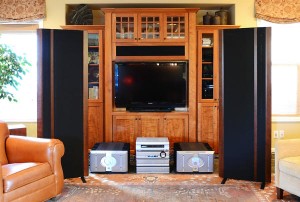
Here the speakers are 8 feet from the the wall and gear rack. This was optimum in my room which is 33 feet long by 17 feet wide and the first 17 feet has 23 foot ceiling.

The tweeter is a new generation of 1" compression drivers with ring radiator technology. The 38mm Mylar diaphragm used in the pressure chamber driver is driven by a particularly strong neodymium magnet, which guides the voice coil with a magnetic force of 2.4 Tesla. The result is a driver that guarantees highest resolution and ultra-fast reproduction. ( and does it ever - Gary)
The handmade 13cm midrange drivers come from a German manufacturer. They combine a modern aluminum die-cast basket and a powerful Alnico magnet with a magnetic force of 1.4 Tesla as well as an ultra-light cellulose membrane in NAWI (non-unwindable) form. This hyperbolic membrane shape, in contrast to the conventional cone shape, ensures a more even movement and load on the membrane during long strokes and thus prevents parasitic vibrations that can lead to erasure effects. In addition, a very fine centering and the one-piece construction of cone and surround ensure an accentuated, controlled, and fast movement of the midrange driver. Instead of a rubber surround connecting the cone to the basket, the multiple folded edge of the cone takes over the function of the surround. This prevents back reflections between cone and surround. The excellent mass-to-drive ratio and the special design of the system allow the signal to be generated faster and make the midrange driver used one of the fastest ever built of its kind.
A paper woofer from Audax is used in the bass range. The system has a diameter of 38cm. The relatively light cone is driven by a very strong, oversized ferrite magnet. The result is an efficiency of 97dB.
The power, speed, and ease of reproduction are exceptional and create a lifelike intensity. The woofer works in a 60cm measuring waveguide, which supports the basic tone range and ensures a clean take-over of the midrange driver at 450Hz. The result is an extraordinary plasticity in the lower vocal or fundamental tone range.

To keep the deviations between the channels as small as possible, we use selected components for the crossovers with a maximum deviation of only one percent. Oil-paper capacitors from Jantzen, Miflex, and Duelund are used. The inherent sound of these capacitors is openness and harmonizes perfectly with the sound character of the Alnico midrange and tweeter used. For a more direct saturation of the capacitors and the resulting faster signal processing, many capacitors are connected together in the Carnegie and equipped with bridge capacitors. The flat coils used come from the Mundorf company in Germany. Only non-magnetic components are used as resistors.
When setting these speakers up, I was so grateful that each one came in two halves. Top and bottom. Otherwise, I would have needed a good deal of help with them. Once the woofer cabinets were set and laser dialed in on dimensions apart from each other, from the listening chair and the walls, the tops were installed and refocused. At 253 pounds, moving them much is not an option for me at this age. The real saving grace, though, is the lack of spikes. That make them easier to slide a bit with some help for fine tuning of the position. After half a dozen small moves during the first couple of weeks, they reside now in a permanent placement not to be moved again.
What all that means is that these speakers sound beyond great. To explain that statement will take quite a bit, so bear with me.
As I have said, I have listened to the Carnegie's with 22-watt and 32-watt tube amps. I have never listened with the push from 70-watt amps sporting two 845 tubes, two 300B tubes in the output stage. From my very first listen till right now, that seems to be a magic combination as it delivers low-level detail in bulk and yet can move the house an inch or two under heavy load without a single bit of breakup, distortion, or loss of detail. The soundstaging is immense! The bottom end is immense! The midrange is immense! The highs? You tell me!
I streamed music pretty much twenty-four-seven for the first few weeks at different levels throughout the day to break them in nicely before I ever even sat for a seriously focused listening session.
Once I felt that the Carnegies had bedded into the system, I began the serious work of critical listening.
The very first track I ran through them at tilt was "Kashmir" by the artist Marcin Parzalek (he goes by just his first name). Recorded in 2021. He is a 25-year-old Polish guitar genius, and his acoustic guitar rendering of the famous Led Zeppelin tune is thoroughly captivating and swings through just about all the dynamics you can muster in a single track. Sparkling highs, silky smooth midrange, snappy percussion, and absolutely thunderous bass.
From the very first notes of the familiar tune to the end, Marcin takes you on a roller coaster ride of intensity in delivery that will challenge lesser systems to keep up. The Carnegies chewed it up and spit it out like it was a lazy Sunday afternoon stroll through the park. Not one thing ruffled the speakers. I asked my wife to listen to them in a focused manner at volume with this particular track. This was something she will rarely do. "Kashmir" is one of her all-time favorites, so I figured she would indulge me for that track at least. She sat in the listening chair, and I cranked it up to slightly less than a concert level. She sat motionless the entire time. At the end of the song, she turned around with tears in her eyes and said, for the first time in 38 years of my chasing this level of quality in the hobby, "I totally get it now!" Right there would be reason enough to seriously consider buying these speakers if you can swing it because I have never seen her be so taken by the sound of our system in all its versions over the years. She visits the listening chair more since I have had the Carnegies than in the entirety of our 38 years together combined. No greater endorsement, and for the first time, she fell in love with the look of a speaker. She said they were damned sexy!
You can see a video where Marcin explains his unique playing HERE.
She agreed to sit for a few more, and so next was a track I recently discovered that also tests the accuracy of both the human voice and the depths to which it can plumb in the lower registries. Many of you probably have this track in your critical listening list: "Hoist the Colours" by The Wellerman. Ten West Recordings, 2023. This is a group of vocalists whose voices occupy the lower spectrum of the frequency range. The voices do not really match the faces of the singers, and these can go very, very low. Led primarily by Bobby Bass ( ironic name, no?), this lovely pirate's anthem features some of the most astonishing vocals I have ever heard. Think of Nicole Scherzinger's range of highs on the theme from the Phantom of the Opera in the final crescendo being answered by male bass voices that match her on the opposite end of the frequency range. That will get you beginning to understand the power of this track and most of their performances. The Carnegie's presented this track with such perfection. Plumbing the absolute depths of the human vocal range and doing it with absolute authority tempered with a decidedly unexpected delicacy. This track immediately gave me huge goosebumps and hit me straight in the gut. You just cannot begin to fathom the delivery these speakers provide until you test them with the extremes of the frequency range. Nothing but pure musical delivery with a crispness and with the strength of a monster cannon being fired right at your soul.
For another example, find the video of Bobby Bass singing "The Sound of Silence."
I switched up to vinyl for the next round with a cut from Chris Botti Vol. 1. Blue Note B003751201. "Paris" is a jazzy little number featuring vocals by John Splithoff, piano by Taylor Eigsti, bass by Zach Morrison, Vinny Colaiuta providing percussion, guitar by Leonard Amuedo and Shane Fontaine, and Patrick Warren strings.
What a great ensemble. Chris always has some of the most stellar musicians alive playing with him. Just as Sting brought Chris to mass attention by hiring him as his touring and recording trumpeter, Chris does the same with many young and upcoming players. This is a romantic, tongue-in-cheek song about hooking up over a bottle of wine on a Parisian night. The lyrics "quick before I wake up and don't know who you are." as an indicator. Upbeat with a strong vocal performance by John, who cites one of his big influences as Marvin Gaye. Slightly reminiscent of Michael Franks, with way more soul, his voice carries more weight and timbre than Franks. The delivery is perfectly matched by the backing musicians. I could talk about Botti's trumpet sound and control, but the wonderful thing about Chris is he has no need to take the limelight on these collaborations, and so the balance is spot on. The rhythms are of a boss's nova groove, and the backing musicians were exceptionally well presented across a broad sound stage with plenty of air in between each person and very focused, so you can close your eyes and see everyone in proper space. Drums slightly back and center, piano off to the right, bass slightly to the left of the drums and a bit forward, guitars on either side. When Botti takes a short solo, you can sense he steps up where John is standing at the mic. Splithoff's vocals certainly channeled Marvin without being a copy. He has a very pleasing tenor to his voice that is presented creamy smooth by the Carnegies. This song makes you smile, and you can almost see the scene unfolding between the two passing casual lovers. What more can you ask of a speaker to deliver than something that not only lets you hear but also see everything unfolding during the performance?
Next, I had to go with something a bit more dynamic and raucous. Joe Satriani is one of my all-time favorite guitarists, and his album Flying In A Blue Dream is easily my favorite of his. (Relativity Records 8656) The title track is also one of my two favorite songs of his. This is a bit of a lilting yet soaring exercise in digital mastery of the fretboard. From the nylon string strumming over a long wavering feedback intro through the pyroclastic licks, strong sustain, and melodic squeals, this track will challenge any speaker with the swings in dynamics that prevail throughout. The Carnegies delivered the song with maximum slam in the drums through the soaring feedback-driven melody lines. The delivery had me rocking along in my chair as though I was front seat at his concert. As I was writing while playing the song a couple of times, I let it run into the next track on the second listen, and I am glad I did. That song, "The Mystical Potato Head Groove Thing," has a drum intro where the drummer is setting the beat using the kit with quite the snap on the snare drum augmented by triplets on a wood block. You could hear the tone of the block quite clearly. I snapped up and had to listen again as the position of each of the drums and the wood block were so clear in the space I could almost see them in scale. (Having been a drummer at one phase of my musical journey, I know the normal setup.) I could feel myself behind the kit playing along. What absolute fun.
Finally, I pulled something out from one of my favorite female vocalists. Anne Bisson is a French Canadian jazz singer of great talent. I have met Anne on a number of occasions, and when I go to shows, she is often there. I always carry cash with me so I can buy more of her albums if she is in attendance. I was in Munich last year for the show, and while walking through one of the venues, I got a tap on my shoulder and turned around. There she was with her husband. I immediately asked her if she brought any new vinyl with her and told her I had a fresh $100 bill with me. She said sadly no. I told her that was a shame. Her husband looked at me and said, "Gary, give me that bill! I will send you one you don't have as soon as we get back." Three weeks later, I got Keys To My Heart (Camilo Records CAMS 5034), which was the only one of her seven albums I did not have. All are signed by her to me. She is always gracious, treats me like an old friend, and is completely devoid of ego for someone of such immense talent. Not only is she a phenomenal singer but a very accomplished piano player, composer, and arranger. So from that album, I pulled the song "Where Am I Now?" The delivery of her voice was just magical. Having seen her perform live, it was almost like having her in my listening room. I could feel her breath, and her voice just floated across the room. This is a bit uptempo romp with great percussion, bass, and piano, and not only was the musicality of it spot on, but the hothead percussive nature of the bass piano could be felt and heard. The drums were pushed out front a bit and were sharp and impactful without being overbearing. This is a superior pressing, and the clarity of every instrument was so sweet. The cymbals were sharp and crisp with incredible decay, and the kick drum was direct with no real bloat. The bass was detailed and resonant. The electric piano had an ethereal quality that made it just the perfect to underlie her voice, and none of it overshadowed her vocals.
What does it all mean? Well, aside from the astonishing levels that the Carnegies can produce with moderate watts, is that everything they do deliver is smooth, unruffled, and incredibly well balanced. High frequencies sparkle with incredible brilliance, great decay, but zero edge. Vocals are some of the best I have ever heard from any speaker, and I have seriously listened to hundreds over the years. Neutral, well-rounded, even at low levels, they are crystal clear with no harshness or muddiness at all. The low frequencies belie the manufacturers' claim of 26hz. I swear they go lower than that in my room but have not done a reading to verify that. That being said, they will reward a great recording with a memorable performance without adding or taking anything away that is in the recording.
For a passive speaker with dynamic drivers, the balance is so linear, and there is nothing they cannot handle with neutrality and slam combined. Nothing overblown, no horn "honk." Just honest delivery of everything you throw at it. Close your eyes on any decent track you play, and you will find yourself front and center at the venue, and you will feel you are really there. Immediacy is not something I expect from large, looming boxes. Delicacy of delivery seems more that domain of high-end monitor speakers, but the Carnegies manage to deliver all of that with little to no fuss at all.
Quite simply, the most positive thing I can say about the Odeon Carnegies is that I own a pair. I cannot think of a more solid endorsement than that. No writer buys a set of speakers that they are not willing to live with day in and day out. As I said, these will be the last speakers I will probably own. If you have a desire for a large dynamic speaker that not only delivers all the goods from top to bottom but also looks absolutely stunning at the same time, there is no speaker I can recommend in this price range that will outdo the Carnegies especially when paired with tube amps! They are simply magical!!! Pretty simple!
Carnegie Loudspeakers
$120,000 as configured (subject to change according to current tariffs and exchange rate - Check with distributor)
Odeon
Supreme Acoustic Systems
6770 Silver Crescent St.
Las Vegas , Nevada 89148
USA