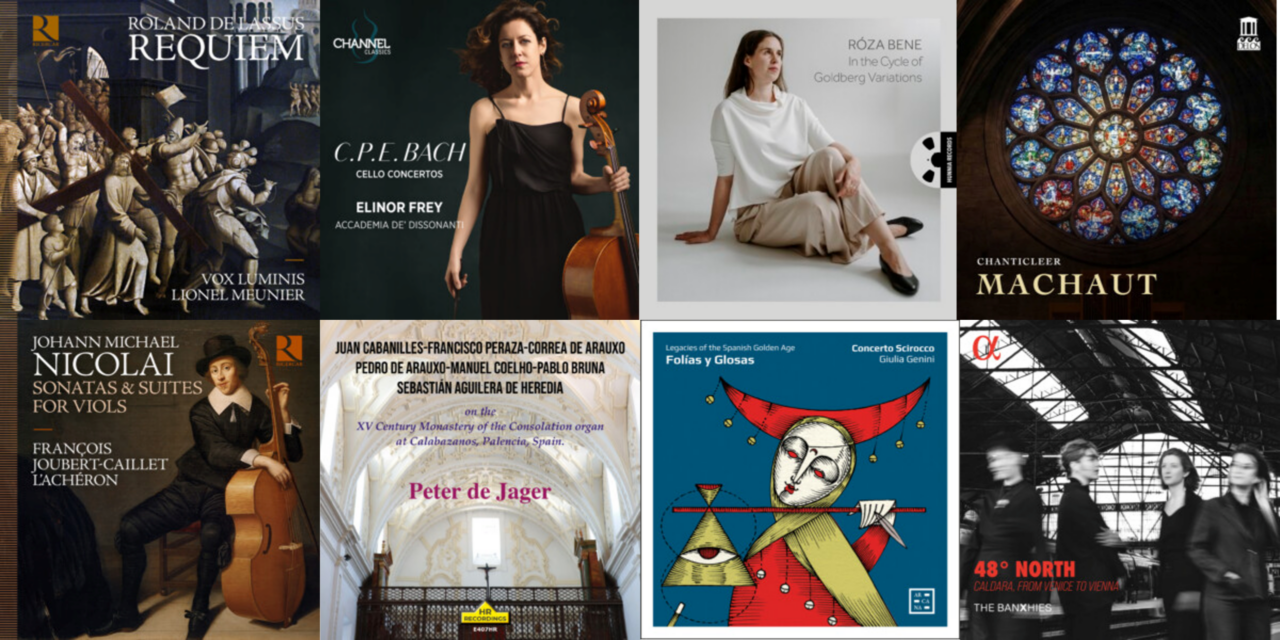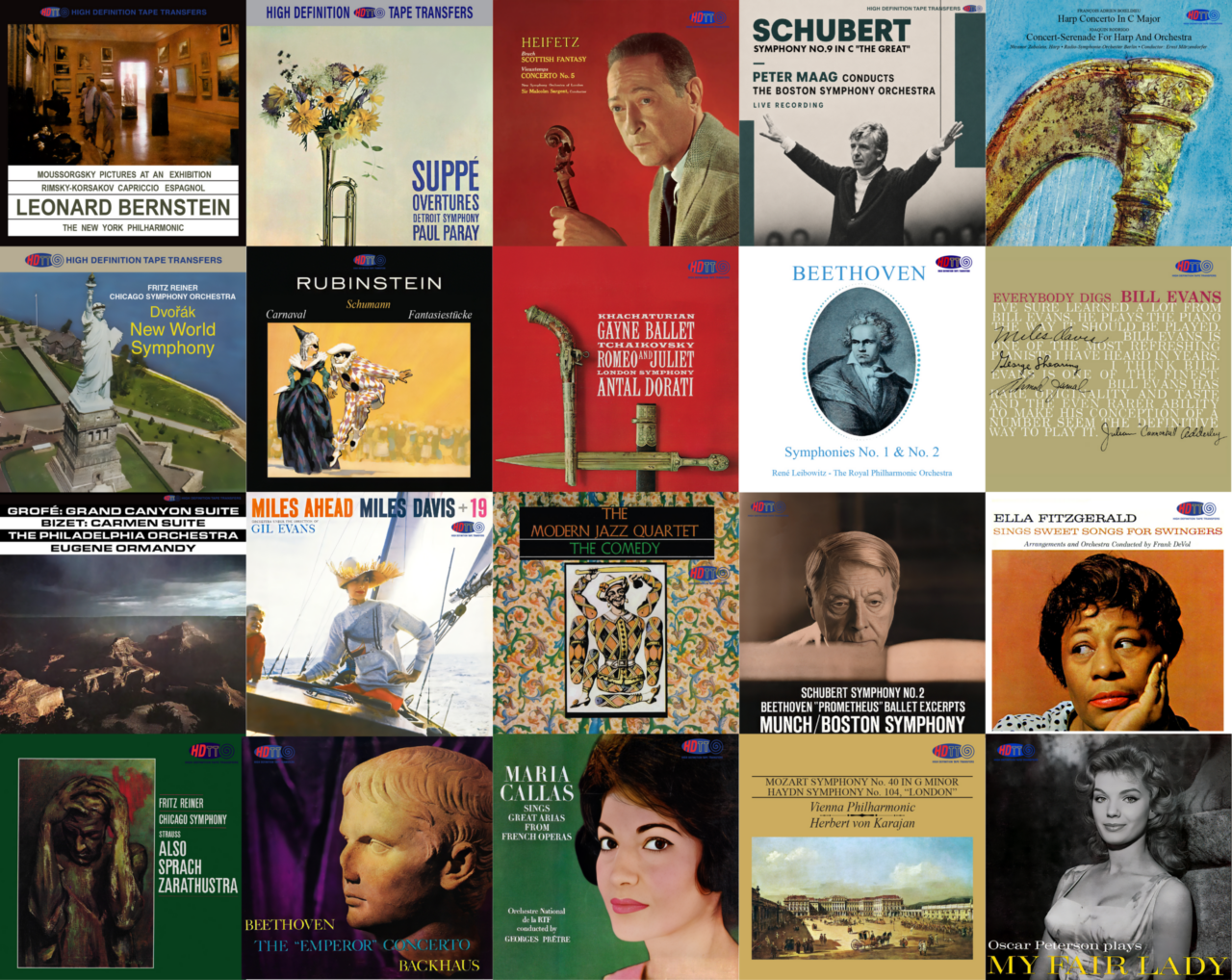
I admit to getting utmost pleasure from the outstanding releases Bob Witrak continues providing to us via his High Definition Tape Transfers catalog. As I've said before, his extensive offerings are like wandering into a treasure room filled with some of the greatest classical and jazz albums ever released. I'm delighted to have these opportunities to recapture in superb ultra-high resolution digital sound some of the best of the LPs that once graced my music library back in my vinyl days. Plus many more that I never had on my shelves but am immensely gratified to explore. With this new Recent Finds article, I hope you will find something you will explore.


Music For Violin and Guitar, Arturo Delmoni and David Burgess. HDTT 1993 2026 (DSD256, DXD*) HERE
I've written about the restoration of this album, but I'm returning to it once again because I find it such an important release. The restoration is a remarkable story of what to do when the original master tapes have been lost, but the album contains performances of great historical and artistic merit. In that article, I trace the steps that HDTT, restoration magician John Haley, and John Marks applied to recover and reissue this album in even better sound quality than the original release. Also included are free download sample files so you can hear for yourself the transformation they achieved. HERE
As I listen to this full album reissue again today, the restoration continues to surprise and delight me. The music is so well played, and the recording itself (by Bob Katz) is so utterly natural and unpretentious. Like two musicians in the room with me. John Haley has done an amazing job restoring this album.
Most of the works are just comfortable as well worn slippers, the Handel in particular. But it is the humanity of the playing throughout that is so enticing, from both Delmoni and Burgess. And then you get to composer David Leisner's "Sonata for Violin and Guitar" and it's "Katie bar the door"—what a phenomenal piece of music.
I just had to revisit and share once again my enthusiasm for this album. Of the several albums Arturo Delmoni recorded, this is the one that I would take to my desert island should the need arise. As much as I like his "Sonatas of Franck and Faure," and his "Songs My Mother Taught Me" is so very dear to me, but it is THIS album that I think best displays his craftsmanship, interpretive skills, and subtle phrasing. Just a delight!
The original CD never did these performances justice. This new restoration does.

Beethoven Concerto No. 1 & Sonata Op. 54, Sviatoslav Richter, Charles Munch, Boston Symphony. HDTT 1960 2026 (DSD256, DXD*) HERE
I've listening to this recording most of my life, and I've never heard it sound better in my listening system than in this new release from HDTT. Sviatoslav Richter is monumental, with commanding technique and uncompromising musical intellect. He brings a depth to both works that is very special. Recorded during Richter's first visit to the United States at the age of 44, his technical perfection can be taken for granted. Much has been written about Richter's dislike of his experience of the United States, but his performances recorded during this visit are "must" listens.
The Beethoven Piano Concerto No. 1, op. 15 scintillates—the performance is bright, energetic, vivid, delicately nuanced. No untoward excesses here. This is pure dance-like magic.
Richter's solo performance of the Piano Sonata No. 22 is another experience unto itself. At just under 11 minutes, this work is like a small jewel. Pay attention or its gone, but when you pay attention, there are depths that Richter unfolds as few other pianists.
The transfer here is from a 15ips 2-track tape and sounds alive and transparent. The engineer is Lewis Layton, and he has Orchestral Hall's acoustic envelop well in hand with excellent sound stage, balance, natural sounding reverberation, and detail.

Beethoven Symphony No. 9, George Szell, Cleveland Orchestra. HDTT 1961 2026 (DSD256, DXD*) HERE
As always, Szell prioritizes clarity, focus, and balance over sheer opulence in this powerful performance from 1961. It is model of discipline, structural clarity, and orchestral precision. As with so many Columbia classical releases, the LP is vastly outshined in quality by the tape. Why Columbia could get its jazz vinyl so right, but the classical so wrong, has ever been a frustration to me. I feel abundantly happy to now have this outstanding performance in this transfer from a 4-track tape. The recording is from 1961 in Cleveland by engineers Bud Graham and Frank Bruno, producer Howard H. Scott. The capture of the orchestra is spot-on, with excellent balance, sound stage, and inner detail.
Bob Witrak has been using a Merrill Audio Master MX Tape Head Preamp for a number of his recent releases. With the clarity of Szell's interpretation, the precision and clarity of the Master MX is a terrific match that brings out all the inner detail superbly. As with other 4-track tape transfers, this one is transferred in DSD256 then post-processed in DXD, which then becomes the edit master to which I'm listening. The DSD256 release is derived from this DXD edit master.

Hello Love, Ella Fitzgerald. HDTT 1959 2026 (DSD256, DXD*) HERE
HDTT summarizes this album very nicely, so I'm just going to repost their summary of the album with a few following comments:
"Hello, Love occupies a distinctive and often understated place in Ella Fitzgerald's recorded legacy, offering a portrait of the singer at a moment of artistic ease and emotional depth. Released in 1959 by Verve Records, the album draws from recording sessions held in 1957 and 1959, a period when Fitzgerald had already secured her reputation through the Songbook series and no longer needed to prove her technical authority. Instead, she turns inward, presenting a set of standards shaped by warmth, patience, and a deep respect for melody and lyric.
"The album's overall character is defined by its reflective mood. Rather than emphasizing swing or vocal bravura, Hello, Love leans toward ballads and gently flowing tempos, allowing Fitzgerald's interpretive gifts to come to the foreground. Her voice during these sessions is remarkably supple and controlled, glowing with clarity and poise. Each phrase is delivered with careful attention to meaning, yet never feels calculated. Fitzgerald's sense of timing, her ability to place a note just behind or ahead of the beat, and her subtle dynamic shifts give the performances an intimate, almost confessional quality. Familiar songs are transformed not through radical reinterpretation, but through emotional sincerity and quiet authority."
This transfer by HDTT is sourced from a 4-track tape. Once again we get a lesson in Master Tapes, Shmaster Tapes as the sound quality of this release is just excellent, particularly with respect to Ella Fitzgerald's voice. It is a credit to skill and attention to detail that Bob Witrak brings to his releases. As with some other recent releases, he is using his new Merrill Audio Master MX Tape Head Preamp which brings a remarkable clarity and transparency to the transfer process. Combine this with exceptional attention to AC power, noise isolation, tape alignment, choice of tape heads, and cabling, and we listeners get the benefit of superb sound reproduction that so many other music sources fail to deliver.

Beethoven Piano Concerto No. 2, Mozart Symphony No. 39, Leon Fleisher, George Szell, Cleveland Orchestra. HDTT 1960 2026 (DSD256, DXD*) HERE
One of the great Beethoven piano concerto recordings in the catalog is beautifully reissued by HDTT in this release. And the Mozart is quintessential Szell—which means great. And this delightful high definition digital release comes to us via a Bob Witrak transfer from an Epic Records original LP.
For those of you who may have experienced needle drops you've made yourself or obtained from a friend, I promise you that what Bob is doing with his Vinyl Records Restoration process will surprise and excite you. It continues to do so for me. The results he obtains with his transfers off the vinyl, with gentle post-processing, is phenomenally good. If you'd not looked into his VRR process before, I encourage you to read his blog post about what he is doing, HERE.
As to the performance and recording, it is well recognized by music lovers and audiophiles as one of the great performances of the Beethoven Piano Concerto No. 2. Fleisher and Szell are masterful, their collaboration a joy to experience—they are utterly compatible in their approach to performing this music. As Amazon purchaser KaleHawkwood comments, tongue in cheek, about these Fleisher/Szell performances of the Beethoven piano concertos in a supposed conversation about the concertos:
"1961! How do they sound?"
"Like so many of Szell's recordings, they're vibrant with life, heart and soul."
"And Fleisher?"
"He's godlike."
"Come on, now ~ "
"Really, it sounds like you're listening to the perfect match: Beethoven and Fleisher. He plays with such mercurial attention to detail and nuance, it fair takes your breath away." (full review HERE)
Yes, and yes.
And for nearly 28 minutes you can be transported to another world. It ends all too soon.
And then a gift emerges in the next track: Szell leading the Cleveland Orchestra in a magical performance of Mozart's Symphony No. 39. With utter clarity, Szell leads the Cleveland through a direct, no nonsense performance of this symphony. The performance is refreshing, cleansing, perhaps a bit pedantic in its strict adherence to meter, perhaps a bit too stately in it's middle movements. But the opening movement and the final movements are complete joy—with the fleet-footed, exuberant, finale just magical. Overall, it is a classic account with which every lover of Mozart's symphonies should be familiar.
One final comment... bear in mind that the recording is from 1960. It does not have the utter transparency of modern recordings. You will likely find it just a bit dark by comparison—the electronics of the day just weren't of today's caliber. But this is the sound you hear on the original LP, just better than you're likely ever to have heard it. The microphone technique, however, is excellent: full sound stage, excellent balance of soloist and orchestra, excellent capture of inner detail.

Mozart Piano Concertos No. 20 and No. 24 - Clara Haskil, Igor Markevitch. HDTT 1960 2026 (DSD256, DXD*) HERE
There can be a tendency by modern listeners to discount the performances of Mozart recorded by Clara Haskill, but one does so to one's detriment. As Bob Witrak opines on his HDTT page introducing this reissue, this performance “stands as one of the most inward and serious readings in the Mozart concerto discography. Recorded in Paris in 1960, shortly before Haskil's death, it captures an artist whose approach to Mozart was marked by humility, clarity, and an almost ascetic devotion to the score.”
As Bob goes on to say,
"Her touch is light yet firm, her articulation crystalline, and her phrasing free from rhetorical excess. She avoids any sense of virtuoso display, instead allowing Mozart's melodic lines to unfold with natural speech-like inflection. There is no attempt to 'project' emotion through exaggerated dynamics or rubato; expressiveness arises from balance, timing, and tonal purity. This restraint gives her interpretations a moral seriousness that suits these two dark, minor-key concertos particularly well.
"This recording remains a landmark not because of orchestral brilliance or interpretive novelty, but because of its integrity. Haskil reveals Mozart as a composer of profound seriousness and emotional depth, achieved through simplicity rather than excess. In these performances, the music speaks with rare honesty, making this recording an enduring reference for understanding Mozart's darker, more philosophical side."
This description is so completely on point, I simply share it with you because I can't better describe it and I completely agree with it.
What I will add is that the sound quality will surprise you—I think you will find it utterly satisfactory. Yes, the recording quality sounds a bit dated, but it is Philips of 1960 and is serviceable in every respect. Perhaps more than serviceable, if not up to the highest standards produced by Decca in the same period.
The transfer is from a 4-track tape. Bob's current tape transfer equipment and software is allowing for some very fine releases from these 4-track tapes he's been mining recently.

Original Philips LP cover and side 1 label

Mozart String Quartet No. 20 in D major, K.499, and String Quartet No. 22 in B flat major, K.589, Vienna Philharmonic Quartet. HDTT 1961 2026 (DSD256, DXD*) HERE
One can talk endlessly about historically informed performance practice versus traditional practice, and we can all have preferences. But there is no denying excellence of musicianship, insight, technical mastery, and ensemble in whichever practice style. Here we have masters of traditional performance practice from leading members of the Vienna Philharmonic Orchestra, with first violinist Willi Boskovsky and comrades.
There are few performance that can match the level of authority and stylistic assurance heard in these performances. They reflect one of the most storied orchestral traditions in the world in a distinctly Viennese approach to sound and interpretation. Patrician, elegant, resonant, and redolent of the great traditions of central Europe, these are performances to treasure.
As the HDTT summary describes, "The four instruments blend into a warm, rounded sonority that avoids both excessive brilliance and aggressive edge. This cultivated warmth is especially effective in Mozart, where clarity must coexist with lyricism. The Vienna Philharmonic Quartet achieves this balance with remarkable consistency, allowing melodic lines to sing while maintaining a transparent texture."
The sound is classic Decca timbral excellence. Recorded 15 March 1961 in the Sofiensaal, Vienna, by Decca engineer James Brown and producer Erik Smith, and sourced from a Decca "Wideband" original pressing, the sound quality is that of which vinyl enthusiasts have raved for decades. From the glorious golden age of stereo recordings, this release is a pleasure to the ears and a joy to experience.
This is yet another outstanding release from HDTT's Vinyl Records Restoration series. More please!

Coleman Hawkins and Roy Eldridge at The Opera House. HDTT 1957 2026 (DSD256, DXD*) HERE
Just wow. Two of the most influential voices in the history of jazz captured live in 1957 at the height of their powers. They are joined by a sophisticated rhythm section comprised of core members of the Modern Jazz Quartet: pianist John Lewis, bassist Percy Heath, and drummer Connie Kay. This is a very special concert and a very special recording.
Sourced from a Verve original LP pressing, this is a prime example of the excellent transfers Bob Witrak is achieving through his meticulous work in this Vinyl Records Restoration series. When Bob first mentioned to me three years ago that he was thinking of offering transfers from LP, I was ecstatic and encouraged him to move ahead. As did Dr. David, Positive Feedback's editor-in-chief. Bob proceeded with his vision and has knocked this series out of the park. As the result of his efforts, we are getting to hear some of the most outstanding recordings released on vinyl during the 1950s and early 1960s. And, these are coming with sound quality that matches the best that I was ever able to achieve in my own, very tricked out, vinyl playback system back in the day. If you are not taking advantage of these releases, you just don't know what you're missing.
If you a jazz fan, just get this album. If you have your digital playback set up to the same degree of care and quality as you may have done with your vinyl system, you'll not regret it.
* For those who may ask... Where asterisked, I'm listening to the DXD iteration. The DSD256 transfer from the source was post-processed in DXD making the DXD version the "edit master." Bob Witrak is always very clear about the steps he is applying in creating his releases. As noted several times previously in other articles, in our primary system with the Playback Designs MPD-8 DAC, the edit master almost always sounds best, regardless of resolution. That may not be the case in other systems, so I encourage you to listen and compare for yourself. For example, in Ann's office system with her Teac UD-501 DAC, the DSD256 file will typically sound best.